


Key cautions
- Wash the whole fruit before slicing; refrigerate cut produce and keep utensils clean.
- Use tested pickling instructions. Do not improvise the acid, water or salt proportions that make a preserved product safe.
What’s inside
Modern raw cucumber is chiefly water, with small amounts of carbohydrate, fiber and minerals and some vitamin K in the edible portion. Cultivar, peeling, maturity and pickling change the composition; salt comes mainly from processing rather than the fresh fruit.
Uses in brief

- Use washed modern cucumbers as a crisp raw vegetable or in cooked dishes.
- Pickling and fermentation preserve the crop, but require a tested recipe and a different sodium assessment.
In the King James Bible
In the King James Bible
Probable botanical identification
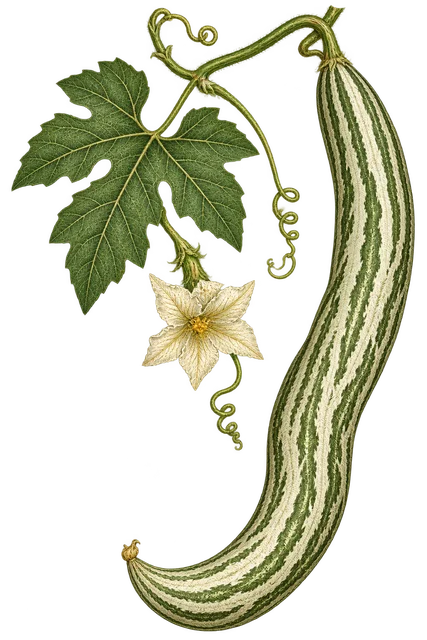
The KJV names cucumbers. Historical-botanical research identifies ancient Mediterranean qishu’im with immature vegetable or snake melons, Cucumis melo, rather than securely with modern Cucumis sativus. The nutrient serving below is explicitly a modern cucumber comparison.
We remember the fish, which we did eat in Egypt freely; the cucumbers, and the melons, and the leeks, and the onions, and the garlick:
Numbers 11:5 (KJV)
And the daughter of Zion is left as a cottage in a vineyard, as a lodge in a garden of cucumbers, as a besieged city.
Isaiah 1:8 (KJV)
Words & their stories
WORDS & THEIR STORIES
The name behind the KJV
Biblical Hebrew · Numbers 11:5 (KJV)
הַקִּשֻּׁאִיםhaqqiššuʾīm
“The cucumbers,” among the foods remembered from Egypt.
Dictionary form: קִשֻּׁאָה · qiššuʾāh
Ha- is the article; the verse is plural. The singular dictionary form is reconstructed in Brown–Driver–Briggs.
Biblical Hebrew · Isaiah 1:8 (KJV)
בְמִקְשָׁהbəmiqšāh
“In a cucumber field,” describing the setting of a lonely shelter.
Dictionary form: מִקְשָׁה · miqšāh
Bə- means “in.” This is a related word for the cultivated plot, rather than the fruit noun itself.
What the language reveals
The field has its own name
Isaiah’s miqšāh shows that Hebrew could name a growing place with a related agricultural noun.
Why “snake melon” appears here
Janick and colleagues identify the ancient qishu’im as immature long-fruited vegetable melons, using ancient descriptions and images.
The KJV wording is retained, while Cucumis melo (snake or vegetable melon) is a leading identification. Modern Cucumis sativus is not established by these verses.
Language and identification bibliography
- Hebrew text: Numbers 11:5 (Mechon-Mamre)
- Brown–Driver–Briggs: קִשֻּׁאָה, cucumber (H7180; Bible Hub transcription)
- Hebrew text: Isaiah 1:8 (Mechon-Mamre)
- Brown–Driver–Briggs: מִקְשָׁה, cucumber field (H4750; Bible Hub transcription)
- Janick, Paris and Parrish (2007): The Cucurbits of Mediterranean Antiquity
History, folklore and reported uses
History, folklore and traditional uses
Numbers 11 places cucumbers among the remembered foods of Egypt, while Isaiah uses a temporary shelter in a cucumber garden as an image of exposure and isolation. The words preserve food and farming scenes. Research on ancient images and crop names adds a caution: the elongated vegetables were often immature forms of Cucumis melo, the species that also contains familiar sweet melons, rather than the modern cucumber species.
Today’s cucumber has several kitchen lives. Singapore’s NParks describes fruits eaten raw, cooked in stews or preserved, and distinguishes green immature salad types from mature old-cucumber types used in soup. This is a useful reminder that harvest stage can matter as much as the common name. A yellow mature cooking type is not merely an overgrown version of every salad cultivar.
Preserving adds another chapter. Fermented dill pickles develop acidity through microbial activity, while fresh-pack pickles use an acidified recipe. Both preserve a crop, but their methods are not interchangeable. This card records four distinct documented food or cultural roles; it does not add unverified cucumber remedies to reach a larger count.
Traditional, historical and reported uses
- Immature vegetable melons in ancient food culture
Mixed/contextual sourcesWhy this label?
Botanical interpretation combines ancient images and descriptions with species uncertainty.
Historical botanical analysis of ancient images and descriptions places vegetable and snake melons among the cucurbits of Mediterranean antiquity. They help explain the KJV cucumber wording without establishing a modern C. sativus cultivar.
- Cooked old-cucumber soups
Food or household practiceWhy this label?
Modern mature-cucumber soup preparation.
Singapore NParks records mature old-cucumber types harvested for soup, a use distinct from immature salad cucumbers. This describes modern C. sativus culinary practice.
- Pickling and fermentation
Food or household practiceWhy this label?
Food preservation through pickling and fermentation.
Modern cucumbers become fermented dill pickles or acidified fresh-pack products. The preservation function is well documented; safe salt and acidity requirements belong to the chosen tested method.
- A cultivated-garden image
Historical recordWhy this label?
Specific Isaiah passage documents an agricultural literary image.
Isaiah’s lodge in a cucumber garden evokes a small agricultural shelter. It records a cultural setting and literary use of the crop, rather than a medicinal preparation.
Four distinct roles are documented here. Additional folk remedies were not added without adequate species- and preparation-specific sources.
Story sources
- Janick, Paris and Parrish (2007): Mediterranean cucurbit identification, PubMed record
- Singapore NParks GardeningSG: Cucumber, culinary types and harvesting
- National Center for Home Food Preservation: General Pickling FAQs
- USDA Complete Guide to Home Canning, hosted by the National Center for Home Food Preservation
- Isaiah 1:8 (King James Version)
Regional reading paths
These sourced notes describe cultivation, trade, food traditions or material history. A regional connection does not claim exclusive origin.
Antarctica
Controlled Antarctic greenhouse research.
Cultivated food crop; not native Antarctic flora.
Identity & detailed reference
Identity
The KJV names cucumbers. Historical-botanical research identifies ancient Mediterranean qishu’im with immature vegetable or snake melons, Cucumis melo, rather than securely with modern Cucumis sativus. The nutrient serving below is explicitly a modern cucumber comparison.
Ingredient details, preparation and research
Also known as: cucumbers
Source plant or material
Cucumis sativus L. (modern cucumber); Cucumis melo L., vegetable/snake-melon types (biblical candidates); KJV cucumber is probably an immature vegetable melon; modern raw C. sativus is labeled separately for nutrition.
Plant family / material: Cucurbitaceae (gourd family)
Forms and route
Modern cucumber is eaten raw with or without peel, cooked in soups or stews, and made into fresh-pack or fermented pickles. Snake/Armenian cucumber belongs to Cucumis melo and is a different crop. Pickle brine, cosmetic preparations and extracts are not the raw vegetable.
Vitamins and minerals
Modern Cucumis sativus, raw with peel: one-half cup slices (52 g) supplies about 8 kcal, 1.9 g carbohydrate, 0.9 g sugars, 0.3 g fiber, 0.34 g protein, 76 mg potassium, 8 mg calcium, 1.5 mg vitamin C and 8.5 micrograms vitamin K. USDA SR28 food 11205. These numbers do not establish the composition of the ancient snake/chate melon or of salted pickles.
Absorption and preparation
Eat the vegetable as part of an ordinary meal; no cucumber-specific absorption booster is established. Peeling and draining change what is eaten, and making pickles changes the food rather than simply improving nutrient absorption. Water content makes cucumber a refreshing food, not an electrolyte-replacement or detoxification treatment.
Traditional and reported uses
- Use washed modern cucumbers as a crisp raw vegetable or in cooked dishes.
- Pickling and fermentation preserve the crop, but require a tested recipe and a different sodium assessment.
- For a biblical garden comparison, label snake melon as Cucumis melo rather than assuming every crop called cucumber is Cucumis sativus.
Contraindications and cautions
- Wash the whole fruit before slicing; refrigerate cut produce and keep utensils clean.
- Use tested pickling instructions. Do not improvise the acid, water or salt proportions that make a preserved product safe.
- Pickles may contain substantial sodium and sometimes added sugar; read the product label rather than applying raw-cucumber values.
- Do not force down an unusually bitter specimen or use unidentified wild cucurbits as a food substitute.
Similar items and how they compare
- Snake or Armenian cucumber
A cucumber-like vegetable eaten immature.
Cucumis melo, not C. sativus; it is especially relevant to interpreting the ancient word.
- Watermelon
Another cucurbit recalled alongside cucumbers in Numbers.
Citrullus lanatus is a separate genus, and ripe flesh differs from immature vegetable melon.
- Dill pickles
A familiar preserved cucumber form.
Fermentation or vinegar and salt change taste, storage requirements and sodium.
Separate translation, ancient identity and modern comparison
The ancient-food interpretation is based on botanical and historical scholarship. Modern cucumber nutrient data are useful to a reader shopping today, but they must not be relabeled as measured snake-melon data.
What the food serving contributes
A half-cup serving is mostly water and supplies modest nutrients, including vitamin K. It is not a concentrated vitamin source. Peeling, cooking and pickling each call for their own composition entry.
Preservation is a safety process
A jar of fermented or vinegar-pickled vegetables has safety requirements beyond sour taste. Tested guidance specifies the preparation, acidification and storage conditions; no home-curing recipe is inferred from Numbers.
Evidence limits
- Explicit KJV vegetable name; modern cucumber equivalence uncertain
- The KJV word cucumbers is preserved, while modern Cucumis sativus is used only as a labeled food comparison.
Entry sources
- Janick, Paris and Parrish (2007): Mediterranean cucurbit identification, PubMed record
- Singapore NParks GardeningSG: Cucumber, culinary types and harvesting
- National Center for Home Food Preservation: General Pickling FAQs
- USDA Complete Guide to Home Canning, hosted by the National Center for Home Food Preservation
- FDA: Selecting and Serving Produce Safely
- USDA SR28: Cucumber, with peel, raw, food 11205, PDF page 713
- Isaiah 1:8 (King James Version)
- Numbers 11:5 (King James Version)
- Janick, Paris and Parrish (2007): The Cucurbits of Mediterranean Antiquity: Identification of Taxa from Ancient Images and Descriptions
- Paris, Daunay and Janick (2012): Occidental diffusion of cucumber (Cucumis sativus) 500–1300 CE: two routes to Europe
Reference entry 144 · Recorded content review: 2026-10-06 · Review scope and dates