


Key cautions
- Do not treat KJV juniper as a reference to Juniperus berries or essential oil.
- Do not eat broom roots or make a broom remedy from these passages; serious poisoning from a Retama raetam preparation has been reported.
What’s inside
No constituent profile is assigned to the biblical material, and no essential-oil composition is inferred.
Uses in brief

- Shelter in Elijah’s wilderness narrative.
- Fuel coals in the imagery of Psalm 120; Job separately names roots amid hunger.
In the King James Bible
In the King James Bible
Uncertain botanical connection
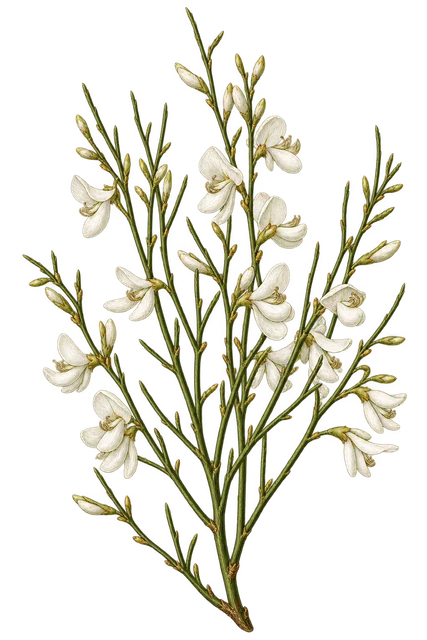
First Kings places Elijah beneath a juniper during his wilderness flight; Psalm 120 names juniper coals. Hebrew rothem is commonly identified as white broom, Retama raetam. These are references to a shrub and fuel, not to a modern Juniperus essential oil.
But he himself went a day’s journey into the wilderness, and came and sat down under a juniper tree: and he requested for himself that he might die; and said, It is enough; now, O LORD, take away my life; for I am not better than my fathers.
1 Kings 19:4 (KJV)
Sharp arrows of the mighty, with coals of juniper.
Psalm 120:4 (KJV)
Scripture and identification sources
- King James Bible: 1 Kings 19:4
- King James Bible: Psalm 120:4
- Project Gutenberg: The King James Version of the Bible, ebook 10
- Lytton John Musselman, Old Dominion University: White Broom
- Brown–Driver–Briggs Hebrew Lexicon: rothem, H7574 (hosted by Bible Hub)
- Kew Plants of the World Online: Retama raetam (Forssk.) Webb & Berthel.
- Dafni and Böck (2019): Medicinal plants of the Bible—revisited
Words & their stories
WORDS & THEIR STORIES
The name behind the KJV
Biblical Hebrew · 1 Kings 19:4 (KJV)
רֹתֶםrōtem
The desert shrub rendered “juniper,” sheltering Elijah.
Dictionary form: רֹתֶם · rōtem
The noun is singular in this passage.
Biblical Hebrew · Psalm 120:4 (KJV)
רְתָמִיםrətāmīm
Broom shrubs, rendered “juniper,” in the phrase about coals.
Dictionary form: רֹתֶם · rōtem
This is the plural form of rōtem.
What the language reveals
Shade and fuel imagery
Kings presents a shrub as shelter; the psalm invokes its coals in a sharp image of judgment on deceit. The shared noun need not mean the modern evergreen juniper.
Broom is the conventional botanical interpretation of rōtem. These verses do not identify Juniperus berries or juniper essential oil.
Language and identification bibliography
History, folklore and reported uses
History, folklore and traditional uses
The juniper in Elijah’s story is a place to stop when the wilderness journey has become unbearable. First Kings describes him sitting and then sleeping beneath it; food and water arrive in the next part of the narrative, enabling the journey to continue. The plant contributes shelter and a recognizable setting to this episode. In Psalm 120, the same KJV name appears in a different register: burning coals accompany the poem’s sharp arrows in its answer to a deceitful tongue.
Botanists commonly connect the Hebrew rothem with white broom, a dry-country shrub in the pea family. Musselman records the use of its underground wood for charcoal, an illuminating comparison for the psalm. Job’s reference to roots belongs instead to an account of severe hunger, and older commentators already debated how to understand it. Keeping those contexts apart preserves the plant’s practical and literary history without recasting it as the familiar conifer that supplies present-day juniper products.
Traditional, historical and reported uses
- Shelter in a wilderness journey
Historical recordWhy this label?
Specific Kings passage documents shelter within a biblical narrative.
Elijah sits and sleeps beneath the KJV juniper in 1 Kings 19:4–5. The shrub marks a stopping place within the narrative of his flight and renewal.
- Charcoal and burning-coal imagery
Historical recordWhy this label?
A Psalm supplies the written image; botanical charcoal use provides interpretation.
Psalm 120:4 names juniper coals. White broom’s underground wood has a documented charcoal use, which offers a botanical explanation for the image.
- Roots in an account of hunger
Historical recordWhy this label?
Specific Job passage and historical textual commentary document the disputed food wording.
Job 30:4 describes juniper roots as food. Historical commentary records debate over this difficult wording; the KJV’s description is retained without presenting the roots as a safe food.
Three supported biblical or traditional contexts are distinguished. No additional medicinal-use list is inferred from the proposed broom identification.
Story sources
- King James Bible: 1 Kings 19:1-8
- King James Bible: Psalm 120:4
- King James Bible: Job 30:4
- Lange Commentary on the Holy Scriptures: Job 30:4, within the commentary on Job 29–31
- Lytton John Musselman, Old Dominion University: White Broom
- Brown–Driver–Briggs Hebrew Lexicon: rothem, H7574 (hosted by Bible Hub)
- Kew Plants of the World Online: Retama raetam (Forssk.) Webb & Berthel.
- Dafni and Böck (2019): Medicinal plants of the Bible—revisited
Identity & detailed reference
Identity
KJV juniper translates Hebrew rothem and is commonly identified as white broom, Retama raetam, rather than a Juniperus conifer.
Ingredient details, preparation and research
Also known as: Rothem / rotem (Hebrew transliterations); White broom (candidate identification)
Source plant or material
White broom, Retama raetam (Forssk.) Webb & Berthel., is the main candidate for rothem.
Plant family / material: Candidate white broom belongs to Fabaceae, the pea family; this is not a Juniperus identification.
Forms and route
A living desert shrub, roots and fuel coals in biblical contexts. No distilled juniper oil or herbal preparation is specified.
Vitamins and minerals
No vitamin or mineral values, serving size or dietary contribution can be assigned to this biblical name. Measurements from a proposed modern species cannot establish the composition of the ancient material.
Absorption and preparation
No absorption method, food pairing or medicinal dose is assigned to this uncertain biblical term. A named modern product needs a separate assessment of its identity and preparation.
Traditional and reported uses
- Shelter in Elijah’s wilderness narrative.
- Fuel coals in the imagery of Psalm 120; Job separately names roots amid hunger.
Contraindications and cautions
- Do not treat KJV juniper as a reference to Juniperus berries or essential oil.
- Do not eat broom roots or make a broom remedy from these passages; serious poisoning from a Retama raetam preparation has been reported.
- Seek urgent poison-service or medical advice after suspected ingestion of a broom preparation. Breathing difficulty or marked drowsiness needs emergency care.
Similar items and how they compare
- Juniper essential oil
Both use juniper in English.
The KJV desert shrub is commonly identified as a broom, not a Juniperus source or a distilled product.
- Mallows (KJV; saltbush candidate)
Mallows and juniper roots appear together in Job 30:4.
The shared famine setting does not make their identities or uses interchangeable.
A desert shrub behind the English name
Musselman identifies KJV juniper with white broom. Kew places Retama raetam in Fabaceae and records its native range across dry Mediterranean, Saharan and Arabian regions.
Shelter, coals and a difficult food reference
Elijah rests beneath the shrub in 1 Kings 19. Psalm 120:4 names its coals; Job 30:4 names its roots as food in a scene of deprivation. These passages preserve different contexts, not a preparation guide.
A real candidate-plant hazard
A published clinical case associated a Retama raetam folk preparation with respiratory failure in a newborn. The report concerns a modern exposure; it is a reason not to turn the ancient food wording into a present-day remedy.
Evidence limits
- This card documents a KJV name; a proposed modern species remains separate from the ancient identification.
- Biblical description and later traditional practice are not evidence of a safe present-day remedy.
Entry sources
- Lytton John Musselman, Old Dominion University: White Broom
- Brown–Driver–Briggs Hebrew Lexicon: rothem, H7574 (hosted by Bible Hub)
- Kew Plants of the World Online: Retama raetam (Forssk.) Webb & Berthel.
- Dafni and Böck (2019): Medicinal plants of the Bible—revisited
- King James Bible: 1 Kings 19:4
- King James Bible: Psalm 120:4
- Project Gutenberg: The King James Version of the Bible, ebook 10
- King James Bible: 1 Kings 19:1-8
- King James Bible: Job 30:4
- Lange Commentary on the Holy Scriptures: Job 30:4, within the commentary on Job 29–31
- Schmid et al. (2006): Respiratory failure in a neonate after folk treatment with broom bush (Retama raetam) extract
Reference entry 138 · Recorded content review: 2026-10-06 · Review scope and dates