


Key cautions
- Do not identify a gathered plant from the English word mallows alone.
- Do not use this famine passage as a foraging guide or eat an unidentified wild plant.
What’s inside
No constituent profile is assigned to biblical mallows. Candidate-plant analyses do not identify Job’s gathered material.
Uses in brief

- Biblical gathering of wild plants during hardship.
- The candidate saltbush has a separately documented Sahrawi camel-forage tradition.
In the King James Bible
In the King James Bible
Uncertain botanical connection
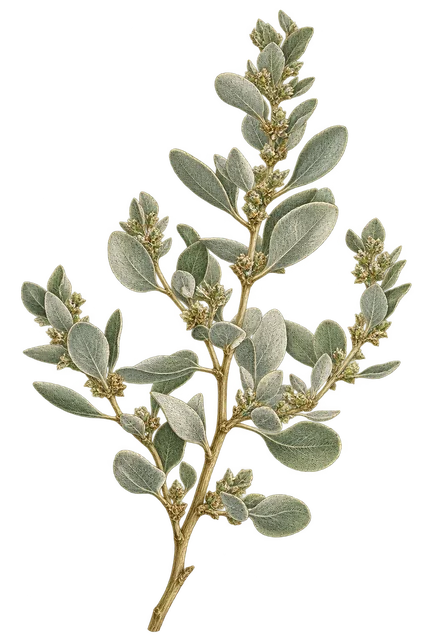
Job names mallows in a description of hunger and social exclusion. Hebrew malluach is often interpreted as saltbush, with Atriplex halimus as a candidate. The verse does not identify medicinal marshmallow root.
Who cut up mallows by the bushes, and juniper roots for their meat.
Job 30:4 (KJV)
Scripture and identification sources
- King James Bible: Job 30:4
- Project Gutenberg: The King James Version of the Bible, ebook 10
- Brown–Driver–Briggs Hebrew Lexicon: malluach, H4408 (hosted by Bible Hub)
- Lange Commentary on the Holy Scriptures: Job 30:4, within the commentary on Job 29–31
- Kew Plants of the World Online: Atriplex halimus L.
- Dafni and Böck (2019): Medicinal plants of the Bible—revisited
Words & their stories
WORDS & THEIR STORIES
The name behind the KJV
Biblical Hebrew · Job 30:4 (KJV)
מַלּוּחַmallūaḥ
The plant rendered “mallows,” often interpreted as saltwort or saltbush.
Dictionary form: מַלּוּחַ · mallūaḥ
The verse-form matches the dictionary form; the name is associated with salt.
What the language reveals
A scene of deprivation
Job places the gathering of this plant among images of people surviving outside ordinary cultivated food supplies. The verse does not recommend it as a remedy or a foraging identification guide.
A salt-tolerant plant is a leading interpretation. KJV “mallows” does not securely identify modern Malva, marshmallow, or one Atriplex species.
Language and identification bibliography
History, folklore and reported uses
History, folklore and traditional uses
Mallows appear in Job’s account of people living at the edges of society. The surrounding verses speak of hunger, expulsion and shelter among rocks; the gathered plants help make that hardship concrete. Job evokes their circumstances while contrasting his former honor with his present humiliation. Within that speech, the plant name preserves a glimpse of subsistence under severe hardship.
The Hebrew word malluach has long prompted a saltbush interpretation. Atriplex halimus, also called shrubby orache, is the candidate used in older botanical commentary. Its own later story includes Sahrawi pastoral knowledge: field researchers recorded it as a camel-forage plant known as legtaf. That is a distinct, documented tradition, separated here from the uncertain identification in Job. The familiar English word mallows should therefore not quietly turn this passage into a reference to medicinal marshmallow root.
Traditional, historical and reported uses
- Gathering during hunger
Historical recordWhy this label?
Specific Job passage documents literary subsistence gathering.
Job 30:4 places mallows among the wild plants gathered by people enduring want. The role is subsistence within Job’s speech.
- Candidate saltbush as camel forage
Food or household practiceWhy this label?
Field interviews document candidate-plant use as camel forage.
Sahrawi field interviews document legtaf, identified as Atriplex halimus, in traditional camel grazing. This later candidate-plant use does not establish which species Job meant.
Two supported contexts are included: the biblical account of gathering and a later pastoral tradition of the candidate plant. The evidence does not support five distinct uses of biblical mallows.
Story sources
- King James Bible: Job 30:1-8
- Volpato and Puri (2014): Dormancy and Revitalization; Sahrawi camel-forage field research, Table 1 and pp. 204–205
- Brown–Driver–Briggs Hebrew Lexicon: malluach, H4408 (hosted by Bible Hub)
- Lange Commentary on the Holy Scriptures: Job 30:4, within the commentary on Job 29–31
- Kew Plants of the World Online: Atriplex halimus L.
- Dafni and Böck (2019): Medicinal plants of the Bible—revisited
Identity & detailed reference
Identity
The mallows of Job 30:4 represent Hebrew malluach, often identified as saltbush. Atriplex halimus is a candidate, not an authenticated species determination.
Ingredient details, preparation and research
Also known as: Malluach / malluwach (Hebrew transliterations); Saltbush / shrubby orache (candidate identification)
Source plant or material
Unresolved ancient plant; Atriplex halimus L. is the saltbush candidate discussed here.
Plant family / material: Unresolved for the biblical term; candidate Atriplex halimus belongs to Amaranthaceae.
Forms and route
Gathered wild plant material in a passage about hunger. Neither a marshmallow-root medicine nor a modern extract is specified.
Vitamins and minerals
No vitamin or mineral values, serving size or dietary contribution can be assigned to this biblical name. Measurements from a proposed modern species cannot establish the composition of the ancient material.
Absorption and preparation
No absorption method, food pairing or medicinal dose is assigned to this uncertain biblical term. A named modern product needs a separate assessment of its identity and preparation.
Traditional and reported uses
- Biblical gathering of wild plants during hardship.
- The candidate saltbush has a separately documented Sahrawi camel-forage tradition.
Contraindications and cautions
- Do not identify a gathered plant from the English word mallows alone.
- Do not use this famine passage as a foraging guide or eat an unidentified wild plant.
Similar items and how they compare
- Marshmallow root
The English names sound similar.
Job does not identify Althaea officinalis or a medicinal root preparation.
- Juniper (KJV; broom candidate)
Both names occur in Job 30:4.
They are separate plants in the verse, and neither name supplies a safe modern food identification.
Name and candidate
The Hebrew lexical tradition connects malluach with a salty habitat. Lange’s historical commentary proposes Atriplex halimus; Kew accepts that species in Amaranthaceae. The identification remains a reading of the ancient name.
The passage describes hardship
Job 30:1–8 describes hunger, exclusion and life outside ordinary society. Its plant gathering belongs to that portrait; it is not a catalogue of medicinal herbs.
A separate living tradition
Volpato and Puri recorded Atriplex halimus, called legtaf, among the camel-forage plants named by Sahrawi informants. This evidence concerns a botanically identified modern plant and a pastoral practice.
Evidence limits
- This card documents a KJV name; a proposed modern species remains separate from the ancient identification.
- Biblical description and later traditional practice are not evidence of a safe present-day remedy.
Entry sources
- Brown–Driver–Briggs Hebrew Lexicon: malluach, H4408 (hosted by Bible Hub)
- Lange Commentary on the Holy Scriptures: Job 30:4, within the commentary on Job 29–31
- Kew Plants of the World Online: Atriplex halimus L.
- Dafni and Böck (2019): Medicinal plants of the Bible—revisited
- King James Bible: Job 30:4
- Project Gutenberg: The King James Version of the Bible, ebook 10
- King James Bible: Job 30:1-8
- Volpato and Puri (2014): Dormancy and Revitalization; Sahrawi camel-forage field research, Table 1 and pp. 204–205
Reference entry 137 · Recorded content review: 2026-10-06 · Review scope and dates