


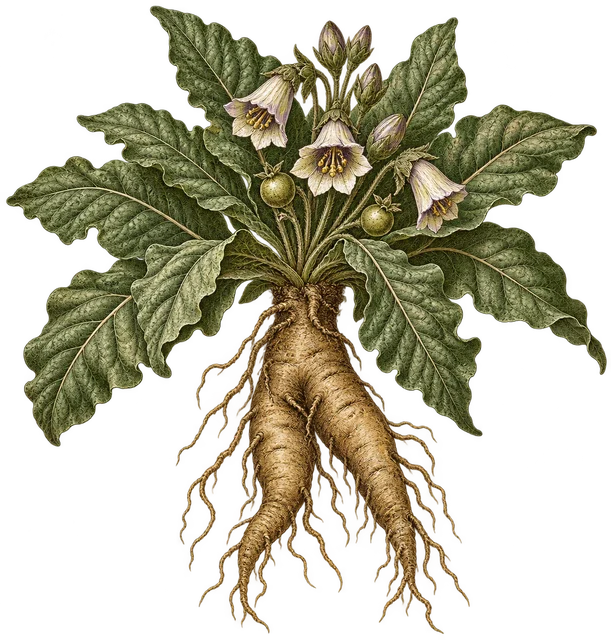
Key cautions
- Do not ingest mandrake or make home medicines from its roots, leaves or fruit. Keep it away from children and pets.
- Suspected ingestion or symptoms such as confusion, hallucinations, racing heart or blurred vision need urgent poison-service or medical advice.
What’s inside
Toxic anticholinergic tropane alkaloids, including hyoscyamine, atropine and scopolamine, have been implicated in Mandragora poisoning. Composition varies; no home preparation is treated as safe.
Uses in brief

- Historical fertility and love folklore; fragrance imagery in the Song of Solomon.
- Recorded sedative, pain-relieving and other medicinal traditions, retained only as history because the plant can poison.
In the King James Bible
In the King James Bible
Probable botanical identification
The KJV explicitly names mandrakes in the Leah–Rachel narrative and in the Song of Solomon. Mediterranean Mandragora is the customary botanical interpretation, but a precise modern species is not given. Fertility folklore should not be confused with a biblical promise of efficacy or a safe home remedy.
And Reuben went in the days of wheat harvest, and found mandrakes in the field, and brought them unto his mother Leah. Then Rachel said to Leah, Give me, I pray thee, of thy son’s mandrakes.
Genesis 30:14 (KJV)
The mandrakes give a smell, and at our gates are all manner of pleasant fruits, new and old, which I have laid up for thee, O my beloved.
Song of Solomon 7:13 (KJV)
Scripture and identification sources
- King James Bible: Genesis 30:14
- King James Bible: Song of Solomon 7:13
- Project Gutenberg: The King James Version of the Bible, ebook 10
- Jiménez-Mejías et al. (1990): Atropine poisoning by Mandragora autumnalis, 15 cases
- Kew: Titans, mandrakes and morels, botanical art from Kew’s collections (2025)
- Kew Plants of the World Online: Mandragora autumnalis Bertol.
Words & their stories
WORDS & THEIR STORIES
The name behind the KJV
Biblical Hebrew · Genesis 30:14 (KJV)
דוּדָאִיםdūdāʾīm
Mandrakes gathered during wheat harvest.
Dictionary form: דּוּדַי · dūday
The plural noun is used for the plants or their fruits; BDB gives the singular dictionary form in brackets.
Biblical Hebrew · Song of Solomon 7:13 (KJV); Song 7:14 in the Hebrew edition
הַדּוּדָאִיםhaddūdāʾīm
The mandrakes, described as giving fragrance.
Dictionary form: דּוּדַי · dūday
Ha- adds “the.” The Hebrew chapter division shifts this reference by one verse.
What the language reveals
Desire and fragrance
Genesis places mandrakes in the negotiation between Rachel and Leah; the Song emphasizes their scent. A literary association with desire does not demonstrate fertility treatment or safety.
The mandrake identification is traditional, but the passages provide no safe dose, root preparation or evidence of reproductive benefit.
History, folklore and reported uses
History, folklore and traditional uses
Reuben brings mandrakes home at wheat harvest, and Rachel asks Leah for them. The exchange unfolds inside a story about family rivalry and hoped-for children, which helped make the plant a lasting emblem of fertility. The Song of Solomon gives it another memorable quality: fragrance. Neither passage specifies a dose or says that the plant caused a pregnancy. Indeed, the Genesis narrative attributes the births to God’s response, a point worth retaining when later herbal folklore is read back into the text.
Beyond scripture, mandrake acquired an extraordinary cultural life. Its branching root suggested a human figure, and early herbals pictured male and female mandrakes. Amulets, love traditions and stories of a fatal cry surrounded a plant also used in attempts to relieve pain, bring sleep or provoke vomiting. This mingling of symbolism and medicine is part of its historical interest. Modern poisoning reports supply the essential counterweight: its alkaloids can produce severe anticholinergic illness, so these records belong to the history of remedies rather than a household recipe collection.
Traditional, historical and reported uses
- Fertility and love folklore
Mixed/contextual sourcesWhy this label?
Combines scriptural interpretation, fertility folklore and modern historical commentary.
Mandrake was valued as an aphrodisiac and fertility charm. The Genesis story helped sustain that reputation, but it does not establish that the plant improves fertility.
- Pain relief and surgical history
Historical recordWhy this label?
Historical medical account documents classical pain-control and surgical practices.
Historical accounts record mandrake in attempts to reduce pain and, in classical medicine, produce insensibility for procedures. These dangerous practices are not instructions for present-day anesthesia.
- Sedative traditions
Traditional accountWhy this label?
Traditional sedative practice; poisoning report provides safety context.
Kew records a traditional sedative role. A plant capable of causing delirium and poisoning is not a suitable home sleep remedy.
- Emetic traditions
Traditional accountWhy this label?
Obsolete traditional emetic practice.
Kew also records use to provoke vomiting. This is an obsolete hazardous practice, not a first-aid treatment or a suggested use.
- Amulets and human-shaped roots
Traditional accountWhy this label?
Amulet and fertility-symbolism folklore, without a medical-efficacy claim.
Mandrake roots were kept as amulets, their human-like form lending itself to fertility symbolism and elaborate legends. This is a material-cultural use rather than a medical benefit.
Story sources
- Kew: Titans, mandrakes and morels, botanical art from Kew’s collections (2025)
- King James Bible: Genesis 30:14-24
- Purkis (2003): Myths and mandrakes, letter on interpreting Genesis 30
- Carter (2003): Myths and mandrakes, Journal of the Royal Society of Medicine
- Jiménez-Mejías et al. (1990): Atropine poisoning by Mandragora autumnalis, 15 cases
- Kew Plants of the World Online: Mandragora autumnalis Bertol.
- Kew Plants of the World Online: Mandragora officinarum L.
- Frasca, Brett and Yoo (1997): Mandrake toxicity. A case of mistaken identity
Identity & detailed reference
Identity
Mediterranean Mandragora plants, traditionally linked with the biblical mandrakes. Species limits have been treated differently: older accounts often use M. officinarum broadly, while Kew recognizes M. autumnalis separately. All medicinal home use is inappropriate because of toxicity.
Ingredient details, preparation and research
Also known as: Mediterranean mandrake; Dudaim (biblical transliteration); Mandragora officinarum (broad historical usage)
Source plant or material
Mediterranean mandrake; biblical passages name mandrakes without specifying a modern species or plant part. Kew records M. autumnalis as native in Palestine and Lebanon–Syria.
Plant family / material: Solanaceae (nightshade family)
Forms and route
Living plant, roots, leaves and fruits; historical medicinal preparations and talismans are described only as cultural history. No tea, tincture, extraction, ingestion or dosing directions are provided.
Vitamins and minerals
Mandrake is not recommended as a food or nutrient source. No edible serving, vitamin/mineral contribution or safe home dose is assigned.
Absorption and preparation
No absorption-enhancing advice is appropriate for home use. Ingestion can cause systemic anticholinergic poisoning; historical preparation methods do not provide a safe dosing standard.
Traditional and reported uses
- Historical fertility and love folklore; fragrance imagery in the Song of Solomon.
- Recorded sedative, pain-relieving and other medicinal traditions, retained only as history because the plant can poison.
Contraindications and cautions
- Do not ingest mandrake or make home medicines from its roots, leaves or fruit. Keep it away from children and pets.
- Suspected ingestion or symptoms such as confusion, hallucinations, racing heart or blurred vision need urgent poison-service or medical advice.
- “American mandrake” may mean Podophyllum, a different poisonous plant; never substitute one for the other.
Similar items and how they compare
- American mandrake / mayapple
Podophyllum is sometimes sold or described under a similar common name.
It is a different plant with different toxic constituents and must not be substituted.
- Biblical hyssop
Both illustrate the need to separate old names from modern products.
Mandragora carries well-documented poisoning risk; ritual or symbolic use is not a safety endorsement.
Botanical naming requires care
Kew currently recognizes M. autumnalis and M. officinarum separately. Its ranges place M. autumnalis in the eastern Mediterranean, including Palestine, while M. officinarum has a narrower northern Italian and northwestern Balkan native range. Older historical usage is often broader.
Clinical evidence concerns poisoning
A published series described 15 people poisoned after Mandragora autumnalis was mixed with food greens. Effects included dry mouth, blurred vision, rapid heart rate and neuropsychiatric disturbance. This is evidence of harm, not a therapeutic trial.
Different plants share the name
A clinical report documents confusion between European mandrake and American mandrake. Common-name overlap cannot justify substitution, dosing or assumptions about chemical composition.
Reading fertility claims accurately
The biblical plant’s appearance in a family narrative and its later reputation do not prove treatment efficacy. The text contains no clinical demonstration, preparation standard or general recommendation to use it.
Evidence limits
- The biblical name does not identify a modern species, cultivar or safe plant part.
- This card records historical uses and poisoning evidence, not evidence supporting self-treatment.
Entry sources
- Jiménez-Mejías et al. (1990): Atropine poisoning by Mandragora autumnalis, 15 cases
- Kew: Titans, mandrakes and morels, botanical art from Kew’s collections (2025)
- Kew Plants of the World Online: Mandragora autumnalis Bertol.
- Kew Plants of the World Online: Mandragora officinarum L.
- Carter (2003): Myths and mandrakes, Journal of the Royal Society of Medicine
- Purkis (2003): Myths and mandrakes, letter on interpreting Genesis 30
- Frasca, Brett and Yoo (1997): Mandrake toxicity. A case of mistaken identity
- King James Bible: Genesis 30:14
- King James Bible: Song of Solomon 7:13
- Project Gutenberg: The King James Version of the Bible, ebook 10
- King James Bible: Genesis 30:14-24
Reference entry 127 · Recorded content review: 2026-10-06 · Review scope and dates