


Key cautions
- Avoid medicinal amounts and concentrated saffron supplements during pregnancy unless specifically advised by qualified care. Occupational-exposure research raises a pregnancy concern and does not establish a safe supplement dose.
- Discuss supplements with a clinician, especially with medicines or low blood pressure. Short-term studies in healthy adults do not establish long-term safety for every product.
What’s inside
Crocins are water-soluble carotenoid pigments; picrocrocin contributes bitterness and safranal much of the characteristic aroma. Crocetin is the aglycone/metabolite relevant to absorption studies. Drying, storage and extraction influence the finished material.
Uses in brief

- Culinary colour, aroma and flavour from identified saffron stigmas.
- Traditional mood and other medicinal uses; small controlled trials of selected oral preparations have studied depressive symptoms.
In the King James Bible
In the King James Bible
Named material
Song of Solomon places saffron among a garden’s valued aromatics. The customary botanical identification is Crocus sativus; the modern spice is made from its dried stigmas. The verse names the fragrant plant without describing that processing.
Spikenard and saffron; calamus and cinnamon, with all trees of frankincense; myrrh and aloes, with all the chief spices:
Song of Solomon 4:14 (KJV)
Scripture and identification sources
Words & their stories
WORDS & THEIR STORIES
The name behind the KJV
Biblical Hebrew · Song of Solomon 4:14 (KJV)
וְכַרְכֹּםwəkarkōm
And saffron, among the garden’s aromatics.
Dictionary form: כַּרְכֹּם · karkōm
Wə- means “and.” This is the only occurrence of the noun in the Hebrew Bible.
What the language reveals
A rare name in an abundant garden
Saffron is placed between nard and aromatic cane in the poem’s catalogue. The text emphasizes an imagined garden’s richness, without describing harvesting stigmas or preparing a remedy.
Saffron is the conventional identification. A single plant-name does not specify a modern grade, dosage, extract or essential oil.
Language and identification bibliography
History, folklore and reported uses
History, folklore and traditional uses
Saffron’s luxury is hidden in the scale of its harvest: each Crocus sativus flower offers only a few red stigma branches, which must be separated and dried. The cultivated plant is sterile and travels through human planting of corms rather than ordinary seed production. In the Song of Solomon it joins a garden of valued aromatics, an image of richness and fragrance.
The threads later moved through kitchens, dyeing and pharmacy, carrying colour and a distinctive aroma in very small quantities. Nineteenth-century dispensatories already discussed expensive saffron and the problem of adulteration. They also recorded medicinal uses, some now clearly inappropriate to reproduce. Persian mood traditions later inspired controlled studies of defined saffron preparations, adding a new chapter to the plant’s history.
Traditional, historical and reported uses
- Culinary colour and flavour
Food or household practiceWhy this label?
Culinary colour, flavour and spice trade.
The dried stigma has a long spice history. The plant’s tiny harvestable portion and careful drying help explain its prestige and why substitutes or diluted powders have long troubled the trade.
- Colouring medicines
Historical recordWhy this label?
An 1898 dispensatory explicitly records pharmacy colouring preparations.
The 1898 dispensatory records saffron as a colourant for tinctures and other pharmacy preparations. Its pigment gave a recognizable colour to the finished preparation.
- Persian mood remedies
Traditional accountWhy this label?
The exact claim is Persian traditional practice cited as trial background.
Akhondzadeh and colleagues describe saffron’s use for depression in Persian traditional medicine as background to their controlled trial. That attributed tradition helps explain why the researchers chose to investigate mood.
- Historical menstruation remedies
Historical recordWhy this label?
An 1898 dispensatory records historical reproductive uses; a study supplies safety context.
King’s American Dispensatory records saffron for menstrual and postpartum complaints. These are historically specific indications; pregnancy and bleeding-related uses should not be recreated at home.
- Fever and eruptive-disease practice
Historical recordWhy this label?
An 1898 dispensatory records obsolete fever and childhood-disease practice.
The same dispensatory records saffron in older practice for fever and eruptive illnesses, especially in children. That obsolete therapeutic role belongs to history, not to current treatment of childhood fever or infection.
- Golden colour in book arts
Historical recordWhy this label?
Historical manuscript instructions and museum evidence document bookmaking uses.
Dried Crocus sativus stigmas supplied yellow colour for Persian writing paper and medieval manuscript painting. The Bodleian Libraries preserve saffron-paper instructions from a sixteenth-century Persian treatise, while the Metropolitan Museum records its use by illuminators. These related bookmaking purposes form one craft tradition here.
Historical-use additions reviewed 2026-10-08
Story sources
- Kew Plants of the World Online: Crocus sativus L.
- Felter and Lloyd, King’s American Dispensatory (1898): Crocus / Saffron
- Akhondzadeh et al. (2005): Crocus sativus for mild to moderate depression, randomized placebo-controlled trial
- Almodóvar et al. (2020): Bioaccessibility and pharmacokinetics of a commercial saffron extract
- Modaghegh et al. (2008): Safety evaluation of saffron tablets in healthy volunteers
- Ajam et al. (2014): Increased miscarriage rate in female farmers working in saffron fields
- North Carolina Extension: Autumn crocus, Colchicum autumnale
- USDA Standard Reference 28: Spices and Herbs, cinnamon NDB 02010 and saffron NDB 02037
- Lytton John Musselman, Old Dominion University: Saffron
- The King James Bible: Project Gutenberg ebook 10
- Bodleian Libraries, University of Oxford: Persian recipes, dyeing paper
- Metropolitan Museum of Art: Vegetable Gold
Women’s Health: traditions, evidence and cautions
Historical use does not establish benefit or safety. Pregnancy, breastfeeding and fertility care require particular caution: food, tea, essential oil and concentrated extract are not interchangeable. These records are not treatment, dosing or pregnancy-management instructions. Discuss supplements with a qualified clinician or pharmacist; do not delay evaluation of persistent symptoms.
Saffron
Crocus sativus L.
- Plant part / material
- Dried stigmas
- Preparation studied or reported
- Food spice; medicinal stigma powder, infusions and studied stigma extracts are not equivalent to petals, corms or isolated crocin.
Saffron has a Persian medicinal and culinary history; Chinese materia medica also records its stigma as xi hong hua for menstrual-stasis complaints. Modern Iranian PMS trials studied defined stigma preparations, separate from ordinary culinary use.
premenstrual symptoms; menstruation
Documented traditional use; preliminary small PMS trials.
Reported or traditional useHistorical Chinese record includes absent menstruation; modern research examines PMS rather than fertility.
What the evidence supportsSmall placebo-controlled Iranian trials reported reduced PMS symptoms over two cycles. The limited duration and product-specific findings do not establish long-term benefit, infertility treatment, or a reliable way to regulate cycles.
Food seasoning differs from medicinal quantities. Avoid self-directed medicinal saffron in pregnancy or when pregnancy is possible; breastfeeding safety of supplements is not established.
- Do not confuse saffron with safflower or poisonous autumn crocus (Colchicum).
- Pregnancy and breastfeeding safety is not established by this traditional record. Do not self-prescribe medicinal preparations when pregnant, trying to conceive, or breastfeeding; obtain clinician review.
Regional reading paths
These sourced notes describe cultivation, trade, food traditions or material history. A regional connection does not claim exclusive origin.
Africa
Cultivated: Taliouine in Morocco’s Anti-Atlas.
Dried stigmas provide color and aroma in cooking.
Asia
Cultivated: Iran, including the Gonabad qanat-based farming system.
Dried stigmas provide colour and fragrance in food.
Europe
Cultivated and traditional processing: Kozani, Greece; harvesting and drying of stigmas.
Small culinary quantities flavour and colour rice and other dishes.
Identity & detailed reference
Identity
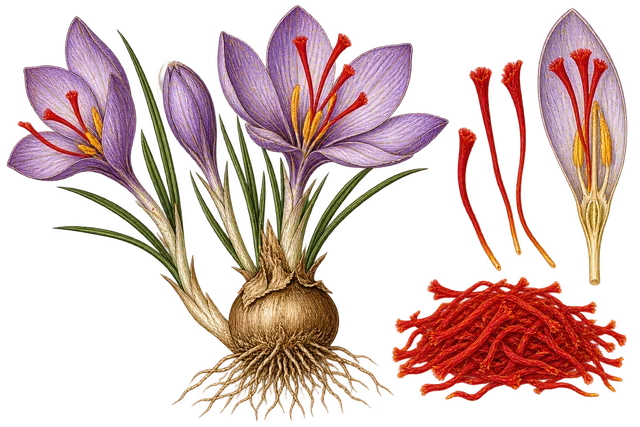
Saffron is the dried red stigmas of cultivated Crocus sativus. The flower, petals, corm and stigma are distinct plant parts. True saffron is not safflower, turmeric or poisonous Colchicum autumnale, sometimes called meadow saffron or autumn crocus.
Ingredient details, preparation and research
Also known as: Saffron crocus; Kesar
Source plant or material
Saffron is the dried red stigmas of cultivated Crocus sativus. The flower, petals, corm and stigma are distinct plant parts. True saffron is not safflower, turmeric or poisonous Colchicum autumnale, sometimes called meadow saffron or autumn crocus.
Plant family / material: Iridaceae (iris family)
Forms and route
Food-grade dried stigma threads or powder; separately standardized stigma extracts and supplements. Products based on petals or isolated crocin are not automatically equivalent to whole stigma. A fragrance product is not a culinary or oral medicinal form.
Vitamins and minerals
At a small example culinary quantity of 0.1 g, USDA data calculate to about 0.3 kcal, 0.028 mg manganese and 0.011 mg iron. This illustrates why saffron is chiefly a colour/flavour ingredient rather than a meaningful vitamin/mineral source. A dish may share that amount among several people; it is not a medicinal dose.
Absorption and preparation
Crocins disperse in water, which explains saffron’s culinary colouring action. In a small human study of a standardized extract, crocetin rather than intact crocins was measured in plasma. That product-specific result does not establish one absorption percentage for cooking or a need to combine saffron with oil or milk.
Traditional and reported uses
- Culinary colour, aroma and flavour from identified saffron stigmas.
- Traditional mood and other medicinal uses; small controlled trials of selected oral preparations have studied depressive symptoms.
Contraindications and cautions
- Avoid medicinal amounts and concentrated saffron supplements during pregnancy unless specifically advised by qualified care. Occupational-exposure research raises a pregnancy concern and does not establish a safe supplement dose.
- Discuss supplements with a clinician, especially with medicines or low blood pressure. Short-term studies in healthy adults do not establish long-term safety for every product.
- Use authenticated food-grade saffron; do not gather an unidentified crocus-like plant. Colchicum autumnale is poisonous and is not saffron.
- Do not replace depression treatment with a kitchen spice or stop prescribed medicine because of a small saffron trial.
Similar items and how they compare
- Safflower
Its petals have been sold as cheaper “saffron” or used for colouring.
It is a different species and plant part, with a different flavour and evidence base.
- Autumn crocus / meadow saffron
Its common names and flowers can confuse identification.
Colchicum autumnale contains toxic colchicine and is not edible Crocus sativus stigma.
The harvested plant part
Kew recognizes Crocus sativus in Iridaceae. The commercial spice is its dried stigma, not the corm or an entire garden flower. Petal studies, isolated crocin and standardized extracts describe different materials.
Pigment, bitterness and aroma
Crocins, picrocrocin and safranal contribute different properties to the stigma. Studies of formulated saffron measure these constituents separately; processing and digestion change their relative availability. A strong colour is not proof of a clinical dose.
A representative human mood trial
A 2005 single-centre, six-week randomized placebo-controlled trial enrolled 40 adults with mild-to-moderate major depression and reported greater symptom improvement with the tested saffron preparation. The authors called for larger trials. This promising result is not an instruction to substitute food saffron for treatment.
Nutrition in a realistic quantity
USDA’s 100 g composition is not a realistic eating portion for this expensive spice. Scaling those data to 0.1 g yields only about 0.3 kcal, 0.028 mg manganese and 0.011 mg iron. Those are calculated reference values, not reasons to increase intake.
Absorption evidence is formulation-specific
In a 13-volunteer study of a standardized extract, researchers quantified crocetin in plasma but did not detect intact crocins, picrocrocin or safranal there. This does not establish one universal absorption rate, and it does not demonstrate that a kitchen food pairing improves a health outcome.
Safety and pregnancy
A one-week healthy-volunteer study found some laboratory and blood-pressure changes at supplemental amounts, while a small occupational study associated saffron-field exposure with miscarriage. Neither provides a general safe pregnancy or long-term supplement regimen. Ordinary food seasoning and intensive exposure should not be treated as the same scenario.
Adulteration and dangerous lookalikes
Historic texts document substitutes and adulteration, making a trusted food source important. The name meadow saffron belongs to poisonous Colchicum autumnale. A photograph, a similar flower or a shared common name is not enough to identify an edible stigma.
Evidence limits
- The cited clinical trial is small, short and preparation-specific.
- Food composition is scaled to an illustrative culinary amount, not a recommended medicinal dose.
- Pregnancy and long-term supplement safety are not established by the cited short studies.
Entry sources
- Kew Plants of the World Online: Crocus sativus L.
- Felter and Lloyd, King’s American Dispensatory (1898): Crocus / Saffron
- Akhondzadeh et al. (2005): Crocus sativus for mild to moderate depression, randomized placebo-controlled trial
- Almodóvar et al. (2020): Bioaccessibility and pharmacokinetics of a commercial saffron extract
- Modaghegh et al. (2008): Safety evaluation of saffron tablets in healthy volunteers
- Ajam et al. (2014): Increased miscarriage rate in female farmers working in saffron fields
- North Carolina Extension: Autumn crocus, Colchicum autumnale
- USDA Standard Reference 28: Spices and Herbs, cinnamon NDB 02010 and saffron NDB 02037
- Lytton John Musselman, Old Dominion University: Saffron
- The King James Bible: Project Gutenberg ebook 10
- Bodleian Libraries, University of Oxford: Persian recipes, dyeing paper
- Metropolitan Museum of Art: Vegetable Gold
Reference entry 134 · Recorded content review: 2026-10-06 · Review scope and dates