


Key cautions
- Do not ingest an unidentified “onycha” product or prepare it as a medicine.
- No home smoke-bath, incense-processing or holy-incense recipe is endorsed here; candidate-material research raises safety concerns.
What’s inside
No fixed chemical profile can be assigned to biblical onycha. Laboratory measurements of candidate mollusc opercula do not identify the ancient ingredient.
Uses in brief

- Named ingredient of the sacred incense in Exodus.
- Candidate opercula have separately documented perfumery and smoke-bath traditions.
In the King James Bible
In the King James Bible
Uncertain botanical connection
Onycha is explicitly named as an incense ingredient, but its biological identity is uncertain and may be animal rather than plant. Exodus also reserves the composition for sacred use rather than personal reproduction.
And the LORD said unto Moses, Take unto thee sweet spices, stacte, and onycha, and galbanum; these sweet spices with pure frankincense: of each shall there be a like weight:
Exodus 30:34 (KJV)
And as for the perfume which thou shalt make, ye shall not make to yourselves according to the composition thereof: it shall be unto thee holy for the LORD.
Exodus 30:37 (KJV)
Scripture and identification sources
- King James Bible: Exodus 30:34
- King James Bible: Exodus 30:37
- Project Gutenberg: The King James Version of the Bible, ebook 10
- Nongmaithem et al. (2017): Volatile and bioactive compounds in opercula from Muricidae molluscs
- S. R. Driver, Cambridge Bible for Schools and Colleges: Exodus 30:34 commentary (1911)
Words & their stories
WORDS & THEIR STORIES
The name behind the KJV
Biblical Hebrew · Exodus 30:34 (KJV)
וּשְׁחֵלֶתūšəḥēlet
And the incense ingredient rendered “onycha.”
Dictionary form: שְׁחֵלֶת · šəḥēlet
Ū- means “and.” This rare Hebrew material-name occurs here in the sacred-incense list.
What the language reveals
A shell interpretation remains an interpretation
BDB records the traditional identification with a mollusc’s operculum, its closing plate, while noting an alternative proposal. The Greek-derived English name does not make the Hebrew a secure species label.
The later verse names the mixture
Exodus 30:37 uses qəṭōret, “incense,” for the finished composition. It does not repeat the ingredient-name šəḥēlet.
Onycha is an uncertain incense material, not securely an herb. Neither a particular shell species nor a modern plant resin or essential oil is established by the verse.
Language and identification bibliography
History, folklore and reported uses
History, folklore and traditional uses
Exodus names onycha alongside stacte, galbanum and frankincense in the account of sacred incense. Its place in that list is clear; its identity is not. The surrounding instructions make the composition holy and distinguish it from an ordinary personal fragrance. That context gives onycha a distinct place in the material culture of worship, even while the source of the ingredient remains disputed.
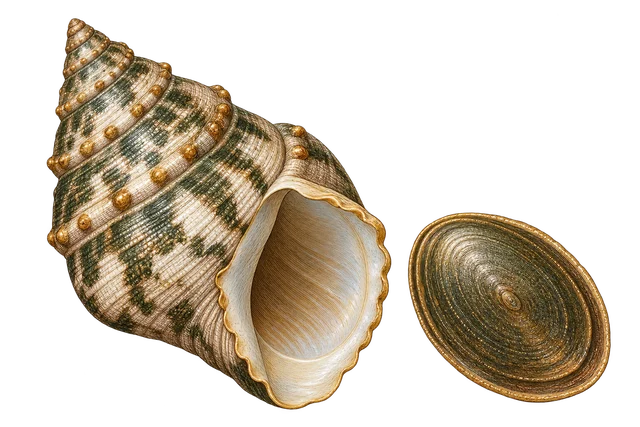
One important proposal points away from the herb garden and toward the sea: the hard operculum that closes a marine snail’s shell. A 2017 experimental study found that candidate opercula can supply fragrance-related compounds, strengthening this interpretation without proving it. Plant resins remain alternatives. The proposal also broadens the history of aromatics: fragrant materials could come from animal sources as well as familiar resin-bearing plants. Distinguishing the securely attested name from its proposed source is central to understanding this ingredient.
Traditional, historical and reported uses
- Sacred incense
Historical recordWhy this label?
Specific Exodus passage provides the written incense record.
Exodus 30:34 names onycha as one ingredient. Verses 37–38 restrict imitation for personal fragrance; this card records the text without reconstructing its mixture.
- Candidate opercula in perfumery
Food or household practiceWhy this label?
Candidate opercula used as perfumery ingredients; research is contextual.
The 2017 study documents opercula as fragrance ingredients and examines their role in stabilizing scent. This concerns a candidate material, not an authenticated sample of biblical onycha.
- Candidate opercula in Sudanese smoke-bath traditions
Food or household practiceWhy this label?
Cultural perfumed smoke-bath practice, without a therapeutic outcome claim.
The same study records opercula in Sudanese perfumed smoke-bath traditions. This is cultural history, not a recommendation to expose the body to smoke.
- Candidate opercula in medieval pharmacy
Traditional accountWhy this label?
Reported medieval pharmacy tradition of the candidate material.
Nongmaithem and colleagues describe operculum medicines sold in medieval Jewish pharmacies, particularly for gynecological complaints. This is a reported tradition of the candidate animal material.
- Candidate opercula in Chinese ulcer remedies
Traditional accountWhy this label?
Traditional Chinese local ulcer-remedy preparations.
The same study’s historical survey records operculum preparations in Chinese traditions for ulcers and other inflammatory complaints. These records concern candidate opercula; the safety cautions on ingestion and smoke remain important.
Five entries distinguish the biblical incense role from separately documented perfumery, smoke-bath and medicinal traditions of candidate opercula.
Identity & detailed reference
Identity
An unidentified ingredient of the sacred incense named in Exodus. Marine snail opercula are a substantial candidate, while plant-resin alternatives have also been proposed. It is not necessarily a plant material.
Ingredient details, preparation and research
Also known as: Sheheleth / shecheleth (transliterations); Unguis odoratus (related operculum tradition)
Source plant or material
Unknown. An animal-derived operculum is plausible; labdanum and other resins have also been discussed. No single modern source is proved.
Plant family / material: Not established as botanical; Muricidae is an animal-family candidate, not a plant family.
Forms and route
Biblical incense ingredient of unspecified biological origin. Candidate opercula are the protective closures of certain marine snail shells; commercial materials named onycha require independent identification.
Vitamins and minerals
This is a historical-material entry, not a dietary recommendation. The biblical name supplies no dependable modern food identity, serving size or vitamin/mineral values.
Absorption and preparation
No absorption guidance or medicinal dose is assigned to this uncertain ancient material. A modern product would require its own verified identity, preparation and safety assessment.
Traditional and reported uses
- Named ingredient of the sacred incense in Exodus.
- Candidate opercula have separately documented perfumery and smoke-bath traditions.
Contraindications and cautions
- Do not ingest an unidentified “onycha” product or prepare it as a medicine.
- No home smoke-bath, incense-processing or holy-incense recipe is endorsed here; candidate-material research raises safety concerns.
Similar items and how they compare
- Galbanum
Both are named in Exodus 30:34.
Being listed together does not make their sources or safety interchangeable.
- Stacte
Another disputed ingredient in the same passage.
Stacte is generally interpreted as a fragrant exudate; onycha may be animal-derived.
What the experiment can and cannot establish
The researchers analyzed modern mollusc opercula, not recovered biblical incense. Their results support an aromatic function but cannot by themselves settle the translation or historical species.
Candidate-material safety
The study detected toxic pyridine under some conditions and reported concerning metal levels. Laboratory bioactive compounds do not establish a safe household preparation or a clinical benefit.
A material entry rather than a herb prescription
The secure connection is the name in Exodus. No food serving, medicinal dose or absorption method follows from that passage, and a plant family is inappropriate unless the identity is first resolved.
Evidence limits
- Ancient names do not provide a verified modern species or product specification.
- Historical practice is recorded as history and does not establish present-day medical benefit or safety.
Entry sources
- Nongmaithem et al. (2017): Volatile and bioactive compounds in opercula from Muricidae molluscs
- S. R. Driver, Cambridge Bible for Schools and Colleges: Exodus 30:34 commentary (1911)
- King James Bible: Exodus 30:34
- King James Bible: Exodus 30:37
- Project Gutenberg: The King James Version of the Bible, ebook 10
- King James Bible: Exodus 30:34-38
Reference entry 132 · Recorded content review: 2026-10-06 · Review scope and dates