


Key cautions
- Concentrated oil can irritate or cause digestive symptoms; never swallow an external-use oil or apply it undiluted.
- Avoid supplement-strength use in pregnancy; breastfeeding and medicines need product-specific review. Ordinary seasoning is a different exposure.
- If you take warfarin, keep dietary vitamin K intake consistent and discuss substantial changes in herb or supplement intake with your clinician. This is not a reason to ban ordinary seasoning.
- Follow the clinician’s wound-care instructions after surgery. The small ointment trial does not establish a safe homemade preparation or justify putting oregano oil on an open wound.
What’s inside
Food measurements below describe dried oregano eaten as a seasoning. Water infusions, alcohol extracts and distilled essential oil select different parts of the plant’s chemistry; none inherits the whole leaf’s nutrient values.
USDA FoodData Central: primary SR Legacy food, nutrient and portion data · De Martino et al. (2009): Three Origanum vulgare subsp. hirtum oil chemotypes · Parra et al. (2021): Phenolic analysis of Atacama-region Origanum vulgare extracts
Nutrients in a teaspoon of dried leaves
USDA SR Legacy lists a teaspoon of dried oregano leaves as 1 g. A teaspoon of ground oregano is 1.8 g, so it is a different portion. These are reference values, not a label for every harvest.
- Energy: about 3 kcal
- Carbohydrate: 0.69 g, including about 0.43 g fiber
- Protein: 0.09 g; total dietary fat: 0.04 g
- Calcium: 16 mg; iron: 0.37 mg
- Magnesium: 2.7 mg; potassium: 13 mg
- Vitamin K: 6.2 micrograms, about 5% of the Daily Value
USDA FoodData Central: primary SR Legacy food, nutrient and portion data · FDA: Daily Values for nutrition labels
Phenolic acids and flavonoids
Oregano contains phenolic acids, including rosmarinic acid, and flavonoids. A study of an alcohol-and-water extract from Socoroma, in northern Chile’s Andean Atacama region, identified rosmarinic, protocatechuic, gallic and ferulic acids, with luteolin and naringenin among the flavonoids. This is a chemical analysis of the tested extract, not a measured dose in a spoonful of herb.
Parra et al. (2021): Phenolic analysis of Atacama-region Origanum vulgare extracts
Aromatic oil and chemical variation
Distillation concentrates volatile aroma compounds. Oils from flowering tops collected at three sites in Campania, southern Italy, had different dominant mixtures: carvacrol with thymol, thymol with alpha-terpineol, or linalool with linalyl acetate. These are different chemical profiles, often called chemotypes. An oil’s composition is not the concentration in leaf, tea or tincture, an alcohol-based extract.
De Martino et al. (2009): Three Origanum vulgare subsp. hirtum oil chemotypes
Uses in brief

- Food seasoning, especially tomato dishes, vegetables, soups and dressings.
- Traditional respiratory and infection-related uses are recorded, but clinical effectiveness is not established.
History, folklore and reported uses
Names and shared folklore
The Herb Society of America warns that old accounts mix wild and sweet marjoram. Associations with happiness, protection and domestic wellbeing belong to that partly shared tradition, not every plant called oregano.
Herb Society of America: Oregano and Marjoram, history and medicinal-use sections
Coughs, digestion and menstrual traditions
The Society’s account of Gerard links wild marjoram with coughs, and broader marjoram traditions with stomach discomfort, bruises and swelling. Later European infusions and tea powders addressed colds, digestion and painful periods or encouraged menstrual flow; Chinese uses included vomiting and dysentery.
Herb Society of America: Oregano and Marjoram, history and medicinal-use sections · NIH LiverTox: Oregano (2023)
External remedies and concentrated oil
Gerard described wild marjoram for itching and skin complaints. Later herbal baths addressed aches and arthritis. LiverTox separately records oregano-oil use for respiratory, fungal and parasitic complaints. An oil is not interchangeable with these leaf preparations.
Herb Society of America: Oregano and Marjoram, history and medicinal-use sections · NIH LiverTox: Oregano (2023)
Milk pails and thunder
European household lore placed wild marjoram with wild thyme near milk pails to stop thunder from souring the milk.
Herb Society of America: Oregano and Marjoram, history and medicinal-use sections
Red yarn in Latvian tradition
A 2018 conference abstract by Latvian researchers connects O. vulgare, called sarkane, with red or dark-red wool and yarn in songs and ethnographic records. Some accounts combined it with apple leaves. The historical shade and dyeing technique remain unresolved; the report described ongoing reconstruction, not a settled recipe.
Karlsone and Nakurte (2018): Oregano as a Latvian dye plant, DHA37 conference abstract, pp. 5–6
Antioxidant research in people
In a randomized, blinded four-week trial, 45 healthy nonsmoking men received mango-orange juice with or without oregano-extract phenolics. The higher-phenolic group excreted more phenolic compounds, showing exposure, but the trial found no significant changes in blood lipids or measured markers of fat oxidation. Laboratory antioxidant activity therefore did not translate into those human benefits.
Nurmi et al. (2006): Oregano-extract juice, phenolic excretion and oxidation markers in 45 men
Digestive-enzyme laboratory research
The Socoroma study used an 80% ethanol extract and tested enzymes involved in carbohydrate and fat digestion. It inhibited alpha-glucosidase in the test system. This was laboratory work, not a trial of diabetes or weight-loss treatment, and it does not establish an effect from ordinary oregano tea or meals.
Parra et al. (2021): Phenolic analysis of Atacama-region Origanum vulgare extracts
A small post-surgery ointment trial
A randomized, blinded study enrolled 40 patients after skin excisions and compared a 3% oregano-extract ointment with plain petroleum jelly. It reported fewer positive bacterial cultures and improvements in some scar measures, but overall scar appearance was equivalent. This preliminary result concerns a formulated extract ointment, not essential oil applied to a wound.
Ragi et al. (2011): Randomized oregano-extract ointment trial after skin excision
Regional reading paths
These sourced notes describe cultivation, trade, food traditions or material history. A regional connection does not claim exclusive origin.
Europe
Native and cultivated: occurs across much of Europe; RHS identifies Origanum vulgare as UK-native wild marjoram and documents its cultivation as culinary oregano.
Fresh or dried aromatic leaves as a kitchen herb. Sweet marjoram, Mexican oregano and concentrated oregano oil are different materials.
Identity & detailed reference
Identity
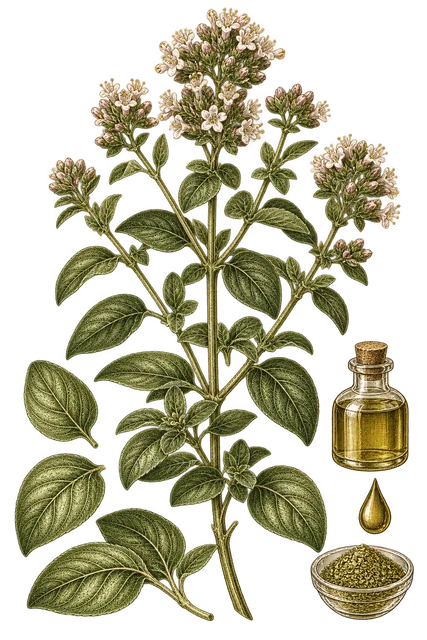
Origanum vulgare L.; leaves and flowering aerial parts. Sweet marjoram is O. majorana; Mexican oregano and other plants sold as oregano may belong to different genera or species.
Ingredient details, preparation and research
Source plant or material
Origanum vulgare L.; culinary leaves and flowering aerial parts, with oil/extracts identified separately.
Plant family / material: Lamiaceae (mint family).
Forms and route
Fresh or dried culinary herb; leaf infusion; alcohol/water extracts and tinctures; separately, distilled essential oil and diluted oil-containing products. “Oil of oregano” does not itself specify species, concentration, carrier or intended route.
Practical preparation
For food, crumble dried leaves into the dish or wash and chop fresh leaves. Follow an identified tea product’s instructions for an infusion. Do not convert leaf teaspoons into essential-oil drops, or assume an oil sold for fragrance is edible.
Combination notes
Tomato, garlic, beans, vegetables and a little olive oil are useful culinary partners. A blend with thyme or marjoram is a flavor choice; it has no established infection-treating synergy.
Traditional and reported uses
- Culinary seasoning for tomato dishes, vegetables, eggs, soups and dressings.
- LiverTox records traditional oregano-oil use for respiratory complaints and fungal or parasitic complaints; these uses lack convincing clinical confirmation.
- Chemical and antimicrobial laboratory research is preparation-specific. A very small uncontrolled human oil study is exploratory, not evidence for a self-treatment regimen.
Contraindications and cautions
- Higher-dose oregano products may cause stomach discomfort, heartburn, nausea, altered bowel movements, dizziness or headache; hypersensitivity is possible.
- Avoid supplement-strength oregano during pregnancy. Breastfeeding safety of concentrated products is insufficiently established; do not improvise oregano oil for nipple Candida.
- Clinically important drug interactions are poorly characterized. Have a concentrated product reviewed with regular medicines rather than treating laboratory enzyme results as proven interactions.
- Do not swallow aromatherapy/external-use essential oil, put undiluted oil on skin or mucosa, or substitute oregano for diagnosis and indicated infection treatment.
- If you take warfarin, keep dietary vitamin K intake consistent and discuss substantial changes in herb or supplement intake with your clinician. This is not a reason to ban ordinary seasoning.
- Follow the clinician’s wound-care instructions after surgery. The small ointment trial does not establish a safe homemade preparation or justify putting oregano oil on an open wound.
Similar items and how they compare
- Sweet marjoram
Both are Origanum food herbs in the mint family.
Marjoram is O. majorana and has a different aromatic profile and specific traditional-use monograph.
- Thyme
Some oils share thymol and carvacrol, and both are familiar seasonings.
Thyme has separate species, chemotypes and traditional cough preparations; it is not a substitute defined by shared constituents.
Identity and material
Origanum vulgare L.; leaves and flowering aerial parts. Sweet marjoram is O. majorana; Mexican oregano and other plants sold as oregano may belong to different genera or species. The family is Lamiaceae. Use the full botanical name for extracts because the common name is used for several unrelated commercial seasonings.
Limits of medicinal claims
LiverTox’s 2023 assessment describes laboratory effects whose clinical significance is unestablished and notes that oregano oil is not approved as a disease treatment in the United States. Individual preliminary studies do not make an oil a proven treatment for respiratory, fungal or parasitic infection.
Human evidence: very small and uncontrolled
A 2000 report gave an emulsified oregano oil to 14 adults with positive stool tests for six weeks and reported changes in organism detection and some symptoms. Without a randomized control group, this cannot establish causation, an effective dose, or equivalence to tea, culinary oregano or a different oil. It does not support self-treatment for suspected parasites.
Laboratory evidence depends on preparation
In one Portuguese oregano comparison, hot-water extract had high phenolic content and antioxidant activity, yet the tested water/ethanol extracts did not inhibit the seven bacteria tested. The essential oil did. These are laboratory and food-preservation findings, not proof that swallowing oil reaches an infected tissue at a safe, effective concentration.
Routes and cautions
Higher-dose products can cause digestive or neurological symptoms and allergic reactions. Avoid supplement-strength use during pregnancy and do not infer breastfeeding safety; clinical support is absent for oregano oil on nipples for Candida. Essential oils need route-specific labeling and can be poisonous if misused. Culinary exposure should not be equated with a concentrate.
Absorption and culinary combinations
Water and ethanol extract different mixtures; distillation concentrates volatile constituents. Extraction yield and an antioxidant test do not measure human absorption or clinical benefit. No established food-pairing or absorption-enhancer rule for oregano remedies was identified. Tomato dishes, soups and vegetables are practical uses. Combining oregano with other seasonings supports flavor, not a proven medicinal synergy.
Related herbs
Sweet marjoram and oregano are different species of Origanum. Thyme can share aroma compounds but has a different medicinal evidence base. Similar fragrance or a shared constituent does not establish interchangeable treatment effects.
Entry sources
- Kew Plants of the World Online: Origanum vulgare L.
- De Martino et al. (2009): Three Origanum vulgare subsp. hirtum oil chemotypes
- Kew Plants of the World Online: Origanum majorana L.
- Parra et al. (2021): Phenolic analysis of Atacama-region Origanum vulgare extracts
- NIH LiverTox: Oregano (2023)
- Force et al. (2000): Uncontrolled 14-person study of emulsified oregano oil
- Teixeira et al. (2013): Oregano water and ethanol extracts versus essential oil, laboratory comparison
- NIH LactMed: Oregano, lactation and unproven nipple-Candida use
- National Capital Poison Center: Essential oils, poisonous when misused
- USDA FoodData Central: SR Legacy downloadable food and portion data
- FDA: Daily Value on the Nutrition and Supplement Facts labels
- University of Minnesota Extension: Herbs, preparation and culinary pairings
- EMA: Thyme herb, traditional-use conclusions and limitations of clinical evidence
- Karlsone and Nakurte: Studies on Origanum vulgare as a traditional dye plant in Latvia, DHA37 abstracts, printed pp. 5–6
Reference entry 11 · Recorded content review: 2026-10-05 · Review scope and dates