


Key cautions
- Leek, especially larger bulb or lower-shank portions, may trigger symptoms in people sensitive to fructans/FODMAPs; tolerance depends on portion and plant part.
- If taking warfarin, keep vitamin K intake reasonably consistent and discuss major dietary changes with the care team.
What’s inside
Water, carbohydrate, fiber and fructans; sulfur-containing Allium compounds; flavonol glycosides including kaempferol derivatives. Vitamin K, folate and carotenoids are present, with amounts affected by portion, cultivar and cooking.
Uses in brief

- Use the cleaned shank and leaves in soups, stews, braises, pies and other vegetable dishes.
- A food source of vitamin K and modest fiber and folate at a real vegetable portion.
- Historical voice, nosebleed and ceremonial uses are documented separately from its established role as food.
In the King James Bible
In the King James Bible
Named material
Leeks appear beside onions and garlic among the foods the Israelites remember from Egypt during their wilderness journey. The usual identification is a cultivated Allium of the leek group; the verse leaves the particular type unspecified.
We remember the fish, which we did eat in Egypt freely; the cucumbers, and the melons, and the leeks, and the onions, and the garlick:
Numbers 11:5 (KJV)
Scripture and identification sources
Words & their stories
WORDS & THEIR STORIES
The name behind the KJV
Biblical Hebrew · Numbers 11:5 (KJV)
הֶחָצִירheḥāṣīr
The leeks, in the remembered foods of Egypt.
Dictionary form: חָצִיר · ḥāṣīr
He- is the article before this consonant. Elsewhere the same noun commonly means grass or herbage.
What the language reveals
Context supplies the narrower meaning
The list of foods supports the traditional “leeks” rendering here. It would be misleading to translate every occurrence of ḥāṣīr as a leek.
Leek is the traditional contextual identification. The verse does not specify a modern cultivar, preparation or supplement.
Language and identification bibliography
History, folklore and reported uses
History, folklore and traditional uses
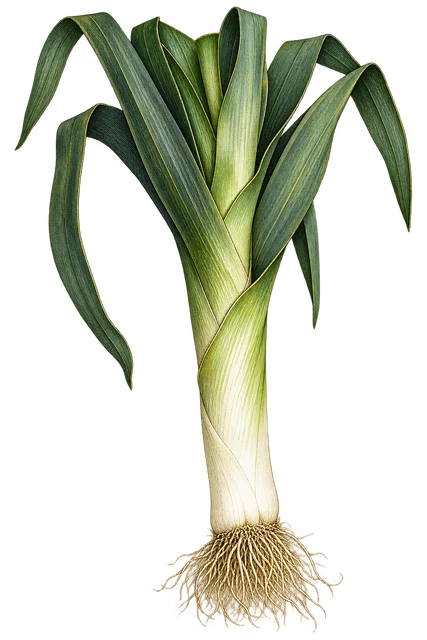
Leeks enter the KJV as a remembered taste of Egypt. In Numbers, they belong to a list of ordinary foods missed in the wilderness, a reminder that familiar vegetables can carry strong associations with home. The edible shank is not a trunk or root: it is a tightly layered bundle of leaves, usually softened by cooking. Its mild allium flavor has kept it useful across centuries of cultivation.
The plant also acquired a life beyond the cooking pot. Pliny recorded leek preparations for the voice and for nosebleeds, illustrating the old overlap between food and medicine. In Wales it became a sign of belonging, worn on St David’s Day and celebrated in stories of identifying allies in battle. The battlefield origin is a legend; the lasting custom of wearing the leek and its place in cawl are tangible parts of Welsh cultural life.
Traditional, historical and reported uses
- An everyday food remembered from Egypt
Historical recordWhy this label?
Specific Numbers passage is the direct written food-use record.
Numbers 11:5 explicitly includes leeks among the foods remembered from Egypt; this is the card’s direct biblical use as food.
- Soup and cawl
Food or household practiceWhy this label?
Ongoing culinary use in soups, stews and Welsh cawl.
Leek’s mild flavor has long suited soups and stews; Wales.com identifies it with Welsh cawl, a continuing culinary tradition.
- Care of the voice
Historical recordWhy this label?
Specific Pliny chapters document ancient voice and chest remedies.
Pliny’s Book XX, chapters 21–22, credits leek with improving the voice and describes its place in chest and throat remedies.
- Nosebleed remedies
Historical recordWhy this label?
Pliny's primary historical text documents local nosebleed preparations.
Pliny records local leek preparations for nosebleeds. This is an ancient treatment account, not advice to put vegetable material or juice into the nose.
- Welsh identity and ceremony
Traditional accountWhy this label?
Welsh ceremonial emblem practice and explicitly attributed legend.
The leek is worn for St David’s Day and appears in Welsh emblem traditions. The story of soldiers wearing it to distinguish allies is explicitly a legend.
Story sources
- King James Bible, public-domain complete text, Project Gutenberg eBook 10
- Pliny the Elder: Natural History, Book XX; Bostock and Riley translation (1856), public-domain primary historical text
- University of Wisconsin Extension: Leeks, horticulture and history
- Welsh Government, Wales.com: National symbols of Wales, the leek
Identity & detailed reference
Identity
Cultivated leek, usually treated as Allium ampeloprasum L., Leek Group; Allium porrum L. is a widely used synonym. Ancient leeks should not be assumed identical to a particular modern cultivar.
Ingredient details, preparation and research
Also known as: Garden leek; Allium porrum
Source plant or material
Cultivated leek, usually treated as Allium ampeloprasum L., Leek Group; Allium porrum L. is a widely used synonym. Ancient leeks should not be assumed identical to a particular modern cultivar. Parts used: Overlapping leaf sheaths forming the white and pale-green shank, plus tender leaves. Darker, tougher leaves are often used in cooked dishes or stock.
Plant family / material: Amaryllidaceae (amaryllis family), subfamily Allioideae
Forms and route
Fresh vegetable, raw in suitable dishes or cooked; frozen or dried leek as a food ingredient. A leek food portion is not equivalent to an Allium extract or essential oil.
Vitamins and minerals
The USDA table reproduced by University of Florida IFAS gives 1 cup raw leek (89 g, 3.1 oz): about 54 kcal, 1.6 g fiber, 1.3 g protein, 10.7 mg vitamin C, 57 micrograms folate DFE and 41.8 micrograms vitamin K. A half-cup is half these amounts. Cooked-and-drained leek has a different water content and nutrient profile; stock does not retain all the vegetable’s fiber.
Absorption and preparation
Leek is eaten as a food, with no special medicinal absorption protocol. Its fructans are fermented by gut microbes rather than fully digested in the small intestine, which can matter for IBS symptoms. Vitamin K is fat-soluble and is absorbed with dietary fat; a normal mixed meal is sufficient, and no leek-specific oil ratio has been established.
Practical preparation
Trim roots and damaged leaves. Split or slice the leek and rinse between layers, where grit accumulates. The white and pale-green parts cook readily; tougher green tops can flavor stock. Refrigerate cleaned cut produce and follow normal food-storage guidance.
Combination notes
Potato, beans, eggs and broth are familiar culinary companions. Their use does not establish a therapeutic synergy. Individual FODMAP tolerance matters more than adding another herb to make a leek dish supposedly easier to absorb.
Traditional and reported uses
- Use the cleaned shank and leaves in soups, stews, braises, pies and other vegetable dishes.
- A food source of vitamin K and modest fiber and folate at a real vegetable portion.
- Historical voice, nosebleed and ceremonial uses are documented separately from its established role as food.
Contraindications and cautions
- Leek, especially larger bulb or lower-shank portions, may trigger symptoms in people sensitive to fructans/FODMAPs; tolerance depends on portion and plant part.
- If taking warfarin, keep vitamin K intake reasonably consistent and discuss major dietary changes with the care team.
- Wash thoroughly between leaf layers to remove trapped soil. Do not use raw leek juice in the nose, ears, eyes or wounds as described in old remedies.
- Avoid if you have a known leek or Allium allergy; do not identify wild edible plants by onion-like smell alone.
Similar items and how they compare
- Onion
A closely related culinary allium and fellow food in Numbers 11:5.
Onion forms a swollen storage bulb; leek is chiefly eaten for its layered leaf sheaths and usually milder flavor.
- Garlic
Another allium named in the same verse.
Garlic uses cloves and has a different sulfur-compound profile; supplement findings are not interchangeable.
- Ramps or wild leeks
A similar common name can cause confusion.
North American ramps, Allium tricoccum, are a different species with different harvest and conservation considerations.
An allium vegetable within the herb collection
Leek is included here as a named biblical culinary plant. Its edible shank is made of overlapping leaf sheaths rather than a large onion-like bulb. Modern sources use both Allium porrum and Allium ampeloprasum Leek Group; neither name identifies an ancient cultivar.
Biblical and classical context
Numbers remembers leeks among Egyptian foods. Classical writers later described voice and nosebleed remedies, and Welsh tradition developed a national emblem. Those records establish food history and reported practice; they do not make fresh leek juice an appropriate treatment for bleeding or infection.
Constituents and research scale
Laboratory work has identified kaempferol-based flavonoids, and cultivar comparisons found considerable differences in flavonol amounts. These are composition studies rather than clinical demonstrations that a serving of leek prevents clotting, cancer or another disease.
Portion, digestion and medicines
The cup portion in the cited USDA table is 89 g. It contributes vitamin K and folate alongside modest fiber. Leek is among Monash’s higher-FODMAP vegetable examples, with tolerance affected by portion and plant part. People using warfarin should aim for a stable vitamin K intake, not automatically exclude vegetables.
Preparation and absorption
Clean the many leaf layers carefully and distinguish eating the vegetable from straining it into stock. A normal mixed meal provides the dietary context for fat-soluble vitamin absorption. No evidence-based leek tincture dose or medicinal absorption-enhancing recipe is supplied.
Evidence limits
- The portion values describe raw common leek; Chinese leek, extracts and cooked-drained servings differ.
- Historical treatment accounts provide no validated household medicinal dose.
Entry sources
- Charles Darwin Foundation: Allium ampeloprasum, taxonomy and Allium porrum synonym
- University of Wisconsin Extension: Leeks, horticulture and history
- University of Florida IFAS: Leek Cultivation Guide for Florida, including USDA nutrition table
- Pliny the Elder: Natural History, Book XX; Bostock and Riley translation (1856), public-domain primary historical text
- Welsh Government, Wales.com: National symbols of Wales, the leek
- Fattorusso et al. The flavonoids of leek, Allium porrum (2001)
- Bernaert et al. Metabolite profiling of leek cultivars (2014)
- Monash University: About FODMAPs and IBS, vegetable examples including leek and onion
- NIH Office of Dietary Supplements: Vitamin K, consumer fact sheet
- Lytton John Musselman, Old Dominion University: Plants of the Bible: plant index
- King James Bible, public-domain complete text, Project Gutenberg eBook 10
- King James Bible: Numbers 11:5
Reference entry 126 · Recorded content review: 2026-10-06 · Review scope and dates