


Key cautions
- Do not swallow incense resin, fragrance extracts or galbanum essential oil, or reproduce historical medicinal recipes. A safe standardized home dose has not been established.
- Avoid medicinal use during pregnancy: historical sources include menstruation- and abortion-related uses, and adequate reproductive safety is not established.
What’s inside
Whole galbanum combines gum polysaccharides, nonvolatile resin and volatile terpenes. A modern Ferula gummosa study found beta-amyrin prominent in resin and alpha-/beta-pinene among major volatile components, with organ-dependent differences. Historical pharmacopoeias also describe umbelliferone-related resin chemistry.
Uses in brief

- Historic sacred incense and modern perfumery.
- Recorded expectorant, external plaster and fumigation traditions; human treatment benefit is not established by this history.
In the King James Bible
In the King James Bible
Named material
Galbanum is explicitly named in Exodus as an ingredient of sacred incense. Modern galbanum is associated chiefly with Ferula gum-resins, especially F. gummosa, but the exact ancient source is uncertain. The verse concerns incense material, not a modern distilled essential oil.
And the LORD said unto Moses, Take unto thee sweet spices, stacte, and onycha, and galbanum; these sweet spices with pure frankincense: of each shall there be a like weight:
Exodus 30:34 (KJV)
Scripture and identification sources
Words & their stories
WORDS & THEIR STORIES
The name behind the KJV
Biblical Hebrew · Exodus 30:34 (KJV)
וְחֶלְבְּנָהwəḥelbənāh
And galbanum, one of the sacred incense ingredients.
Dictionary form: חֶלְבְּנָה · ḥelbənāh
Wə- means “and”; the substance-name is ḥelbənāh.
What the language reveals
One ingredient in a prepared incense
The following verses distinguish the named ingredient from the compounded and finely beaten sacred incense. The passage does not describe bottled galbanum essential oil.
Galbanum is an aromatic gum-resin name; the verse does not establish a particular Ferula species or modern extract.
Language and identification bibliography
History, folklore and reported uses
History, folklore and traditional uses
Galbanum entered the biblical record as part of a carefully specified incense. Its pungent character may surprise someone expecting only a sweet floral scent: the raw material is an aromatic gum-resin, with a long history in the trade of resins from western and central Asia. Scholars tracing the name also describe repeated confusion among galbanum and neighbouring apothecary materials. A jar bearing the old name therefore needs botanical and material identification of its own.
In later pharmacy, galbanum appeared both in pills and in external plasters. The British Pharmaceutical Codex of 1911 records it as an expectorant in chronic bronchitis and as a plaster material for swellings. Perfumery gave the resin another continuing life, distinct from those medical preparations. These changing uses followed the different fractions of galbanum: gum, resin and volatile fragrance, which remain important distinctions in modern research.
Traditional, historical and reported uses
- Sacred incense
Historical recordWhy this label?
Specific Exodus passage documents sacred incense.
Exodus 30:34 explicitly includes galbanum with other aromatics. The passage gives galbanum a distinct role among the materials of sacred incense.
- Perfumery
Food or household practiceWhy this label?
Aromatic resin used as a perfumery material.
Iranica describes export of galbanum chiefly for perfumery. The resin’s strong aroma made it a fragrance material even as some older internal medicinal uses declined.
- Historical expectorant medicine
Historical recordWhy this label?
The 1911 Codex records historical expectorant pharmacy.
The 1911 British Pharmaceutical Codex describes galbanum in chronic-bronchitis practice, including compound pills with asafoetida. This is evidence of historical pharmacy, not a recommendation to treat a cough by ingesting resin.
- External plasters for swellings
Historical recordWhy this label?
The 1911 Codex records a specific plaster dosage form.
The same Codex lists galbanum plaster for inflammatory swellings. A manufactured historical plaster was a distinct dosage form; raw resin or fragrance oil should not be substituted on painful or infected skin.
- Fumigation against insects
Food or household practiceWhy this label?
Household insect-repellent fumigation practice.
Iranica’s account of Greek and later Islamic materia medica records fumigation as an insect-repellent use. This documents a household practice without establishing indoor smoke exposure as a safe modern pest-control method.
Story sources
- Kew Medicinal Plant Names Services: Galbanum
- British Pharmaceutical Codex (1911): Galbanum
- Sobhani Najafabadi et al. (2017): Transcriptome and metabolome analysis of Ferula gummosa
- Mahboubi (2016): Ferula gummosa, a traditional medicine with novel applications
- Houshang Alam, Encyclopaedia Iranica: Galbanum
- The King James Bible: Project Gutenberg ebook 10
Identity & detailed reference
Identity
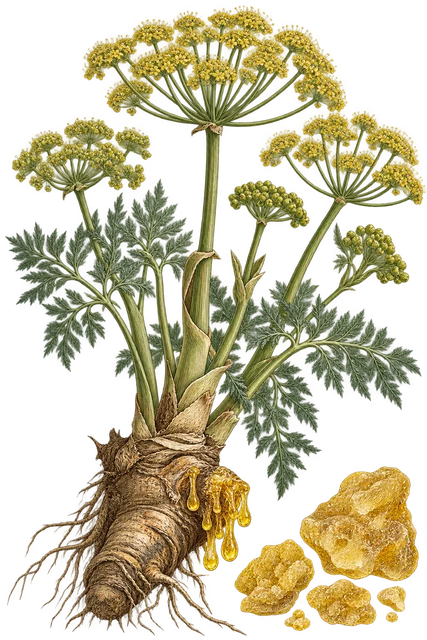
Galbanum is an aromatic oleo-gum-resin associated especially with Ferula gummosa, also historically called Ferula galbaniflua. Other Ferula sources and similarly named resins complicate older records. The biblical material cannot be guaranteed to one modern species.
Ingredient details, preparation and research
Also known as: Galbanum oleo-gum-resin; Barijeh
Source plant or material
Galbanum is an aromatic oleo-gum-resin associated especially with Ferula gummosa, also historically called Ferula galbaniflua. Other Ferula sources and similarly named resins complicate older records. The biblical material cannot be guaranteed to one modern species.
Plant family / material: Apiaceae (carrot family)
Forms and route
Raw gum-resin tears or masses; separately, tinctured or solvent-extracted fragrance material and distilled essential oil. A whole oleo-gum-resin contains gum, resin and a volatile fraction; a distilled oil contains only a selected volatile fraction.
Vitamins and minerals
Galbanum is not assigned a food or nutrient serving. Its gum fraction is not evidence that a fragrance resin is an appropriate dietary-fibre supplement. Distilled oil supplies neither the whole gum nor a useful dietary mineral profile.
Absorption and preparation
Extraction changes which fraction is present. No reliable human oral bioavailability, safe household dose or absorption-enhancing food pairing is established for these products. Fragrance inhalation or skin contact should not be represented as nutritional delivery.
Traditional and reported uses
- Historic sacred incense and modern perfumery.
- Recorded expectorant, external plaster and fumigation traditions; human treatment benefit is not established by this history.
Contraindications and cautions
- Do not swallow incense resin, fragrance extracts or galbanum essential oil, or reproduce historical medicinal recipes. A safe standardized home dose has not been established.
- Avoid medicinal use during pregnancy: historical sources include menstruation- and abortion-related uses, and adequate reproductive safety is not established.
- Concentrated fragrance preparations and smoke can be unsuitable for sensitive skin or airways. Stop if irritation occurs; do not use smoke as treatment for a cough or asthma.
- Verify botanical source and product grade; galbanum, asafoetida, ammoniacum and other historical resins have sometimes been confused.
Similar items and how they compare
- Frankincense
Another resin in the incense named in Exodus 30:34.
Boswellia resin is a separate material, with different chemistry and research.
- Asafoetida
Another strongly scented Ferula resin, also used with galbanum in historical pills.
It has different botanical sources and food traditions; culinary asafoetida does not establish edible use for a galbanum perfume product.
Resin identity
Kew’s medicinal-name database links galbanum to several Ferula names, especially F. gummosa. Older records distinguish or confuse resin grades and related species. Ancient naming and current commercial labelling therefore require different levels of certainty.
Three fractions in one material
A whole oleo-gum-resin contains gum, nonvolatile resin and volatile oil. Distillation excludes most gum and resin; extraction with another solvent gives a different mixture. Historic percentages describe traded samples, not a universal specification for every modern product.
Modern constituent research
A 2017 study compared F. gummosa organs and oleo-gum-resin using metabolite and gene-expression analysis. Resin and essential-oil profiles differed, including beta-amyrin and several mono- and sesquiterpenes. This is chemical and botanical evidence rather than a trial of treatment.
Clinical evidence limits
The 2016 review identified a broad traditional record but emphasized experimental and animal studies. Such findings do not establish an effective human treatment for epilepsy, asthma, pain or infection, and do not define a safe self-care dose.
Nutrition and absorption
Neither the gum-resin nor a fragrant oil has a supported dietary serving in this card. A gum component is not enough to claim a fibre benefit. No human absorption protocol is supplied for products with variable source and extraction.
Pregnancy and airway context
Historical menstruation- and abortion-related claims are a reason for caution, not a use to imitate. The old expectorant tradition also does not justify exposing irritated airways to incense smoke or swallowing fragrance oil.
Evidence limits
- Exact species and historic resin grades are not completely recoverable.
- Clinical human evidence and reproductive-safety data are insufficient for a household medicinal recommendation.
- Oil, gum-resin and solvent extracts are not interchangeable.
Entry sources
- Kew Medicinal Plant Names Services: Galbanum
- British Pharmaceutical Codex (1911): Galbanum
- Sobhani Najafabadi et al. (2017): Transcriptome and metabolome analysis of Ferula gummosa
- Mahboubi (2016): Ferula gummosa, a traditional medicine with novel applications
- Houshang Alam, Encyclopaedia Iranica: Galbanum
- The King James Bible: Project Gutenberg ebook 10
Reference entry 124 · Recorded content review: 2026-10-06 · Review scope and dates