


Key cautions
- Avoid cumin if allergic to it or related herbs. Essential oil has caused phototoxic skin reactions.
- Cumin essential oil is not interchangeable with whole seed or a food seasoning; do not improvise an oral or topical medicinal dose.
What’s inside
Volatile constituents include cuminaldehyde and related aldehydes and terpenes. The fruits also contain flavonoids, fixed oil, protein, fiber and minerals. Constituents and amounts vary with crop and processing.
Uses in brief

- Season lentils, beans, rice, vegetables, breads and spice blends.
- Long-standing digestive-herb use for dyspepsia, colic and intestinal discomfort.
- Reported nursing and household traditions; concentrated preparations have their own evidence and cautions.
In the King James Bible
In the King James Bible
Named material
Isaiah describes the careful threshing of “cummin,” and Matthew includes it among tithed herbs in a teaching about judgment, mercy and faith. The customary botanical identification is cumin, Cuminum cyminum, whose dry fruits are commonly called seeds.
Woe unto you, scribes and Pharisees, hypocrites! for ye pay tithe of mint and anise and cummin, and have omitted the weightier matters of the law, judgment, mercy, and faith: these ought ye to have done, and not to leave the other undone.
Matthew 23:23 (KJV)
For the fitches are not threshed with a threshing instrument, neither is a cart wheel turned about upon the cummin; but the fitches are beaten out with a staff, and the cummin with a rod.
Isaiah 28:27 (KJV)
Scripture and identification sources
Words & their stories
WORDS & THEIR STORIES
The name behind the KJV
Koine Greek · Matthew 23:23 (KJV)
κύμινονkýminon
Cumin, rendered “cummin,” among tithed herbs.
Dictionary form: κύμινον · kýminon
This is a neuter accusative form, identical in appearance to the dictionary form; checked in Scrivener’s Greek.
Biblical Hebrew · Isaiah 28:27 (KJV)
כַּמֹּןkammōn
Cumin, whose seeds are beaten out with a rod.
Dictionary form: כַּמֹּן · kammōn
The same noun appears twice; the second occurrence adds wə-, “and.”
What the language reveals
A crop-specific harvest
Isaiah distinguishes cumin from qeṣaḥ, the KJV’s “fitches,” and from grain treated with heavier equipment. The agricultural comparison depends on different treatment for different crops.
Cumin is the conventional identification. It is distinct from the neighboring black-cumin candidate and does not designate a modern oil.
History, folklore and reported uses
History, folklore and traditional uses
Cumin carries the scent of a working kitchen, but Isaiah remembers it first as a crop. Its small fruits were sown and threshed with care, a familiar farming task used to explain discernment. Matthew later places cummin beside mint and anise among the small herbs counted for tithes. Together the passages place cumin within familiar domestic and agricultural work.
Its wider history follows meals, trade and household belief. The Herb Society records Greek and Roman table use, a cumin spread for bread and medieval cakes associated with a traveler’s fidelity and safe return. Indian traditions placed it among digestive herbs, and nursing traditions gave it another household role. Modern whole seed still links these histories to everyday food, even as extracts and capsules have become separate products.
Traditional, historical and reported uses
- Table spice and bread seasoning
Food or household practiceWhy this label?
Culinary table spice and bread accompaniment.
The Herb Society records ancient Greek and Roman table containers of cumin and a cumin paste eaten on bread.
- Digestive discomfort
Traditional accountWhy this label?
Ayurvedic and regional digestive-remedy accounts.
Ayurvedic and other traditional accounts use cumin for dyspepsia, colic and related digestive complaints.
- Milk-production traditions
Traditional accountWhy this label?
Regional milk-promoting herbal traditions.
LactMed records cumin as a galactagogue in India, Pakistan and Türkiye, sometimes as one ingredient in a mixture.
- Egyptian funerary use
Traditional accountWhy this label?
Secondary historical account of an Egyptian funerary preserving practice.
The Herb Society describes cumin as a seasoning and as a preserving spice in ancient Egyptian mummification.
- Fidelity and safe-return folklore
Traditional accountWhy this label?
Attributed medieval fidelity and safe-return folklore.
Medieval European lore linked cumin cakes given to departing lovers with fidelity and a safe return; this is a recorded belief.
Women’s Health: traditions, evidence and cautions
Historical use does not establish benefit or safety. Pregnancy, breastfeeding and fertility care require particular caution: food, tea, essential oil and concentrated extract are not interchangeable. These records are not treatment, dosing or pregnancy-management instructions. Discuss supplements with a qualified clinician or pharmacist; do not delay evaluation of persistent symptoms.
Cumin fruit
Cuminum cyminum L.
- Plant part / material
- Dried fruit, conventionally called seed
- Preparation studied or reported
- Culinary spice; medicinal drops and multi-herb granules are distinct.
LactMed identifies lactation use in India, Pakistan and Türkiye, citing regional reports rather than a single universal practice.
Lactation / milk-supply tradition
Limited, formulation-dependent human evidence
Reported or traditional useCumin-containing preparations are used to encourage milk supply.
What the evidence supportsOne small cumin-drop trial improved proxy indicators but had formulation/blinding limits; combination trials cannot establish cumin alone as effective.
Medicinal safety and milk-transfer data remain inadequate. Cumin oil can cause phototoxic contact reactions; food spice status does not validate concentrated drops.
- The cited lactation evidence does not establish medicinal-use safety during pregnancy; postpartum traditions must not be extrapolated to pregnancy.
Regional reading paths
These sourced notes describe cultivation, trade, food traditions or material history. A regional connection does not claim exclusive origin.
Africa
Cultivated/traded: longstanding Moroccan and wider North African cuisine.
Dried fruits season savory dishes and spice blends.
Asia
Cultivated and traditional use: India; wider West and South Asian cooking.
Whole or ground fruits season curries and spice blends.
Identity & detailed reference
Identity
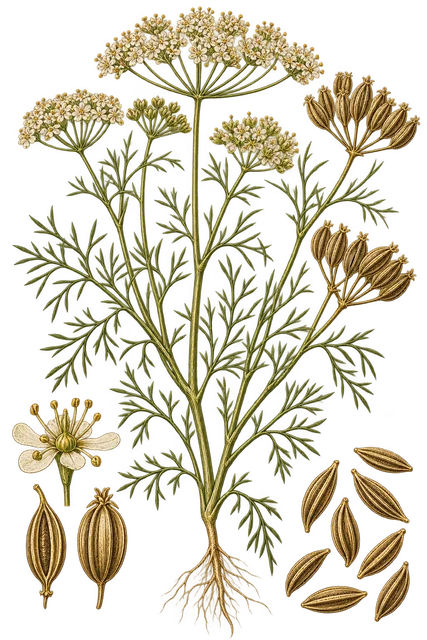
Cuminum cyminum L., an annual aromatic Apiaceae plant. Its ripe dried fruits are sold as cumin seed. Cummin is the KJV spelling.
Ingredient details, preparation and research
Also known as: Cummin (KJV spelling); Cumin seed (botanically the dried fruit)
Source plant or material
Cuminum cyminum L., an annual aromatic Apiaceae plant. Its ripe dried fruits are sold as cumin seed. Cummin is the KJV spelling. Parts used: Ripe dried fruits, commonly called seeds; whole or ground for food. Distilled essential oil and extracts are separate preparations.
Plant family / material: Apiaceae (carrot or parsley family)
Forms and route
Whole dried seed, ground spice, seasoning blends and traditional seed infusions. Supplements and essential oil should be identified separately from culinary cumin.
Vitamins and minerals
USDA whole cumin seed: 1 teaspoon (2.1 g, 0.07 oz) provides about 7.9 kcal, 0.37 g protein, 0.47 g fat, 0.22 g fiber, 19.6 mg calcium and 1.39 mg iron. This is approximately 8% of the 18 mg adult labeling Daily Value for iron, before accounting for absorption. A teaspoon spread across a family dish supplies only a fraction per person. Ground-spice packing density may differ.
Absorption and preparation
Cumin’s iron is nonheme iron; its food-table amount is not the amount absorbed. Vitamin-C-rich foods in the same meal can help absorption of plant iron, but no precise cumin-specific multiplier is established. Toasting or blooming cumin in cooking oil changes flavor release; it is not proof of improved therapeutic absorption.
Practical preparation
Buy whole food-grade seed or clearly labeled ground cumin. Store airtight, away from light and heat. Brief toasting and grinding can emphasize aroma; avoid scorching. Use tested food-preservation recipes rather than relying on a spice’s laboratory antimicrobial activity.
Combination notes
Beans, lentils and vegetables are culinary pairings. Tomatoes or peppers can supply vitamin C with a plant-based meal; the combination is normal nutrition, not a treatment formula. A trial that used capsules does not validate a cooking recipe as a weight-loss intervention.
Traditional and reported uses
- Season lentils, beans, rice, vegetables, breads and spice blends.
- Long-standing digestive-herb use for dyspepsia, colic and intestinal discomfort.
- Reported nursing and household traditions; concentrated preparations have their own evidence and cautions.
Contraindications and cautions
- Avoid cumin if allergic to it or related herbs. Essential oil has caused phototoxic skin reactions.
- Cumin essential oil is not interchangeable with whole seed or a food seasoning; do not improvise an oral or topical medicinal dose.
- Medicinal use during pregnancy or breastfeeding needs individual review. Limited milk-transfer studies after mixed meals do not establish the safety of cumin supplements for nursing infants.
- Discuss regular supplement use with a clinician if treating diabetes or another chronic condition; do not replace established care with a spice or extract.
Similar items and how they compare
- Black cumin seed (Nigella sativa)
Shares a common name and is another pungent seed spice.
Nigella belongs to Ranunculaceae and contains a different constituent profile; it is not Cuminum cyminum.
- Coriander (seed and cilantro leaf)
An Apiaceae fruit used alongside cumin in spice blends.
Coriander seed is citrus-like and has a different volatile-oil composition.
- Fennel, sweet
Another traditional aromatic digestive seed.
Fennel is generally sweeter and anise-like; its monograph and safety advice cannot be transferred to cumin.
Plant identity and biblical farming
Cumin is Cuminum cyminum in Apiaceae, not Nigella sativa. Isaiah describes sowing and gentle threshing of cummin; Matthew names it among tithed herbs. These passages establish an agricultural and household context, while the botanical fruit is conventionally called a seed in the kitchen.
Traditional uses
Indian digestive practice, ancient Mediterranean seasoning and later nursing traditions all appear in the historical record. LactMed records galactagogue use in India, Pakistan and Türkiye. It also describes limited milk-transfer studies after mixed curry meals; these leave medicinal-product safety for nursing infants unresolved.
Cumin trial carries an editorial warning
The cited 2015 trial of cumin capsules, orlistat and placebo carries a 2023 Expression of Concern. The publisher identified inconsistencies in group sizes, demographic data and trial dates relative to its registration. Its positive weight or metabolic findings are not used here as reliable evidence of benefit; nor would a capsule result establish an effect from culinary cumin.
Nutrients and absorption
A whole-seed teaspoon weighs 2.1 g in USDA’s record. It contains measurable iron, but this is nonheme iron with variable absorption. The amount per eater is lower when the spice seasons several servings. Food-table iron should not be treated as treatment for iron deficiency.
Preparation-specific safety
Food use is generally well tolerated. Allergy and oil-related phototoxic skin reactions are meaningful exceptions. Whole seed, ground spice and distilled oil cannot share a single dose or safety assumption; concentrated products deserve additional review when used with medicines or during breastfeeding.
Evidence limits
- The 2015 Taghizadeh trial has a 2023 Expression of Concern and is not relied on for benefit.
- Milk-transfer evidence after mixed meals does not establish safety or efficacy of medicinal cumin products for nursing infants.
Entry sources
- Kew Plants of the World Online: Cuminum cyminum L.
- Herb Society of America: Did You Know? Cumin (2023)
- Herb Society of America: Cumin, culinary and medicinal history
- NIH LactMed: Cumin, revised July 15, 2026
- Taghizadeh et al. Cumin intake, weight and metabolic profiles: randomized double-blind placebo-controlled trial (2015)
- USDA FoodData Central, SR Legacy: Spices, cumin seed (FDC 170923)
- NIH Office of Dietary Supplements: Vitamin C, professional fact sheet
- Lytton John Musselman, Old Dominion University: Cummin
- King James Bible, public-domain complete text, Project Gutenberg eBook 10
- King James Bible: Matthew 23:23
- King James Bible: Isaiah 28:27
- Publisher and Editor (2023): Expression of Concern on the Taghizadeh et al. cumin trial
Reference entry 122 · Recorded content review: 2026-10-06 · Review scope and dates