


Key cautions
- Pregnancy and breastfeeding safety is not established by this traditional record. Do not self-prescribe medicinal preparations when pregnant, trying to conceive, or breastfeeding; obtain clinician review.
- Chinese, Japanese and Korean pharmaceutical source species should not be silently treated as identical.
- Pregnancy, trying to conceive and breastfeeding require professional review.
What’s inside
Analytical studies document phthalides and ferulic acid among rhizome constituents; processing changes their profile. Constituent detection is not evidence of a clinical pain benefit.
Uses in brief

- Traditional menstrual, headache-formula and injury-related uses; single-rhizome efficacy unestablished.
History, folklore and reported uses
History, folklore and traditional uses
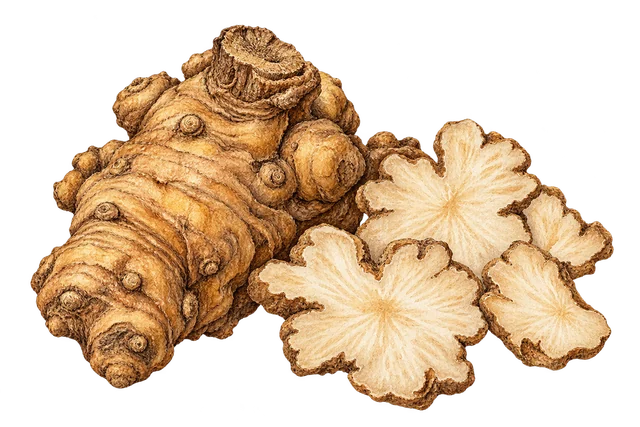
Chuanxiong is a Chinese rhizome medicine for traditional blood-stasis and pain patterns and a component of Si Wu Tang. The pharmaceutical name is retained rather than silently applying an uncertain modern botanical synonym.
Traditional, historical and reported uses
- menstruation
Traditional accountWhy this label?
Tradition is documented. The 78-person Si Wu Tang trial did not show a significant pain advantage at treatment end; it cannot isolate chuanxiong’s contribution.
Recorded for irregular, absent and painful menstruation. Tradition is documented. The 78-person Si Wu Tang trial did not show a significant pain advantage at treatment end; it cannot isolate chuanxiong’s contribution.
- Headache-formula tradition
Traditional accountWhy this label?
HKBU describes chuanxiong as a principal component of Chuan Xiong Cha Tiao San, traditionally used for headache in a particular wind-related pattern. This does not prove that the single rhizome treats migraine or justify self-treatment of a new severe headache.
HKBU describes chuanxiong as a principal component of Chuan Xiong Cha Tiao San, traditionally used for headache in a particular wind-related pattern. This does not prove that the single rhizome treats migraine or justify self-treatment of a new severe headache.
- Bruising and musculoskeletal-pain history
Traditional accountWhy this label?
The material record also lists injury-related swelling and traditional rheumatic-pain use. Those reported aims remain distinct from established clinical efficacy.
The material record also lists injury-related swelling and traditional rheumatic-pain use. Those reported aims remain distinct from established clinical efficacy.
Coverage reflects verified sources, without a minimum use quota.
Story sources
- HKBU materia medica: Szechwan Lovage Rhizome
- Yeh et al. (2007): randomized placebo-controlled Si Wu Tang trial
- HKBU: Tea-Mix and Chuanxiong Powder
- Yi et al. 2016: Constituents of chuanxiong after processing
- Kew POWO: Ligusticum chuanxiong synonym record
- Kew POWO: Conioselinum anthriscoides Chuanxiong, unplaced
Women’s Health: traditions, evidence and cautions
Historical use does not establish benefit or safety. Pregnancy, breastfeeding and fertility care require particular caution: food, tea, essential oil and concentrated extract are not interchangeable. These records are not treatment, dosing or pregnancy-management instructions. Discuss supplements with a qualified clinician or pharmacist; do not delay evaluation of persistent symptoms.
Chuanxiong / Sichuan lovage rhizome
Ligusticum chuanxiong Hort. (pharmaceutical source name)
- Plant part / material
- Dried rhizome (Chuanxiong Rhizoma)
- Preparation studied or reported
- Sliced rhizome in compound decoctions; wine-processed forms are separately described.
Retain Ligusticum chuanxiong Hort. as the pharmaceutical source wording, with a taxonomy note: Kew links the botanically published Ligusticum chuanxiong name to Conioselinum anthriscoides Chuanxiong, currently unplaced. Do not silently replace the drug identity with a confidently accepted synonym.
Chuanxiong is a Chinese rhizome medicine for traditional blood-stasis and pain patterns and a component of Si Wu Tang. The pharmaceutical name is retained rather than silently applying an uncertain modern botanical synonym.
menstruation
Traditional account
Reported or traditional useRecorded for irregular, absent and painful menstruation. Tradition is documented. The 78-person Si Wu Tang trial did not show a significant pain advantage at treatment end; it cannot isolate chuanxiong’s contribution.
What the evidence supportsTradition is documented. The 78-person Si Wu Tang trial did not show a significant pain advantage at treatment end; it cannot isolate chuanxiong’s contribution.
Pregnancy and breastfeeding safety is not established by this traditional record. Do not self-prescribe medicinal preparations when pregnant, trying to conceive, or breastfeeding; obtain clinician review. Chinese, Japanese and Korean pharmaceutical source species should not be silently treated as identical. Pregnancy, trying to conceive and breastfeeding require professional review. Do not use for unexplained bleeding or sudden severe headache in place of urgent assessment. Do not silently substitute Japanese or Korean pharmaceutical source species.
Headache-formula tradition
Traditional account
Reported or traditional useHKBU describes chuanxiong as a principal component of Chuan Xiong Cha Tiao San, traditionally used for headache in a particular wind-related pattern. This does not prove that the single rhizome treats migraine or justify self-treatment of a new severe headache.
What the evidence supportsHKBU describes chuanxiong as a principal component of Chuan Xiong Cha Tiao San, traditionally used for headache in a particular wind-related pattern. This does not prove that the single rhizome treats migraine or justify self-treatment of a new severe headache.
Pregnancy and breastfeeding safety is not established by this traditional record. Do not self-prescribe medicinal preparations when pregnant, trying to conceive, or breastfeeding; obtain clinician review. Chinese, Japanese and Korean pharmaceutical source species should not be silently treated as identical. Pregnancy, trying to conceive and breastfeeding require professional review. Do not use for unexplained bleeding or sudden severe headache in place of urgent assessment. Do not silently substitute Japanese or Korean pharmaceutical source species.
Bruising and musculoskeletal-pain history
Traditional account
Reported or traditional useThe material record also lists injury-related swelling and traditional rheumatic-pain use. Those reported aims remain distinct from established clinical efficacy.
What the evidence supportsThe material record also lists injury-related swelling and traditional rheumatic-pain use. Those reported aims remain distinct from established clinical efficacy.
Pregnancy and breastfeeding safety is not established by this traditional record. Do not self-prescribe medicinal preparations when pregnant, trying to conceive, or breastfeeding; obtain clinician review. Chinese, Japanese and Korean pharmaceutical source species should not be silently treated as identical. Pregnancy, trying to conceive and breastfeeding require professional review. Do not use for unexplained bleeding or sudden severe headache in place of urgent assessment. Do not silently substitute Japanese or Korean pharmaceutical source species.
Retain Ligusticum chuanxiong Hort. as the pharmaceutical source wording, with a taxonomy note: Kew links the botanically published Ligusticum chuanxiong name to Conioselinum anthriscoides Chuanxiong, currently unplaced. Do not silently replace the drug identity with a confidently accepted synonym.
- Pregnancy and breastfeeding safety is not established by this traditional record. Do not self-prescribe medicinal preparations when pregnant, trying to conceive, or breastfeeding; obtain clinician review.
- Chinese, Japanese and Korean pharmaceutical source species should not be silently treated as identical.
- Pregnancy, trying to conceive and breastfeeding require professional review.
- Do not use for unexplained bleeding or sudden severe headache in place of urgent assessment.
- Do not silently substitute Japanese or Korean pharmaceutical source species.
- HKBU materia medica: Szechwan Lovage Rhizome
- Yeh et al. (2007): randomized placebo-controlled Si Wu Tang trial
- HKBU: Tea-Mix and Chuanxiong Powder
- Yi et al. 2016: Constituents of chuanxiong after processing
- Kew POWO: Ligusticum chuanxiong synonym record
- Kew POWO: Conioselinum anthriscoides Chuanxiong, unplaced
Read the complete historical reference and its material distinctions
Identity & detailed reference
Identity
Ligusticum chuanxiong Hort. (pharmaceutical source name); Dried rhizome (Chuanxiong Rhizoma).
Ingredient details, preparation and research
Also known as: chuan xiong; Sichuan lovage rhizome; Chuanxiong Rhizoma
Source plant or material
Ligusticum chuanxiong Hort. (pharmaceutical source name) — Dried rhizome (Chuanxiong Rhizoma)
Plant family / material: Apiaceae (carrot family)
Forms and route
Sliced rhizome in compound decoctions; wine-processed forms are separately described.
Vitamins and minerals
No nutrient quantities or daily-value claims are assigned to this medicinal material. Do not borrow the food nutrient profile of another plant part or use an extract as a dietary substitute.
Absorption and preparation
Preparation and route matter. A tea, whole powder, alcohol extract and isolated constituent can give different exposures. No food pairing or absorption-enhancement technique is established by the sources reviewed.
Traditional and reported uses
- Recorded for irregular, absent and painful menstruation. Tradition is documented. The 78-person Si Wu Tang trial did not show a significant pain advantage at treatment end; it cannot isolate chuanxiong’s contribution.
- HKBU describes chuanxiong as a principal component of Chuan Xiong Cha Tiao San, traditionally used for headache in a particular wind-related pattern. This does not prove that the single rhizome treats migraine or justify self-treatment of a new severe headache.
- The material record also lists injury-related swelling and traditional rheumatic-pain use. Those reported aims remain distinct from established clinical efficacy.
Contraindications and cautions
- Pregnancy and breastfeeding safety is not established by this traditional record. Do not self-prescribe medicinal preparations when pregnant, trying to conceive, or breastfeeding; obtain clinician review.
- Chinese, Japanese and Korean pharmaceutical source species should not be silently treated as identical.
- Pregnancy, trying to conceive and breastfeeding require professional review.
- Do not use for unexplained bleeding or sudden severe headache in place of urgent assessment.
- Do not silently substitute Japanese or Korean pharmaceutical source species.
Similar items and how they compare
- Dong quai
Apiaceae root in the same traditional formula
Angelica sinensis root is not chuanxiong rhizome.
- Japanese or Korean lovage drugs
Similar translated trade names
Source taxa and pharmacopoeial definitions differ.
Identity and composition
Ligusticum chuanxiong Hort. (pharmaceutical source name); Dried rhizome (Chuanxiong Rhizoma). Analytical studies document phthalides and ferulic acid among rhizome constituents; processing changes their profile. Constituent detection is not evidence of a clinical pain benefit.
- HKBU materia medica: Szechwan Lovage Rhizome
- Yeh et al. (2007): randomized placebo-controlled Si Wu Tang trial
- HKBU: Tea-Mix and Chuanxiong Powder
- Yi et al. 2016: Constituents of chuanxiong after processing
- Kew POWO: Ligusticum chuanxiong synonym record
- Kew POWO: Conioselinum anthriscoides Chuanxiong, unplaced
menstruation: what evidence can say
Tradition is documented. The 78-person Si Wu Tang trial did not show a significant pain advantage at treatment end; it cannot isolate chuanxiong’s contribution. Pregnancy and breastfeeding safety is not established by this traditional record. Do not self-prescribe medicinal preparations when pregnant, trying to conceive, or breastfeeding; obtain clinician review.
Exact material and preparation boundaries
Retain Ligusticum chuanxiong Hort. as the pharmaceutical source wording, with a taxonomy note: Kew links the botanically published Ligusticum chuanxiong name to Conioselinum anthriscoides Chuanxiong, currently unplaced. Do not silently replace the drug identity with a confidently accepted synonym.
- HKBU materia medica: Szechwan Lovage Rhizome
- Yeh et al. (2007): randomized placebo-controlled Si Wu Tang trial
- HKBU: Tea-Mix and Chuanxiong Powder
- Yi et al. 2016: Constituents of chuanxiong after processing
- Kew POWO: Ligusticum chuanxiong synonym record
- Kew POWO: Conioselinum anthriscoides Chuanxiong, unplaced
Medicines, pregnancy and breastfeeding
A reliable clinical interaction map for every chuanxiong preparation is not established in the checked primary/traditional sources. Discuss concurrent medicines, particularly when considering multi-herb products. Small formula trials do not demonstrate the safety or efficacy of the rhizome alone or during pregnancy.
- HKBU materia medica: Szechwan Lovage Rhizome
- Yeh et al. (2007): randomized placebo-controlled Si Wu Tang trial
- HKBU: Tea-Mix and Chuanxiong Powder
- Yi et al. 2016: Constituents of chuanxiong after processing
- Kew POWO: Ligusticum chuanxiong synonym record
- Kew POWO: Conioselinum anthriscoides Chuanxiong, unplaced
Processed-rhizome research
HKBU researchers measured changes in major constituents after herbal processing. This supports keeping preparation details visible, not an assumption that every processed form has greater clinical benefit.
Source-supported safety summary
Pregnancy and breastfeeding safety is not established by this traditional record. Do not self-prescribe medicinal preparations when pregnant, trying to conceive, or breastfeeding; obtain clinician review. Chinese, Japanese and Korean pharmaceutical source species should not be silently treated as identical. Pregnancy, trying to conceive and breastfeeding require professional review. Do not use for unexplained bleeding or sudden severe headache in place of urgent assessment. Do not silently substitute Japanese or Korean pharmaceutical source species.
- HKBU materia medica: Szechwan Lovage Rhizome
- Yeh et al. (2007): randomized placebo-controlled Si Wu Tang trial
- HKBU: Tea-Mix and Chuanxiong Powder
- Yi et al. 2016: Constituents of chuanxiong after processing
- Kew POWO: Ligusticum chuanxiong synonym record
- Kew POWO: Conioselinum anthriscoides Chuanxiong, unplaced
Evidence limits
- This is a focused educational source review, not a systematic review or a treatment plan.
- Traditional use documents a practice; it does not establish clinical benefit. Laboratory findings and multi-ingredient trials cannot establish a single ingredient’s effects.
- Kew currently marks Conioselinum anthriscoides Chuanxiong as unplaced; botanical placement is qualified.
- Direct university material/full-study PDFs were blocked; indexed official text was read. No dose or home processing instructions copied.
Entry sources
- HKBU materia medica: Szechwan Lovage Rhizome
- Yeh et al. (2007): randomized placebo-controlled Si Wu Tang trial
- HKBU: Tea-Mix and Chuanxiong Powder
- Yi et al. 2016: Constituents of chuanxiong after processing
- Kew POWO: Ligusticum chuanxiong synonym record
- Kew POWO: Conioselinum anthriscoides Chuanxiong, unplaced
Reference entry 540 · Recorded content review: 2026-10-11 · Review scope and dates