


Key cautions
- Do not ingest cedar oil or wood tar, or apply unstandardized tar to wounds or animals as a home treatment. Laboratory pest tests do not establish safe human or veterinary use.
- Check the scientific name, plant part and extraction on any cedar product. Cedrus libani, Atlas cedar, juniper and thuja products are not interchangeable.
What’s inside
The wood contains structural cellulose and lignin plus aromatic extractives. Analytical studies of Cedrus libani oils and tars identify variable sesquiterpenes, including himachalene/himachalane-related compounds, longifolene and atlantones. Plant part and heating process materially change the profile; tar data do not define a distilled oil.
Uses in brief

- Historical timber for major buildings and ships, and cedar wood in biblical purification ceremonies.
- Traditional Taurus-region cedar tar was used as a wood preservative and in folk human and animal care; these are historical practices.
In the King James Bible
In the King James Bible
Named material
Psalm 104:16 explicitly names the cedars of Lebanon; Leviticus 14:4 calls for cedar wood in ritual cleansing. The Lebanon tree is identified with Cedrus libani, but the exact species in a general cedar-wood instruction is not guaranteed. These are references to trees and wood, not evidence for Atlas cedarwood essential oil.
The trees of the LORD are full of sap; the cedars of Lebanon, which he hath planted;
Psalm 104:16 (KJV)
Then shall the priest command to take for him that is to be cleansed two birds alive and clean, and cedar wood, and scarlet, and hyssop:
Leviticus 14:4 (KJV)
Scripture and identification sources
Words & their stories
WORDS & THEIR STORIES
The name behind the KJV
Biblical Hebrew · Psalm 104:16 (KJV)
אַרְזֵי לְבָנוֹןʾarzē ləbānōn
Cedars of Lebanon.
Dictionary form: אֶרֶז · לְבָנוֹן · ʾerez · ləbānōn
ʾArzē is the plural linking form of ʾerez, cedar.
Biblical Hebrew · Leviticus 14:4 (KJV)
וְעֵץ אֶרֶזwəʿēṣ ʾerez
And cedar wood, one material in the cleansing rite.
Dictionary form: עֵץ · אֶרֶז · ʿēṣ · ʾerez
ʿĒṣ can mean tree or wood; the ritual context specifies wood.
What the language reveals
Living tree and ritual wood
Psalm 104 presents living cedars within creation; Leviticus requires cedar wood with other ritual materials. Neither passage calls for an extracted cedar oil.
Cedrus libani fits the cedars of Lebanon, but the broad ancient cedar name should not authenticate every modern product sold as cedarwood.
History, folklore and reported uses
History, folklore and traditional uses
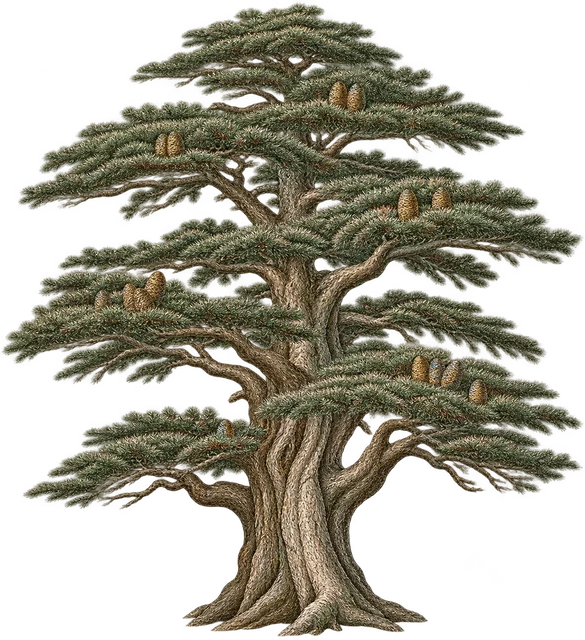
Cedar of Lebanon carries a history measured in beams and mountain forests. Its fragrant, durable wood was important enough to move from the hills to the coast and onward for royal building projects. Biblical descriptions of Solomon’s work made the tree an enduring image of stature and abundance. The living tree is Cedrus libani, a conifer whose clustered needles and upright cones distinguish it from the many unrelated plants later given the English name cedar.
A different cedar tradition survives in the Taurus Mountains of southern Türkiye. Field researchers documented villagers producing katran, a dark wood tar used to protect wood and in local human and animal remedies. That material is neither a biblical anointing oil nor a modern steam-distilled cedarwood oil. The continuity lies in people valuing a strongly aromatic tree; the preparations, purposes and evidence remain separate.
Traditional, historical and reported uses
- Temple and palace timber
Historical recordWhy this label?
Biblical building accounts supply the historical claim.
Biblical accounts describe cedar as a prestigious building material, including royal houses and Solomon’s temple. Its grain, fragrance and resistance to decay explain the long association with enduring structures.
- Shipbuilding
Food or household practiceWhy this label?
Practical timber use in shipbuilding; the research article is contextual.
Researchers discussing traditional Cedrus libani use record timber in houses and ships. This is a practical material use of wood, distinct from burning it or processing it into tar.
- Ritual purification
Historical recordWhy this label?
Leviticus supplies an explicit written ritual-use record.
Leviticus 14 names cedar wood in a purification ceremony. The ritual context is explicit, but the verse alone does not guarantee which modern species supplied every piece of cedar wood.
- Protecting wooden structures
Food or household practiceWhy this label?
Fieldwork records wood-protection craft practice.
Kurt and colleagues’ Taurus fieldwork records cedar tar used on wood against insects and fungi. This local craft use was one reason for processing resinous wood into katran.
- Folk wound and parasite care
Traditional accountWhy this label?
Fieldwork records local human and veterinary folk remedies.
The same field study documents katran in traditional remedies for wounds and parasites in people and domestic animals. These observations preserve local practice; they do not establish a safe home skin, wound or veterinary treatment.
Story sources
- Kew Plants of the World Online: Cedrus libani A.Rich.
- Kurt, Kaçar and Işık (2008): Traditional tar production from Cedrus libani on the Taurus Mountains
- Kilic Pekgozlu et al. (2017): Chemical characterization of Lebanon cedar tar
- Exploring the larvicidal and repellent potential of Taurus cedar tar against the brown dog tick (2023)
- Composition and alpha-amylase inhibitory effect of essential oils from Cedrus libani (2007)
- Lytton John Musselman, Old Dominion University: Cedar of Lebanon
- The King James Bible: Project Gutenberg ebook 10
Identity & detailed reference
Identity
Cedar of Lebanon is Cedrus libani, a true cedar of the eastern Mediterranean. The specific cedars of Lebanon are distinguished from a general biblical reference to cedar wood. Modern Atlas cedarwood oil and oils of junipers or thujas called cedar belong to different botanical materials.
Ingredient details, preparation and research
Also known as: Lebanon cedar; Taurus cedar
Source plant or material
Cedar of Lebanon is Cedrus libani, a true cedar of the eastern Mediterranean. The specific cedars of Lebanon are distinguished from a general biblical reference to cedar wood. Modern Atlas cedarwood oil and oils of junipers or thujas called cedar belong to different botanical materials.
Plant family / material: Pinaceae (pine family)
Forms and route
Living tree, timber and aromatic wood; separately, distilled wood/leaf/cone oils and traditional wood tar called katran. Tar is obtained through heating wood and differs from steam-distilled oil. None is presented here as an edible herb or household medicine.
Vitamins and minerals
Cedar timber, resinous wood, tar and essential oil have no appropriate dietary nutrient serving. The presence of plant minerals or organic compounds does not make these materials vitamin, mineral or fibre supplements.
Absorption and preparation
There is no established human medicinal absorption target or food-pairing strategy for cedar wood, tar or oil. Laboratory effects on enzymes or tick larvae do not establish an effective or safe absorbed dose in people or pets.
Traditional and reported uses
- Historical timber for major buildings and ships, and cedar wood in biblical purification ceremonies.
- Traditional Taurus-region cedar tar was used as a wood preservative and in folk human and animal care; these are historical practices.
Contraindications and cautions
- Do not ingest cedar oil or wood tar, or apply unstandardized tar to wounds or animals as a home treatment. Laboratory pest tests do not establish safe human or veterinary use.
- Check the scientific name, plant part and extraction on any cedar product. Cedrus libani, Atlas cedar, juniper and thuja products are not interchangeable.
- Medicinal safety is not established for pregnancy, breastfeeding or children. Do not infer it from cedar’s biblical or traditional use.
Similar items and how they compare
- Atlas cedarwood essential oil
Another aromatic true-cedar product.
The existing Atlas card concerns a different source and a distilled preparation, not biblical Cedrus libani timber.
- Juniper / red cedar
Some junipers are called cedars in English.
A common name does not make their foliage, berries or oils the same as Lebanon cedar.
True cedar and cedar-labelled products
Kew recognizes Cedrus libani in Pinaceae, native from southern Türkiye to Lebanon. The common word cedar also covers plants outside this genus. Evidence for Atlas cedar oil, red cedar or thuja cannot be transferred automatically to Lebanon cedar.
Wood, oil and tar
Cedar wood is a structural plant material; essential oil is a distilled fraction; katran is a heat-produced wood extract. A study comparing traditional and retort processing found different tar profiles, while separate research analysed oils from wood, leaves and cones. These are analytically distinct products.
What present research actually tested
A 2023 study exposed tick larvae to cedar tar in laboratory assays. Other work tested cedar oils against alpha-amylase in vitro. These results are useful for investigation, but neither establishes treatment for diabetes, parasites or skin disease in a person.
Traditional medicine and its limits
Taurus fieldwork records both external and internal folk applications of katran. Ethnobotanical documentation is evidence that a practice occurred, not evidence that swallowing tar or treating a wound with it is safe.
Nutrition and absorption
There is no food serving or verified nutritional benefit assigned to the wood, tar or volatile oil. An aromatic constituent detected by gas chromatography is not a vitamin claim, and an enzyme assay cannot determine a safe human dose.
Sourcing and conservation
The history of heavy timber demand is part of the cedar’s story. Prefer traceable, lawful sources and distinguish cultivated wood or documented by-products from destructive wild harvesting. The biblical prestige of the tree is no reason to remove material from protected groves.
Evidence limits
- Species-level certainty is stronger for “cedars of Lebanon” than for every general cedar-wood reference.
- Traditional tar, wood and distilled oils are separate materials.
- The cited modern studies are laboratory or ethnobotanical work, not proof of clinical efficacy.
Entry sources
- Kew Plants of the World Online: Cedrus libani A.Rich.
- Kurt, Kaçar and Işık (2008): Traditional tar production from Cedrus libani on the Taurus Mountains
- Kilic Pekgozlu et al. (2017): Chemical characterization of Lebanon cedar tar
- Exploring the larvicidal and repellent potential of Taurus cedar tar against the brown dog tick (2023)
- Composition and alpha-amylase inhibitory effect of essential oils from Cedrus libani (2007)
- Lytton John Musselman, Old Dominion University: Cedar of Lebanon
- The King James Bible: Project Gutenberg ebook 10
Reference entry 120 · Recorded content review: 2026-10-06 · Review scope and dates