


Key cautions
- Do not treat “balm of Gilead” on a label as proof of species, ingredients or medical suitability.
- Jeremiah’s healing language is not evidence that a modern balm cures wounds or illness.
- Burning candidate resins as incense produces airborne particles that can aggravate asthma and reduce lung function. Reduce smoke exposure; if incense is burned indoors, ensure ventilation. An incense tradition does not establish that inhaling its smoke is safe.
- If a product sold as balm or balsam is an essential oil, do not swallow it or assume it is suitable for treating inflamed skin. Essential oils can irritate skin and can cause serious harm if they enter the lungs. After accidental swallowing, do not induce vomiting; contact a poison center immediately with the product label. These are general oil precautions, not a toxicity profile for biblical balm.
What’s inside
No characteristic constituent list is established for biblical balm. Chemical measurements from any modern Commiphora or Cistus candidate remain measurements of that candidate.
Lytton John Musselman, Old Dominion University: Cistus and the balm of Gilead · Sallon et al. (2024): Characterization and analysis of a Commiphora species germinated from an ancient seed · Dafni and Böck (2019): Medicinal plants of the Bible—revisited
The germinated Commiphora specimen
The plant nicknamed Sheba had little or no detectable scent. Headspace analysis of its young leaves and stems found only small amounts of volatile compounds, mainly alpha- and beta-pinene. This is evidence about one living specimen, not an authenticated sample of biblical balm.
Leaf extracts are not resin or a skin product
A hexane extract of Sheba’s leaves and stems contained squalene, alpha-tocopherol and alpha- and beta-amyrin confirmed against commercial standards. Other assignments were tentative, and some compounds remained unidentified. Resin underwent separate solvent extractions; much of it stayed undissolved. These laboratory fractions do not supply a whole-resin composition, a food value or evidence of benefit in people.
Uses in brief

- Biblical traded gift material and a familiar image of hoped-for healing.
- Some candidate resins have their own incense or perfumery histories; those do not resolve the biblical identity.
In the King James Bible
In the King James Bible
Uncertain botanical connection
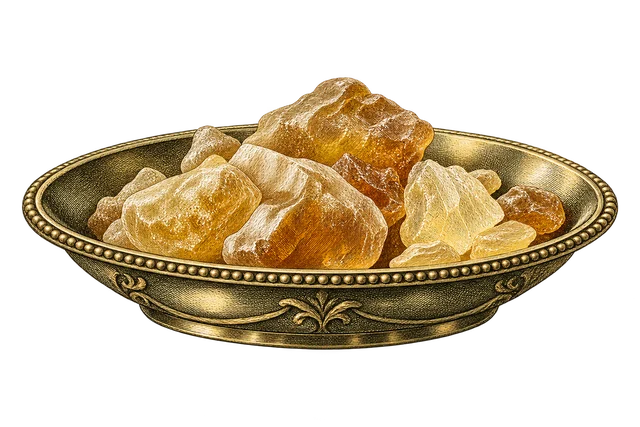
Balm travels from Gilead toward Egypt in Genesis and becomes an image of hoped-for healing in Jeremiah. Its source remains unresolved: Commiphora and Cistus are among the proposals, while modern research also questions whether the biblical material was necessarily fragrant. The name does not establish lemon balm, Melissa officinalis.
Is there no balm in Gilead; is there no physician there? why then is not the health of the daughter of my people recovered?
Jeremiah 8:22 (KJV)
And they sat down to eat bread: and they lifted up their eyes and looked, and, behold, a company of Ishmeelites came from Gilead with their camels bearing spicery and balm and myrrh, going to carry it down to Egypt.
Genesis 37:25 (KJV)
Scripture and identification sources
- King James Bible: Jeremiah 8:22
- King James Bible: Genesis 37:25
- Project Gutenberg: The King James Version of the Bible, ebook 10
- Lytton John Musselman, Old Dominion University: Cistus and the balm of Gilead
- Sallon et al. (2024): Characterization and analysis of a Commiphora species germinated from an ancient seed
- Dafni and Böck (2019): Medicinal plants of the Bible—revisited
Words & their stories
WORDS & THEIR STORIES
The name behind the KJV
Biblical Hebrew · Jeremiah 8:22 (KJV)
הַצֳּרִיhaṣṣŏrī
Balm, invoked with a physician in a question about the people’s recovery.
Dictionary form: צֳרִי · צְרִי · ṣŏrī · ṣərī
The prefixed ha- frames the question; the noun has more than one attested vowel form.
Biblical Hebrew · Genesis 37:25 (KJV)
וּצְרִיūṣərī
And balm, carried by the caravan from Gilead.
Dictionary form: צֳרִי · צְרִי · ṣŏrī · ṣərī
Ū- means “and.” The same material-name belongs here to a list of traded goods.
What the language reveals
Trade and a healing metaphor
Genesis presents balm as merchandise. Jeremiah draws on the familiar association of balm and healing to express a national crisis; this is not evidence of modern therapeutic efficacy.
The term denotes a kind of balsam or resin, with disputed botanical identity. It cannot securely identify a modern “balm of Gilead” product or a distilled oil.
Language and identification bibliography
History, folklore and reported uses
Balm in commerce and lament
Balm travels through Genesis as a valuable commodity: a caravan carries it from Gilead toward Egypt, and Jacob later includes a little balm among the gifts his sons take there. Jeremiah gives the substance a more searching role. His question about balm and a physician turns a familiar hope of healing into an image of a people’s unresolved suffering. These scenes show balm’s economic value and its powerful association with healing, while leaving its plant source undescribed.
King James Bible: Genesis 37:25 · King James Bible: Genesis 43:11 · King James Bible: Jeremiah 8:22
The search for the source plant
The search for that plant remains open. Cistus resin has been proposed from the ecology of Gilead, while other scholars favor a Commiphora connection. A 2024 study of a roughly thousand-year-old germinated seed identified an unusual Commiphora and proposed a possible link to biblical tsori; the authors did not establish that identification and rejected their original idea that it was the famous fragrant Judean balsam. The finding sharpens an important distinction: an ancient healing resin, a celebrated perfume and a modern product sharing the word “balm” need not all be the same thing.
Lytton John Musselman, Old Dominion University: Cistus and the balm of Gilead · Sallon et al. (2024): Characterization and analysis of a Commiphora species germinated from an ancient seed · Dafni and Böck (2019): Medicinal plants of the Bible—revisited
Trade and gift exchange
Genesis 37:25 places balm in a caravan bound for Egypt; Genesis 43:11 includes it in a gift. Ezekiel 27:17 also names balm among traded goods.
King James Bible: Genesis 37:25 · King James Bible: Genesis 43:11 · King James Bible: Ezekiel 27:17
A healing substance in prophetic imagery
Jeremiah 8:22, 46:11 and 51:8 evoke balm in relation to wounds and healing, drawing on a familiar medicinal reputation in prophetic poetry.
King James Bible: Jeremiah 8:22 · King James Bible: Jeremiah 46:11 · King James Bible: Jeremiah 51:8
Candidate labdanum in incense
Musselman records the incense tradition of Cistus resin while proposing it as a balm candidate. This is a separately documented use of a possible source, not a verified biblical recipe.
Lytton John Musselman, Old Dominion University: Cistus and the balm of Gilead
Candidate Cistus resin in skin remedies
Musselman also records Cistus resin in traditional external balms for inflamed skin. This belongs to the proposed labdanum candidate and remains separate from identifying the material in Jeremiah.
Lytton John Musselman, Old Dominion University: Cistus and the balm of Gilead
Gilead and the Cistus proposal
Gilead is the region east of the Jordan associated with balm in these accounts. Musselman’s proposal draws on Cistus shrubs growing in its pine-forest landscape and their sticky resin. His account describes collecting resin from grazing goats’ hair or with leather-tined rakes; those collection traditions concern the candidate resin, not instructions preserved in Jeremiah.
Lytton John Musselman, Old Dominion University: Cistus and the balm of Gilead
Scent is a separate question
The cited Genesis, Ezekiel and Jeremiah passages mention trade, gifts or healing without describing balm’s scent. Fragrance observed in a modern Cistus candidate cannot fill that gap in the biblical text.
King James Bible: Genesis 37:25 · King James Bible: Genesis 43:11 · King James Bible: Ezekiel 27:17 · King James Bible: Jeremiah 8:22 · King James Bible: Jeremiah 46:11 · King James Bible: Jeremiah 51:8 · Lytton John Musselman, Old Dominion University: Cistus and the balm of Gilead
A resin name without a settled species
The disagreement is substantive: Musselman proposes Cistus, whereas other biblical-botanical research considers Commiphora. This card therefore retains an unidentified material rather than selecting one family’s chemistry.
Lytton John Musselman, Old Dominion University: Cistus and the balm of Gilead · Dafni and Böck (2019): Medicinal plants of the Bible—revisited
What the ancient seed study changes
Sallon and colleagues dated the seed to 993–1202 CE and identified the resulting plant within Commiphora. Its proposed association with tsori is a hypothesis, not direct recovery of a biblical-period balm or a demonstration of medical benefit.
Reading the healing language
The quoted Jeremiah verse is a question in a prophetic lament. Its force depends on balm’s healing reputation, but it does not specify how to make or use a medicine.
Identity & detailed reference
Identity
Biblical balm translates an ancient valuable substance associated with healing and trade, often understood as a resinous balm. Its botanical source is unresolved, and its frequently assumed fragrance is not established by the cited biblical passages.
Ingredient details, preparation and research
Also known as: Balm of Gilead (biblical expression); Tsori / tseri (transliterations)
Source plant or material
The plant source of Hebrew tsori/tseri is disputed. Aromatic Judean balsam, Cistus labdanum and the medicinal balm in biblical poetry cannot simply be collapsed into one proven species.
Plant family / material: Unresolved; Commiphora candidates are Burseraceae and Cistus candidates are Cistaceae.
Forms and route
An ancient traded balm or resinous preparation of uncertain identity. Modern products called balm, balsam, balm of Gilead or lemon balm are not automatically the same material.
Vitamins and minerals
This is a historical-material entry, not a dietary recommendation. The biblical name supplies no dependable modern food identity, serving size or vitamin/mineral values.
Absorption and preparation
No absorption guidance or medicinal dose is assigned to this uncertain ancient material. A modern product would require its own verified identity, preparation and safety assessment.
Traditional and reported uses
- Biblical traded gift material and a familiar image of hoped-for healing.
- Some candidate resins have their own incense or perfumery histories; those do not resolve the biblical identity.
Contraindications and cautions
- Do not treat “balm of Gilead” on a label as proof of species, ingredients or medical suitability.
- Jeremiah’s healing language is not evidence that a modern balm cures wounds or illness.
- Burning candidate resins as incense produces airborne particles that can aggravate asthma and reduce lung function. Reduce smoke exposure; if incense is burned indoors, ensure ventilation. An incense tradition does not establish that inhaling its smoke is safe.
- If a product sold as balm or balsam is an essential oil, do not swallow it or assume it is suitable for treating inflamed skin. Essential oils can irritate skin and can cause serious harm if they enter the lungs. After accidental swallowing, do not induce vomiting; contact a poison center immediately with the product label. These are general oil precautions, not a toxicity profile for biblical balm.
Similar items and how they compare
- Lemon balm
It shares the common English word “balm.”
Melissa officinalis is a modern named herb, not an established identification of biblical balm.
- Myrrh
Both are discussed as ancient resinous materials.
The KJV names balm and myrrh separately in Genesis 37:25.
Evidence limits
- Ancient names do not provide a verified modern species or product specification.
- Historical practice is recorded as history and does not establish present-day medical benefit or safety.
Entry sources
- Lytton John Musselman, Old Dominion University: Cistus and the balm of Gilead
- Sallon et al. (2024): Characterization and analysis of a Commiphora species germinated from an ancient seed
- Dafni and Böck (2019): Medicinal plants of the Bible—revisited
- King James Bible: Jeremiah 8:22
- King James Bible: Genesis 37:25
- Project Gutenberg: The King James Version of the Bible, ebook 10
- King James Bible: Genesis 43:11
- King James Bible: Ezekiel 27:17
- King James Bible: Jeremiah 46:11
- King James Bible: Jeremiah 51:8
Reference entry 115 · Recorded content review: 2026-10-06 · Review scope and dates