


Key cautions
- Avoid if you have reacted to dill; allergic reactions can occur, particularly in people sensitive to related Apiaceae herbs.
- Do not give homemade dill oil or concentrated gripe-water remedies to an infant. Feeding problems, persistent crying or poor milk supply deserve qualified assessment.
What’s inside
Seed volatile oil includes carvone and limonene, with other terpenes and phenolics. Leaf and seed profiles differ. Whole fresh leaves contain water, small amounts of fiber and micronutrients; essential oil does not contain the whole-leaf nutrient package.
Uses in brief

- Season fresh foods, fish, potatoes, eggs and cucumber dishes; seed and flower heads also flavor pickles.
- Traditionally used for wind, stomach discomfort and hiccups.
- Historically used in nursing and infant-soothing preparations; these uses need separate safety and efficacy assessment.
In the King James Bible
In the King James Bible
Probable botanical identification
Matthew 23:23 says anise in the KJV. The underlying herb name is generally identified with dill, Anethum graveolens, rather than the modern anise plant, but the precise ancient species is not demonstrable. It is one of the small garden crops being tithed; the passage emphasizes judgment, mercy and faith.
Woe unto you, scribes and Pharisees, hypocrites! for ye pay tithe of mint and anise and cummin, and have omitted the weightier matters of the law, judgment, mercy, and faith: these ought ye to have done, and not to leave the other undone.
Matthew 23:23 (KJV)
Scripture and identification sources
Words & their stories
WORDS & THEIR STORIES
The name behind the KJV
Koine Greek · Matthew 23:23 (KJV)
ἄνηθονánēthon
Dill, rendered “anise” in the KJV.
Dictionary form: ἄνηθον · ánēthon
The neuter accusative form looks the same as the dictionary form. The Greek is checked in Scrivener’s 1894 Textus Receptus.
What the language reveals
A translation-era name
The KJV’s “anise” should be read alongside the Greek plant name rather than used to equate dill with modern culinary anise.
Small produce, weighty obligations
Dill appears with mint and cumin in criticism of meticulous tithing that overlooks justice, mercy and faith. The passage supplies no medicinal recipe.
Dill is the conventional identification of ánēthon; the verse does not identify Pimpinella anisum or an essential oil.
Language and identification bibliography
History, folklore and reported uses
Two harvests from one plant
Soft foliage can be snipped while dill is young. Yellow flower heads later mature into fragrant seed, providing a second harvest. Leaves, seed heads and ripe seed flavour pickles, while northern European food traditions pair leafy dill with fish.
Royal Horticultural Society: How to Grow Dill · Herb Society of America: Essential Guide to Dill, history, culinary use, medicinal use and folklore
A small biblical connection
Matthew’s King James Version text names “anise” among herbs given as a tithe. Dill is the probable identification, but the ancient plant name does not guarantee a modern species.
Pliny’s digestive and hiccup remedies
Book XX, chapter 74 of Pliny’s Natural History describes dill for gas, abdominal cramps and indigestion. The same chapter records smelling heated dill seed for hiccups, a historical practice rather than a steaming remedy.
Bedtime, nursing and good fortune
The Herb Society records Greek sleep customs and a later Dutch bedtime drink of dill in warm milk, alongside household-protection and wedding lore. Dill was also used as a milk-promoting herb in several traditions; LactMed separately evaluates the limited human evidence.
Herb Society of America: Essential Guide to Dill, history, culinary use, medicinal use and folklore · NIH LactMed: Dill, revised May 15, 2025
Women’s Health: traditions, evidence and cautions
Historical use does not establish benefit or safety. Pregnancy, breastfeeding and fertility care require particular caution: food, tea, essential oil and concentrated extract are not interchangeable. These records are not treatment, dosing or pregnancy-management instructions. Discuss supplements with a qualified clinician or pharmacist; do not delay evaluation of persistent symptoms.
Dill fruit
Anethum graveolens L.
- Plant part / material
- Ripe fruit, commonly called seed
- Preparation studied or reported
- Culinary fruit, teas and multi-herb preparations; leaf is a different material.
LactMed cites Indian and traditional Persian lactation literature; this does not establish a uniform custom throughout either region.
Lactation / milk-supply tradition
Insufficient single-herb evidence; combination-product signal
Reported or traditional useDill fruit preparations have a milk-supply reputation.
What the evidence supportsNo convincing dill-only clinical proof exists. One old constituent study was negative; a newer Indian multi-herb trial was positive but cannot isolate dill.
Carvone can reach milk. Culinary use and experimentally studied combinations do not establish safety of concentrated dill preparations in pregnancy or nursing infants.
- The cited lactation evidence does not establish medicinal-use safety during pregnancy; postpartum traditions must not be extrapolated to pregnancy.
Regional reading paths
These sourced notes describe cultivation, trade, food traditions or material history. A regional connection does not claim exclusive origin.
Europe
Cultivated and traditional processing: Poland, including Rogowo cucumber ferment traditions.
Aromatic foliage and flowering heads season pickles; seed is a separate harvest stage.
Identity & detailed reference
Identity
Anethum graveolens L., an aromatic annual. The word “anise” in the King James Version of the Bible is usually interpreted as dill, rather than modern anise, Pimpinella anisum.
Ingredient details, preparation and research
Also known as: Dill weed; Dill seed (botanically the dried fruit); KJV anise (probable dill identification)
Source plant or material
Anethum graveolens L., an aromatic annual. The KJV word anise is usually interpreted as dill; it does not establish modern anise, Pimpinella anisum. Parts used: Fresh or dried leaves and tender stems (dill weed); ripe dried fruits, commonly called seeds; edible flowers and seed heads.
Plant family / material: Apiaceae (carrot or parsley family)
Forms and route
Fresh herb, dried leaf, whole or ground seed, culinary vinegar and pickling herb. Infusions and proprietary extracts also occur. Distilled seed oil and dill-weed oil are concentrated, compositionally different products.
Vitamins and minerals
USDA fresh dill: 5 sprigs weigh about 1 g (0.04 oz) and supply approximately 0.4 kcal, 0.02 g fiber, 0.85 mg vitamin C, 2.1 mg calcium and 0.07 mg iron. A cup of loose sprigs is only 8.9 g (0.31 oz) in this record. A garnish therefore contributes little nutrition. Dried seed, dried leaf, tea and oil require their own data.
Absorption and preparation
The whole eaten herb supplies nutrients; a strained infusion does not retain all its fiber or minerals, and distilled oil is a different fraction. No established human absorption-enhancing combination or universal medicinal dose is identified here. Culinary pairings are for flavor.
Practical preparation
Wash the fresh herb, use leaves promptly and store dried material airtight. Use food-grade seed, not seed treated for sowing. Add delicate leaves near serving; whole seeds tolerate longer cooking. Follow a tested pickling recipe for preservation safety.
Combination notes
Fish, cucumber, potatoes and yogurt are culinary companions. Combining dill with other herbs in a study or traditional formula does not establish an effect for dill alone.
Traditional and reported uses
- Season fresh foods, fish, potatoes, eggs and cucumber dishes; seed and flower heads also flavor pickles.
- Traditionally used for wind, stomach discomfort and hiccups.
- Historically used in nursing and infant-soothing preparations; these uses need separate safety and efficacy assessment.
Contraindications and cautions
- Avoid if you have reacted to dill; allergic reactions can occur, particularly in people sensitive to related Apiaceae herbs.
- Do not give homemade dill oil or concentrated gripe-water remedies to an infant. Feeding problems, persistent crying or poor milk supply deserve qualified assessment.
- Food use does not establish the safety of concentrated extracts during pregnancy or breastfeeding; check the actual product with a clinician.
- Culinary dill is not a safe identification guide for wild carrot-family plants; use a positively identified food crop.
Similar items and how they compare
- Fennel, sweet
A related aromatic Apiaceae seed and digestive tradition.
Fennel has a more anise-like flavor; its chemistry and medicinal guidance cannot be assigned to dill.
- Coriander (seed and cilantro leaf)
Another plant with different leaf and seed kitchen roles.
Coriander seed is more citrus-like; its leaf and seed identities remain separate.
- Modern anise, Pimpinella anisum
Shares the English name used by the KJV translation.
Modern anise is a different plant, not the default botanical identification of Matthew 23:23.
Identity, plant parts and the Bible
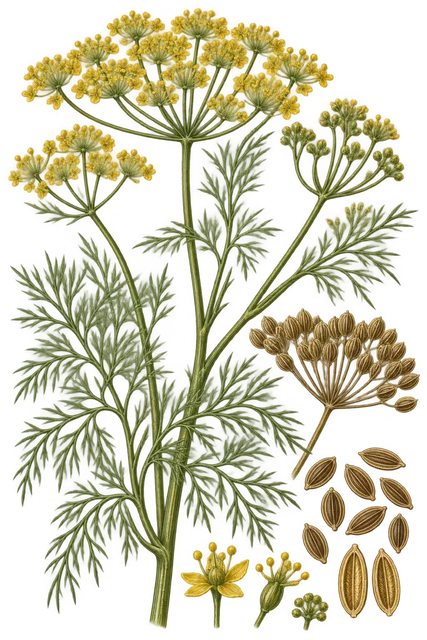
Dill is an annual Apiaceae plant with fine foliage and yellow flower umbels. The kitchen seed is botanically a dried fruit. The King James Version of the Bible uses the word “anise”; botanical commentary generally identifies it as dill while acknowledging related regional plants. The verse concerns tithing and moral priorities, not an herbal prescription.
Food, tradition and modern evidence
Pliny recorded digestive and hiccup remedies. Later accounts add dill water and nursing traditions. LactMed finds no scientifically valid clinical evidence that dill alone increases milk production; evidence from mixed products cannot isolate its contribution. This does not diminish its well-established use as food.
Composition and preparation
Seed oil contains carvone and limonene. Leaf, fruit, water extract and distilled oil differ in composition and concentration, so an oil study or laboratory antioxidant test is not evidence for the effects of a sprig of fresh dill.
Practical cautions
Dill is generally recognized as safe for food use, but allergy is possible. Concentrated oils and infant remedies require a different risk assessment. Do not use a historical account as dosing instructions for a baby or as a substitute for breastfeeding support.
Nutrients at the amount actually eaten
The USDA reference portion of five fresh sprigs is about one gram. Its vitamin and mineral contribution is small; larger per-100-gram figures would be misleading for a garnish. Fresh-leaf values do not describe dill seed, pickled cucumber or strained tea.
Evidence limits
- Evidence about dill mixtures or isolated carvone cannot establish an effect for culinary dill alone.
- Infant remedies, oils and lactation supplements require product-specific assessment.
Entry sources
- USDA GRIN-Global: Anethum graveolens L.
- Royal Horticultural Society: How to Grow Dill
- Herb Society of America: Essential Guide to Dill, history, culinary use, medicinal use and folklore
- Pliny the Elder: Natural History, Book XX; Bostock and Riley translation (1856), public-domain primary historical text
- NIH LactMed: Dill, revised May 15, 2025
- USDA FoodData Central, SR Legacy: Dill weed, fresh (FDC 172233)
- Lytton John Musselman, Old Dominion University: Dill
- King James Bible, public-domain complete text, Project Gutenberg eBook 10
- King James Bible: Matthew 23:23
Reference entry 114 · Recorded content review: 2026-10-06 · Review scope and dates