


Key cautions
- Separate local rinses/tinctures, swallowed products and essential oil
- Allergy/alcohol irritation; seek advice for pregnancy, children, medicines or persistent symptoms
What’s inside
Oleo-gum-resin is the name for the whole aromatic exudate. Its chemical fractions help explain why water, alcohol and distillation yield different preparations.
EMA: Final assessment report on Commiphora molmol gum-resin · FAO: Flavours and fragrances of plant origin, chapter 9
Gum, resin and volatile fractions
Myrrh contains a water-soluble gum fraction, resin and a smaller volatile fraction. Analytical work identifies furanosesquiterpenes such as furanoeudesma-1,3-diene, curzerene and isofuranodiene; profiles vary among commercial samples and with processing. The 2025 chemical study examined insect effects, not human dental or digestive efficacy. Distillation removes the whole-resin matrix and cannot reproduce a labeled extract merely because the aroma is similar.
Spinozzi et al. (2025): Myrrh volatile furanosesquiterpenes; mosquito laboratory study · Primary analytical study: Variation among 17 commercial myrrh samples
How extraction changes the material
IFF’s named myrrh resinoid uses ethanol extraction followed by molecular distillation. This industrial fragrance process is different from the medicinal tincture assessed by EMA, which uses one part herbal substance to five parts extraction solvent, with ethanol at 90% by volume. These are manufacturing specifications, not instructions for a home rinse.
IFF LMR Naturals: Myrrh Resinoid MD · EMA: Final Community herbal monograph on Commiphora molmol gum-resin
Uses in brief

- Traditional labeled local mouth/skin preparations
- Preliminary product-specific dental-gel/rinse studies; aromatic resin/perfume use
In the King James Bible
Myrrh in the KJV
Named material
Myrrh appears in the sacred anointing oil in Exodus and as “oil of myrrh” in Esther’s account of preparation for the Persian king. Myrrh is a fragrant Commiphora resin; the ancient oil preparation is not identified as a modern distilled essential oil.
Take thou also unto thee principal spices, of pure myrrh five hundred shekels, and of sweet cinnamon half so much, even two hundred and fifty shekels, and of sweet calamus two hundred and fifty shekels,
Exodus 30:23 (KJV)
Now when every maid’s turn was come to go in to king Ahasuerus, after that she had been twelve months, according to the manner of the women, (for so were the days of their purifications accomplished, to wit, six months with oil of myrrh, and six months with sweet odours, and with other things for the purifying of the women;)
Esther 2:12 (KJV)
Scripture and identification sources
Words & their stories
WORDS & THEIR STORIES
The name behind the KJV
Biblical Hebrew · Exodus 30:23 (KJV)
מָר־דְּרוֹרmār-dərōr
The myrrh ingredient rendered “pure myrrh” by the KJV.
Dictionary form: מֹר · דְּרוֹר · mōr · dərōr
Mār is a linking form of mōr. The phrase is also understood as flowing myrrh; it should not be turned into a modern purity specification.
Biblical Hebrew · Esther 2:12 (KJV)
בְּשֶׁמֶן הַמֹּרbəšemen hammōr
“With oil of myrrh,” in the women’s preparation for the king.
Dictionary form: שֶׁמֶן · מֹר · šemen · mōr
Bə- means “with” here; ha- marks “the” before myrrh. The wording names an oil preparation without specifying its manufacturing process.
What the language reveals
Two settings for an aromatic
Exodus describes an ingredient of sacred anointing oil; Esther describes a royal preparation. Neither passage establishes modern essential-oil distillation.
Myrrh is associated with Commiphora resin, but the words do not fix a species, extraction method or clinical benefit.
History, folklore and reported uses
Accepted plant and harvested material
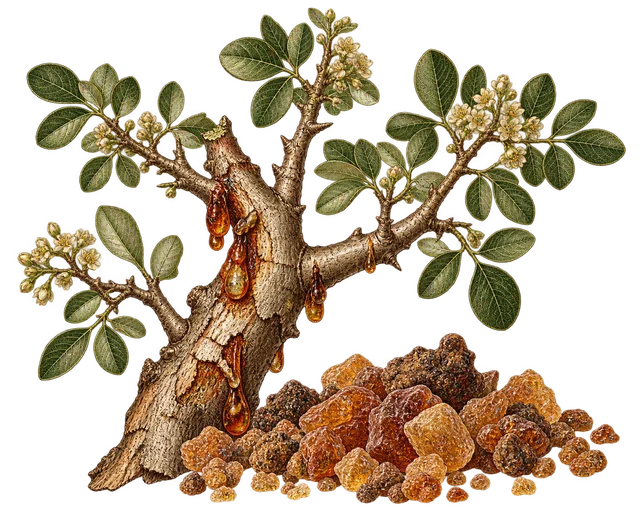
Kew identifies Commiphora myrrha in Burseraceae, and EMA’s 2018 addendum explicitly recognizes C. molmol as its medicinal-literature synonym. The material is gum-resin exudate, not roots. Frankincense comes from Boswellia and guggul from other Commiphora material; a shared resin appearance or family does not establish interchangeable ingredients.
Kew: Commiphora myrrha, identity and Burseraceae family · EMA (2018): Myrrh assessment addendum, pilot-trial and interaction appraisal
Caravan trade and cultural exchange
Myrrh begins as an aromatic exudate from a Commiphora tree, but its history quickly expands into a story of travel. Smithsonian accounts of the ancient incense trade describe how frankincense and myrrh helped enrich southern Arabian kingdoms through caravan routes and international exchange. These fragrant materials moved among ceremonial, household and commercial worlds. Their importance was tangible enough to support cities and artistic traditions, rather than existing only in legend.
Smithsonian National Museum of Asian Art: Caravan Kingdoms and the ancient incense trade · Metropolitan Museum of Art: Trade between Arabia and the empires of Rome and Asia · EMA: Myrrha, currently published assessment and traditional local uses
From incense to the apothecary
Within herbal medicine, myrrh also acquired a practical reputation for tending the mouth and skin. The European medicinal record preserves resin-based liquid preparations for minor mouth sores, inflammation and small skin lesions. That local-use tradition gives the familiar incense name another dimension: a material valued for fragrance could also become an apothecary ingredient. Ancient traded “myrrh” need not always map neatly onto one modern botanical species or extract. Commiphora myrrha supplies medicinal gum-resin, while incense, tincture and distilled oil each carry a different part of that aromatic heritage.
Smithsonian National Museum of Asian Art: Caravan Kingdoms and the ancient incense trade · Metropolitan Museum of Art: Trade between Arabia and the empires of Rome and Asia · EMA: Myrrha, currently published assessment and traditional local uses
Reading the older medicinal accounts
The following uses are historical records, not instructions. A tonic was thought to restore strength; atonic dyspepsia meant sluggish digestion, and an expectorant was used to help bring up mucus. Emmenagogue means a substance used to bring on menstruation. These older terms do not establish a modern diagnosis or proven effect.
U.S. Dispensatory (1918): Myrrha, historical preparations and uses · Finley Ellingwood (1919): Commiphora myrrha
Sore gums and mouth ulcers
European herbal medicine used resin-based myrrh tincture preparations locally for mouth ulcers and inflammation. Earlier American dispensatories likewise described myrrh applications to tender, unhealthy gums.
EMA: Myrrha, currently published assessment and traditional local uses · U.S. Dispensatory (1918): Myrrha, historical preparations and uses
Minor wounds and boils
Myrrh gum-resin preparations had a separate external use for minor wounds and boils, preserved by EMA. Earlier dispensatories described local tincture applications to slow-healing sores.
EMA: Myrrha, currently published assessment and traditional local uses · U.S. Dispensatory (1918): Myrrha, historical preparations and uses
Digestive tonic
The 1918 U.S. Dispensatory records myrrh gum-resin powder, pills and other preparations as a tonic for weak digestion. Ellingwood likewise described its use for appetite and atonic dyspepsia.
U.S. Dispensatory (1918): Myrrha, historical preparations and uses · Finley Ellingwood (1919): Commiphora myrrha
Chronic cough and difficult expectoration
Nineteenth- and early-twentieth-century Western pharmacy used oral myrrh resin preparations as expectorants when mucus was difficult to bring up. The 1918 dispensatory places this use within chronic chest complaints.
U.S. Dispensatory (1918): Myrrha, historical preparations and uses
Suppressed-menstruation remedies
The same dispensatory records myrrh-resin pills in combinations intended for absent menstruation, often with aloes and iron. This emmenagogue history is retained without instructions; it must not be used to induce menstruation during possible pregnancy.
U.S. Dispensatory (1918): Myrrha, historical preparations and uses
Resin incense
FAO records myrrh among aromatic resins burned as incense in religious ceremonies. Its account identifies true myrrh as Commiphora myrrha while noting that traded resins may include other Commiphora species.
Resin-based perfumery materials
IFF identifies an eastern African Commiphora myrrha gum-resin extract as a fragrance ingredient with a warm balsamic character. This perfumery material is separate from oral medicinal resin preparations and home skin recipes.
Preparation, absorption and nutrition
Resin identity, solvent and route define the product. A manufactured mucosal gel or rinse differs from a do-it-yourself tincture, incense or swallowed oil. No verified myrrh food portion, micronutrient target or clinically validated absorption booster is available. A local product’s goal is appropriate contact, not maximal systemic absorption; seek product-specific directions rather than increasing strength.
EMA: Final Community herbal monograph on Commiphora molmol gum-resin · EMA: Final assessment report on Commiphora molmol gum-resin · Primary analytical study: Variation among 17 commercial myrrh samples
Regional reading paths
These sourced notes describe cultivation, trade, food traditions or material history. A regional connection does not claim exclusive origin.
Africa
Native and traded: the resin-producing tree occurs in the Horn of Africa and adjacent East Africa; FAO documents Somali myrrh production and trade.
Aromatic gum-resin with incense and perfumery history. This is the resin card, not myrrh essential oil or a food ingredient.
Identity & detailed reference
Identity
Aromatic oleo-gum-resin exuded from Commiphora myrrha (T.Nees) Engl., in Burseraceae. Commiphora molmol is a synonym used in EMA and older medicinal literature. This entry concerns resin-based materials, not root decoctions, Boswellia frankincense, guggul or concentrated myrrh essential oil.
Ingredient details, preparation and research
Source plant or material
Commiphora myrrha, a shrub or small tree; the medicinal material is its gum-resin exudate, not its roots. C. molmol is a synonym used in medicinal literature.
Plant family / material: Burseraceae (incense family).
Forms and route
Gum-resin tears/powder; defined resin extracts and labeled oral-mucosal or skin preparations; some separately formulated swallowed combination products. Distilled essential oil and incense-grade resin are separate products. A mouth preparation is locally applied, not automatically a medicine to swallow.
Food sources
Not a routine nutritional food. Medicinal resin, an oral-mucosal gel, a mouth rinse, perfume and incense are not interchangeable edible products.
Vitamins and minerals
No reliable dietary serving or vitamin/mineral contribution is established for myrrh resin products. Gum polysaccharides and terpenoids are chemical constituents, not a standardized nutritional claim. Incense and essential oil are not nutrient sources.
Absorption and preparation
Local mouth and skin preparations seek local contact rather than a specified systemic blood level. Human absorption data for swallowed gum-resin mixtures remain inadequate for a universal regimen or food-based absorption booster. Water, ethanol and distillation recover different fractions; stronger extraction does not establish superior benefit.
Practical preparation
Prefer a manufactured product with species, preparation and intended route stated, and follow the leaflet, including any dilution and age restrictions. Do not prepare an alcoholic resin tincture at home for mouth wounds, add essential oil to drinking water, or improvise post-extraction care. Follow the dentist’s instructions after an extraction; rinse timing matters. No household-dose or drops conversion is provided.
Combination notes
A myrrh–chamomile–coffee-charcoal medicine is a distinct product. Observational or comparative results cannot isolate myrrh’s contribution or prove synergy. Do not assume combining myrrh with frankincense, another mouthwash or an essential oil improves absorption or clinical outcomes.
Traditional and reported uses
- EMA recognizes longstanding local use of particular resin tincture preparations for minor mouth sores/inflammation and minor skin wounds or small boils; this is traditional-use evidence.
- Small controlled studies of specific mouth gels and post-extraction rinses suggest local symptom/healing benefits, but are too limited to validate every preparation or replace dental care.
- Historical digestive/carminative use exists, and swallowed combination products have been studied. Neither proves myrrh alone treats lactose maldigestion or restores lactase.
- Resin and separately distilled oil have incense, perfumery and aroma roles. Their scent does not establish the medicinal exposure studied in mouth-care products.
Contraindications and cautions
- Use the exact labeled route. Do not swallow topical tinctures, mouth rinses or essential oil; alcohol-containing preparations may sting and allergy can occur. Keep out of eyes.
- EMA does not recommend the assessed preparations for children under 12 or during pregnancy/breastfeeding because adequate data are lacking. Consult a professional for persistent symptoms beyond one week, worsening infection or fever; facial boils need medical care.
- For a swallowed product, have a pharmacist check medicines, especially narrow-therapeutic-index treatment. Animal interaction findings with cyclosporine and theophylline have uncertain human relevance; a warfarin case used a root preparation, not the assessed resin tincture.
- Do not replace brushing, necessary dental treatment, infection treatment or prescribed bowel-disease therapy. Painful recurrent sores, unexplained bleeding, significant swelling or persistent digestive symptoms need evaluation.
Similar items and how they compare
- Frankincense (Boswellia resin / extract)
Both are aromatic gum-resins from the Burseraceae family.
Myrrh comes from Commiphora; frankincense comes from Boswellia. Boswellic-acid extract research cannot be transferred to myrrh.
- Myrrh essential oil
Distilled from the same resin and shares some aromatic compounds.
It is the concentrated volatile fraction, without the whole gum-resin composition, and is not a substitute for a labeled mouth rinse or oral product.
Tradition and the current EMA status
The published EMA assessment supports particular local liquid preparations for minor mouth ulcers/inflammation and minor wounds/small boils on longstanding-use grounds. The active page still lists the 2011 final monograph and 2018 addendum alongside a 2024 periodic-review call; that call is not a new efficacy approval. Historical digestive use is recorded separately and is not one of those final monograph indications.
Ninety-person aphthous-ulcer gel trial
The 2014 trial assigned 90 people with minor recurrent aphthous ulcers to a 0.5% myrrh gel, an aloe gel or the gel vehicle, about 30 per group. Myrrh-treated participants reported substantial pain improvement by day 6; aloe performed better on some healing measures. It was a small, short study of purpose-made mucoadhesive gels. No reported adverse events over a few days cannot establish long-term or pregnancy safety.
Forty-person post-extraction mouthwash trial
A trial published in the 2021 journal issue, first online in 2019, compared myrrh rinse with saline in 40 healthy adults after extraction. At one week, some swelling, tenderness and socket-size measures favored myrrh. The small sample, short follow-up and specific preparation limit confidence and generalizability. It does not establish an essential-oil rinse, prevent every complication, or justify changing the dentist’s post-extraction instructions.
Digestive evidence is combination-specific
An observational study followed 1,062 patients with diarrhea-related gastrointestinal diagnoses receiving a myrrh–chamomile–coffee-charcoal product alone, as add-on treatment or other therapies. Symptoms improved across groups. Nonrandom treatment selection and spontaneous recovery limit causal claims, and three ingredients prevent attribution to myrrh. Such findings do not establish lactose digestion; lactose reduction/tolerance assessment or lactase has a different rationale.
Oral analgesic pilot: why EMA remained cautious
EMA’s addendum reviewed an oral standardized myrrh-extract pilot spanning several pain complaints. The assessor questioned blinding because placebo participants reporting symptoms were told to interrupt placebo and use analgesics; individual symptom/sex subgroups were tiny. EMA did not consider the new evidence sufficient to upgrade to well-established-use status. A branded-extract pilot is not a general analgesic claim for raw resin or perfume oil.
Interactions need route and species context
The addendum reports lower cyclosporine exposure in rats and altered theophylline handling in rabbits, without confirmed clinical relevance. The older warfarin case concerned an aqueous preparation described as boiled roots; EMA judged it of limited relevance to resin tincture. These signals justify medicine review for swallowed products, while not proving every local rinse causes the same interaction. Do not independently change an anticoagulant or other prescribed medicine.
Local irritation and when to seek care
Alcohol can cause transient pain on damaged mucosa or skin, and contact allergy is reported. Follow the medicinal leaflet and avoid eye contact. Persistent or worsening sores/wounds, fever or spreading infection warrant professional care; an apparent boil on the face deserves medical assessment. The assessed medicinal products lack adequate data for young children or pregnancy/lactation.
Entry sources
- Kew: Commiphora myrrha, identity and Burseraceae family
- EMA: Myrrha, currently published assessment and traditional local uses
- EMA: Final Community herbal monograph on Commiphora molmol gum-resin
- EMA: Final assessment report on Commiphora molmol gum-resin
- EMA (2018): Myrrh assessment addendum, pilot-trial and interaction appraisal
- Spinozzi et al. (2025): Myrrh volatile furanosesquiterpenes; mosquito laboratory study
- Primary analytical study: Variation among 17 commercial myrrh samples
- Mansour et al. (2014): Myrrh or aloe mucoadhesive gels for minor aphthous ulcers
- Al Eid (2021): Myrrh mouthwash versus saline after tooth extraction in 40 adults
- Albrecht et al. (2015): Observational myrrh–chamomile–coffee-charcoal study in 1,062 patients
- Al Faraj (2005): Case report of a Commiphora preparation and reduced warfarin effect
- NIDDK: Eating, diet and nutrition for lactose intolerance
- National Capital Poison Center: Essential oils can be poisonous when misused
- FAO: Flavours and fragrances of plant origin, chapter 9
- IFF LMR Naturals: Myrrh Resinoid MD
Reference entry 105 · Recorded content review: 2026-10-05 · Review scope and dates