


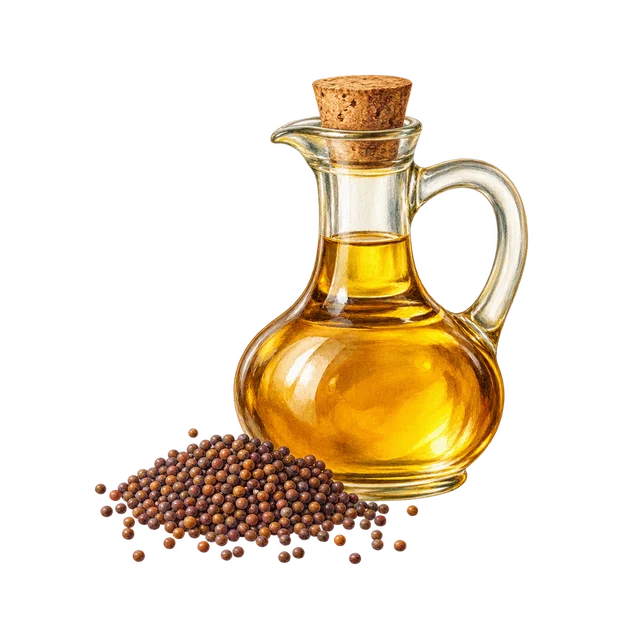
Key cautions
- In the United States, FDA Import Alert 26-04 addresses expressed mustard oil because of potentially unsafe erucic-acid levels. Do not cook with external-use-only products.
- Heating until smoking does not establish that erucic acid has been removed or that an unsuitable product becomes food-safe.
What’s inside
Predominantly fat, with a fatty-acid profile determined by the source seed and processing. Some traditional expressed oils contain high erucic acid; pungency does not indicate its amount.
Uses in brief

- Regional cooking oil
- Traditional ghani-pressed material
History, folklore and reported uses
History, folklore and traditional uses
FAO documents ghani crushing in India, while ICAR-IISR records mustard oil’s regional culinary role. A study of West Bengal market samples illustrates why the identity and quality of the actual oil matter.
Traditional, historical and reported uses
- Regional cooking oil
Food or household practiceWhy this label?
The cited source documents this material, preparation or cultural practice; it does not establish treatment efficacy.
Identified edible products serve as cooking fats in parts of India. This describes regional use only: choose a product legally sold for food where it will be consumed.
- Traditional ghani-pressed material
Food or household practiceWhy this label?
The cited source documents this material, preparation or cultural practice; it does not establish treatment efficacy.
Ghani processing extracts fixed oil from seeds and leaves a press cake. The resulting oil is a distinct food material, not a seed tea or a volatile aromatic oil.
2 supported featured food or cultural uses; no treatment claim.
Historical-use additions reviewed 2026-10-09
Regional reading paths
These sourced notes describe cultivation, trade, food traditions or material history. A regional connection does not claim exclusive origin.
Asia
Traditional processing/use: India, notably West Bengal.
Regional fixed cooking oil; use only products sold as food where permitted.
Identity & detailed reference
Identity
Expressed fixed oil from authenticated mustard seed, including Brassica juncea. It differs from volatile mustard oil, whole mustard seed, prepared mustard and low-erucic rapeseed oils.
Ingredient details, preparation and research
Also known as: Sarson oil; Sarson ka tel; Expressed mustard oil
Source plant or material
Brassica juncea and other identified edible-oil mustard sources
Plant family / material: Brassicaceae
Forms and route
Commercial pressed or refined culinary products where compliant with local food rules. Bottles labelled for external use are not cooking products.
Vitamins and minerals
Oil supplies concentrated dietary fat, not the protein or fiber of mustard seed. No universal fatty-acid percentage or nutrient amount is assigned to all mustard oils.
Absorption and preparation
No special food pairing or heating practice is established here to neutralize erucic acid or enhance a therapeutic effect.
Practical preparation
Use only an appropriate food-grade product and its intended culinary directions. Store closed, away from heat and light; avoid overheating and discard rancid or deteriorated oil.
Combination notes
Use the chosen culinary fat as part of the recipe, not as a medicinal spoonful.
Traditional and reported uses
- Regional cooking oil
- Traditional ghani-pressed material
Contraindications and cautions
- In the United States, FDA Import Alert 26-04 addresses expressed mustard oil because of potentially unsafe erucic-acid levels. Do not cook with external-use-only products.
- Heating until smoking does not establish that erucic acid has been removed or that an unsuitable product becomes food-safe.
The restriction concerns the specific material
FDA distinguishes expressed mustard oil concerns from other mustard-derived ingredients. Product composition and compliance matter; this is not a blanket conclusion that every food bearing the word mustard is unsafe.
Evidence limits
No intake recommendation or workaround for food rules. Product suitability must be verified at purchase.
Entry sources
- Chakraborty et al. (2018): Mustard oils sampled in West Bengal, FAO AGRIS record
- US FDA: Import Alert 26-04, expressed mustard oil and erucic acid
- ICAR-IISR: Mustard
- FAO: Ghani oil processing in India
Reference entry 350 · Recorded content review: 2026-10-09 · Review scope and dates