


Key cautions
- Do not swallow fragrance oil or substitute concentrated essential oil for a leaf or berry preparation. Products sharing the word myrtle can contain quite different materials.
- Persistent, unusually large or recurrent mouth ulcers need assessment; a small paste trial does not validate homemade oil applications in the mouth.
What’s inside
Leaves contain tannins and other polyphenols plus volatile compounds such as pinene and cineole; proportions vary. Dark berries contain anthocyanins, particularly in the peel, and other phenolics. Alcoholic extracts, water extracts and essential oils recover different constituent groups.
Uses in brief

- Traditional ceremonial branches, culinary flavouring and perfumed waters.
- Local skin and mouth-care traditions; a small trial studied a specific myrtle paste for recurrent mouth ulcers.
In the King James Bible
In the King James Bible
Named material
Isaiah uses the myrtle tree in an image of restoration, and Nehemiah names myrtle branches gathered to make booths. Common myrtle, Myrtus communis, is the customary botanical identification. The passages concern the living shrub and its branches.
Instead of the thorn shall come up the fir tree, and instead of the brier shall come up the myrtle tree: and it shall be to the LORD for a name, for an everlasting sign that shall not be cut off.
Isaiah 55:13 (KJV)
And that they should publish and proclaim in all their cities, and in Jerusalem, saying, Go forth unto the mount, and fetch olive branches, and pine branches, and myrtle branches, and palm branches, and branches of thick trees, to make booths, as it is written.
Nehemiah 8:15 (KJV)
Scripture and identification sources
Words & their stories
WORDS & THEIR STORIES
The name behind the KJV
Biblical Hebrew · Isaiah 55:13; Nehemiah 8:15 (KJV)
הֲדַסhădas
Myrtle: a plant of the restored landscape in Isaiah and a source of branches for booths in Nehemiah.
Dictionary form: הֲדַס · hădas
The noun has the same form in both verses. Nehemiah specifies branches or leafy boughs of it.
What the language reveals
Hope and festival practice
Isaiah presents myrtle replacing the brier; Nehemiah includes its boughs in the material gathered for booths. These are distinct literary and ritual uses of the plant.
Myrtle is the conventional identification; neither passage describes an essential oil or assigns medicinal effects.
Language and identification bibliography
History, folklore and reported uses
History, folklore and traditional uses
Myrtle is a modest evergreen shrub with an unusually wide symbolic life. Nehemiah names its branches among those gathered for booths, while Isaiah uses the replacement of briers by myrtle as an image of renewal. The living plant suits such imagery: its glossy leaves remain green, its small flowers are fragrant, and it grows in the moister parts of Mediterranean landscapes. The branches and growing shrubs carry the imagery.
Beyond the biblical setting, myrtle moved between ceremony, kitchen and perfumer’s workshop. Historical accounts describe wreaths and bridal decorations, seasoning with leaves or berries, and the French aromatic water called eau d’ange. Nineteenth-century physicians also used its astringent preparations on skin and mucous membranes. Modern research has begun to test particular formulations, but a berry, an aromatic water, a mouth paste and a distilled oil remain different ways of meeting the same plant.
Traditional, historical and reported uses
- Ceremonial branches and wreaths
Historical recordWhy this label?
Biblical passage and an 1898 dispensatory document ceremonial branches.
Nehemiah records myrtle branches used for booths. Later historical accounts describe myrtle in Greco-Roman wreaths and bridal decorations, showing a ceremonial life beyond medicinal use.
- Seasoning food and drinks
Food or household practiceWhy this label?
Leaves, berries and twigs used for culinary flavouring.
King’s American Dispensatory records leaves, berries and twigs used to flavour food and wine. The edible berry belongs to this food tradition; a concentrated fragrant oil is a separate material.
- Perfumed water
Historical recordWhy this label?
The 1898 dispensatory records a named French aromatic-water preparation.
The 1898 dispensatory describes French eau d’ange distilled from myrtle leaves and flowers. This is an aromatic-water tradition, distinct from taking an essential oil internally.
- Astringent skin care
Mixed/contextual sourcesWhy this label?
Combines historical physician records with a broader astringent-leaf tradition.
Historical physicians applied myrtle preparations to wounds and irritated skin. The museum’s botanical account also describes an astringent leaf tradition linked with tannins.
- Mouth and throat care
Mixed/contextual sourcesWhy this label?
Combines historical local use with a later human oral-paste trial.
Myrtle has been used locally for mouth ulcers and throat complaints. A later randomized trial tested a formulated oral paste, giving this traditional mucosal use a specific, limited research context.
- Ottoman household aromatics: provisional attribution
Historical recordWhy this label?
Conference abstract explicitly attributes a use to a named Ottoman text; attribution remains provisional.
A Society for Classical Studies abstract attributes household use of myrtle leaves during plague to Hajī Pasha’s Muntakhāb al-Shifā. The practice belongs to the medical effort to improve corrupted air. Retain the attribution and its limits until the underlying Ottoman text is independently checked.
Historical-use additions reviewed 2026-10-08
Story sources
- Royal Horticultural Society: Myrtus communis
- Felter and Lloyd, King’s American Dispensatory (1898): Myrtus / Myrtle
- Muséum national d’Histoire naturelle: Myrte commun
- Babaee et al. (2010): Myrtle paste for recurrent aphthous stomatitis, randomized controlled trial
- Wild Myrtus communis fruit by-product as a natural food colourant: extraction and chemical characterization (2025)
- Tuberoso et al. (2010): Chemical composition and antioxidant activities of myrtle berry extracts
- Lytton John Musselman, Old Dominion University: Myrtle
- The King James Bible: Project Gutenberg ebook 10
- Osman Süreyya Kocabaş: Scent Use in the Epidemic Treatment of Early Modern Ottoman Medicine
- CDC: Clinical Care of Plague
Identity & detailed reference
Identity
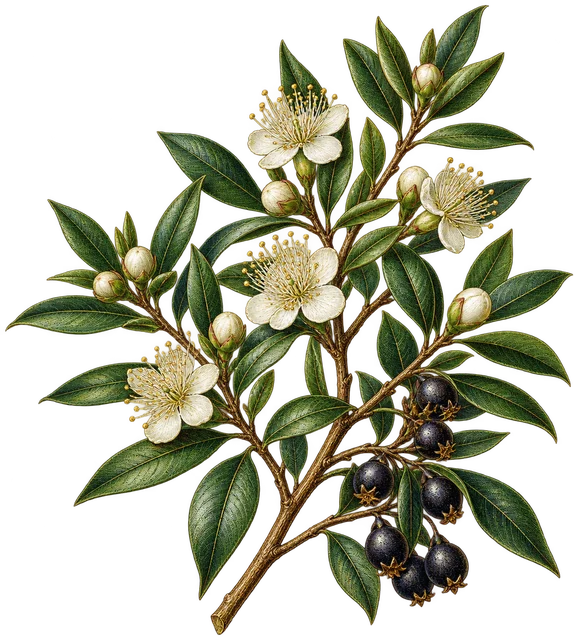
Common myrtle is the evergreen Mediterranean shrub Myrtus communis. Its branches, aromatic leaves, flowers and dark berries have different uses. It is distinct from unrelated plants also called myrtle and from concentrated products sold under branded myrtol names.
Ingredient details, preparation and research
Also known as: Common myrtle; European myrtle
Source plant or material
Common myrtle is the evergreen Mediterranean shrub Myrtus communis. Its branches, aromatic leaves, flowers and dark berries have different uses. It is distinct from unrelated plants also called myrtle and from concentrated products sold under branded myrtol names.
Plant family / material: Myrtaceae (myrtle family)
Forms and route
Living shrub and cut branches; food-grade berries or culinary leaves; traditionally leaf infusions and aromatic waters; separately leaf extracts, mouth pastes and distilled essential oil. Berry liqueur is an alcoholic food product, not a medicinal dose or equivalent to whole fruit.
Vitamins and minerals
Whole berries can contribute ordinary fruit carbohydrate and some fibre when eaten, but this card has no validated household vitamin/mineral serving value for them. Their measured anthocyanins are phytochemicals, not a Daily Value nutrient. Leaf tea, fragrant water and essential oil do not retain the whole berry’s fibre; sweetened liqueur has its own sugar/alcohol contribution.
Absorption and preparation
Extraction yield is not the same as absorption into a person. Solvents change myrtle’s phenolic profile, and laboratory antioxidant assays do not measure a clinical benefit. A mouth paste chiefly provides local contact; no food pairing or oral essential-oil absorption recipe is established.
Traditional and reported uses
- Traditional ceremonial branches, culinary flavouring and perfumed waters.
- Local skin and mouth-care traditions; a small trial studied a specific myrtle paste for recurrent mouth ulcers.
Contraindications and cautions
- Do not swallow fragrance oil or substitute concentrated essential oil for a leaf or berry preparation. Products sharing the word myrtle can contain quite different materials.
- Persistent, unusually large or recurrent mouth ulcers need assessment; a small paste trial does not validate homemade oil applications in the mouth.
- Medicinal-dose safety is insufficiently established during pregnancy, breastfeeding and childhood. Treat skin irritation or allergy as a reason to stop a topical product.
- Berry liqueur contains alcohol and often added sugar; it should not be used as a way to obtain a myrtle health benefit.
Similar items and how they compare
- Eucalyptus
Another aromatic member of Myrtaceae.
Being in the same family does not make its leaves or essential oil interchangeable with common myrtle.
- Bay leaf
Another aromatic leaf used in Mediterranean cooking.
Bay belongs to Lauraceae and has a separate botanical and safety profile; do not identify plants by a culinary common name alone.
Plant and material
Myrtus communis is an evergreen Myrtaceae shrub with aromatic leaves and small berries. Biblical passages name the tree or its branches. Whole fruit, leaves, flower water, extracts and essential oil must be identified separately.
Constituents depend on preparation
Research on berry extracts finds different phenolic and antioxidant-test profiles with different solvents. Newer compositional work locates much of the berry pigment in its peel. Distilled oil does not carry these nonvolatile pigments or whole-fruit fibre.
A small mouth-paste trial
Babaee and colleagues studied 45 people with recurrent aphthous ulcers over separate episodes treated with myrtle or placebo paste. Ulcer size and pain improved with the studied paste. The small, short study does not establish that all myrtle products work or that essential oil should be applied to ulcers.
Laboratory antioxidants are not clinical outcomes
Chemical assays can show that an extract reacts with oxidants under test conditions. They cannot establish how much is absorbed, whether a food prevents disease, or whether an alcoholic myrtle drink is beneficial.
Nutrients and realistic forms
Berries are food; flavouring leaves and filtered liquids are usually used in much smaller amounts. This review does not have a standardized nutrient serving for myrtle. Pigment-rich extracts should not be marketed here as vitamin or mineral replacements.
Safety and care boundaries
Use the labelled identity and formulation, rather than transferring directions among oil, tea and paste. A persistent mouth lesion requires assessment. Pregnancy and paediatric medicinal use lack adequate safety support in the cited research.
Plague care boundary
No historical plant or material here is established to prevent or cure plague. Suspected plague requires urgent medical assessment and prompt antibiotics.
Evidence limits
- There is no standardized nutrient serving or general medicinal dose established here.
- A small formulation-specific clinical trial does not support all myrtle products.
- Commercial myrtol mixtures and other plants called myrtle require separate identification.
Entry sources
- Royal Horticultural Society: Myrtus communis
- Felter and Lloyd, King’s American Dispensatory (1898): Myrtus / Myrtle
- Muséum national d’Histoire naturelle: Myrte commun
- Babaee et al. (2010): Myrtle paste for recurrent aphthous stomatitis, randomized controlled trial
- Wild Myrtus communis fruit by-product as a natural food colourant: extraction and chemical characterization (2025)
- Tuberoso et al. (2010): Chemical composition and antioxidant activities of myrtle berry extracts
- Lytton John Musselman, Old Dominion University: Myrtle
- The King James Bible: Project Gutenberg ebook 10
- Osman Süreyya Kocabaş: Scent Use in the Epidemic Treatment of Early Modern Ottoman Medicine
- CDC: Clinical Care of Plague
Reference entry 130 · Recorded content review: 2026-10-06 · Review scope and dates