


Key cautions
- Check Salvia sclarea and the intended route; common sage, distilled oil and seed oil are different materials.
- Medicinal pregnancy, breastfeeding, child-use and interaction data are inadequate. Do not put homemade preparations in eyes or swallow aromatherapy oil.
What’s inside
Clary herb contains aromatic and nonvolatile plant compounds. The part used and the extraction process determine which mixture reaches a preparation.
Primary study: Clary sage extract chemistry and in-vitro effects · Primary study: Salvia sclarea essential-oil chemistry
What the chemistry does and does not show
Rosmarinic acid was prominent in a study of water, methanol and ethyl-acetate extracts. Sclareol occurs in inflorescences and is obtained by a different extraction process from ordinary tea. Analyses of distilled oil commonly emphasize linalyl acetate and linalool; their oil percentages are not leaf-infusion doses.
Primary study: Clary sage extract chemistry and in-vitro effects · Caissard et al. (2012): Sclareol localization in clary-sage inflorescences · Primary study: Salvia sclarea essential-oil chemistry
Where sclareol accumulates
Sclareol is a diterpene, a type of plant compound studied separately from the scented oil. Microscopy and chemical analysis found crystals mostly on the outer surface of the calyces, the cups surrounding the flowers. This helps explain the value of flowering material in extraction; it does not establish an estrogen treatment.
Caissard et al. (2012): Sclareol localization in clary-sage inflorescences
Nutrition is not transferable between materials
No suitable standard leaf/flower nutrient dataset was verified for this species. Absence of a verified profile is not proof that the plant contains no nutrients. It means vitamin/mineral claims for ordinary servings, teas and skin products are not supportable here; seed fixed oil and common sage require their own data.
NC State Extension: Clary sage, edible parts and historical uses · Kew: Salvia sclarea, accepted name and Lamiaceae family
Uses in brief

- Culinary leaves and flowers; historical flavoring of wines and other foods.
- Traditional digestive use, with limited direct clinical evidence for leaf or flower preparations.
History, folklore and reported uses
Identity and plant parts
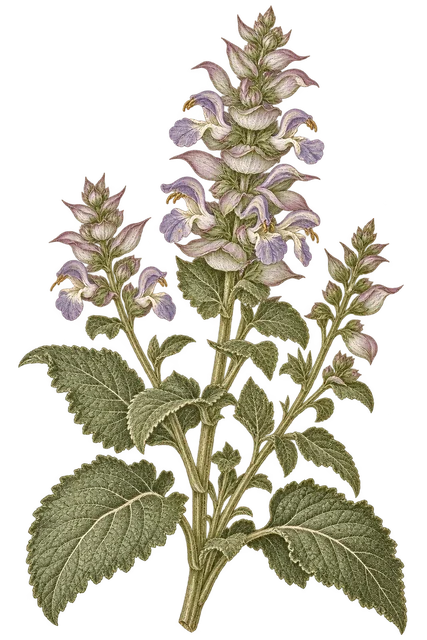
Salvia sclarea L. is accepted by Kew in Lamiaceae. This entry concerns leaves and flowering aerial parts. Salvia officinalis is another species; steam-distilled clary oil, solvent-extracted perfumery material and pressed seed oil are separate preparations.
Kew: Salvia sclarea, accepted name and Lamiaceae family · EMA (2016): Salvia officinalis leaf and essential-oil assessment, revision 1 · Primary study: Salvia sclarea essential-oil chemistry
Preparation and absorption
Food herb, a strained water infusion and an alcohol extract retain different constituents. Distillation concentrates a volatile fraction rather than reproducing the whole herb. No clinical evidence reviewed establishes a superior oral preparation, an added-fat rule or a need to seek maximal strength. Essential oil should not be added to a drink as a shortcut.
Primary study: Clary sage extract chemistry and in-vitro effects · Primary study: Salvia sclarea essential-oil chemistry · Poison Control: Essential oils, poisonous when misused
Clear-eye names and household history
Clary sage’s old names, clear-eye and see-bright, preserve a very particular piece of herbal history. NC State Extension records the former use of its mucilaginous nutlets to remove material from the eye. The name carries the memory of that practice even though the plant is now more familiar for its tall flowering spikes, scented leaves and role in perfumery. It is a historical account, not an eye-care technique to repeat: seeds and household herbal liquids do not belong in the eye.
NC State Extension: Clary sage, edible parts and historical uses · Royal Horticultural Society: Clary and its historical common names · Maud Grieve, A Modern Herbal (1931): Sage, Clary section
From kitchen herb to perfumery
Clary also had a less dramatic place at the table. Its leaves flavored omelets, fritters and stews, and the herb was used in beers and wines. NC State’s ethnobotanical account records a reputation for easing spasms and flatulence, linking its culinary aroma with digestive herbalism. The same aromatic plant thus acquired kitchen, household and perfumery roles. These older leaf-and-herb customs form one strand of Salvia sclarea’s history; its distilled oil belongs to another, while common culinary sage is a separate species.
NC State Extension: Clary sage, edible parts and historical uses · Royal Horticultural Society: Clary and its historical common names · Maud Grieve, A Modern Herbal (1931): Sage, Clary section
The clear-eye seed tradition
Clary’s seeds were historically used to clear the sight, the practice behind its clear-eye name. NC State preserves the record; putting seeds or nonsterile herbal liquids into an eye can injure it and is not advised.
NC State Extension: Clary sage, edible parts and historical uses · NHS: Eye injuries
Digestive wind and stomach discomfort
Grieve’s 1931 Salvia sclarea entry describes fresh or dried herb and leaves in infusions or tinctures for unsettled digestion and wind colic. Her account places digestion among clary’s principal medicinal uses.
Nervous distress
Grieve describes a compound tincture containing clary leaves and flowers for what older physicians called hysteria. Leaves and flowers were combined with other aromatic herbs in that historical nervous-remedy practice.
Boils and inflamed swellings
Grieve quotes Culpeper’s external clary practice: seed mucilage for swellings and leaf salves for inflamed boils. His account gives the seeds and leaves different places in local skin care.
Maud Grieve, A Modern Herbal (1931): Sage, Clary section · NHS: Boils
Kidney complaints
The same 1931 herbal records clary herb and leaf preparations for kidney complaints, alongside its better-known stomachic role. The account gives infusions and tinctures as general preparations but no precise diagnosis or kidney-specific formula.
Maud Grieve, A Modern Herbal (1931): Sage, Clary section · NHS: Kidney infection
Culinary herb and beverage flavouring
NC State Extension records Salvia sclarea leaves in omelets, fritters and stews, and the herb in beers and wines. These kitchen uses concern clary herb, separately from distilled clary-sage essential oil.
NC State Extension: Clary sage, edible parts and historical uses
Beverage history and its limits
Grieve attributes to earlier writers the use of clary to imitate Muscatel wine and to replace hops in beer. Her account explains the German name Muskateller Salbei. It is historical beverage lore, not evidence that the herb safely intensifies intoxication or has a predictable interaction with alcohol.
Labor claims: a feasibility study, not proof
A 2017 pilot enrolled 11 women at 38–40 weeks of pregnancy: five inhaled clary-sage oil scent and six were controls. Several saliva measurements could not be obtained, and no uterine contractions were observed in either group. This small feasibility study cannot establish reliable labor induction, and it did not test herb tea.
Tadokoro et al. (2017): Clary-sage scent in term pregnancy, feasibility pilot
Identity & detailed reference
Identity
Salvia sclarea L.; leaves and flowering aerial parts. This is distinct from common culinary sage (Salvia officinalis), clary sage essential oil and clary-sage seed fixed oil.
Ingredient details, preparation and research
Source plant or material
Salvia sclarea L.; aromatic leaves and flowering aerial parts.
Plant family / material: Lamiaceae (mint family).
Forms and route
Fresh or dried leaves and flowers, small culinary uses, and herb infusions or extracts sold for their stated route. Distilled essential oil, perfumery absolute and seed fixed oil are separate materials; none should be substituted for the herb.
Vitamins and minerals
A dependable nutrient profile for ordinary portions of Salvia sclarea leaves or flowers was not verified. Do not borrow common-sage or pressed-seed-oil nutrient values. A small flavoring portion or strained tea should not be counted as a reliable vitamin/mineral source; topical use supplies no established dietary nutrition.
Absorption and preparation
No validated human absorption strategy for Salvia sclarea leaf/flower tea was identified. Water infusion, alcohol extraction and distillation produce different mixtures; scent studies do not quantify oral exposure. There is no established benefit from adding fat, fasting or combining herbs to enhance a medicinal effect.
Practical preparation
For food, use correctly identified, food-grade leaves or flowers in a recipe. For a purchased infusion or extract, follow its specific route and label rather than converting oil studies into spoonfuls of herb. Check alcohol in tinctures. Do not add essential oil to tea or improvise an eye wash.
Combination notes
Clary sage may be combined with other aromatic herbs for flavor. Evidence for a multi-oil massage or inhalation blend belongs to that blend and route; it cannot establish synergy for a mixed herbal tea. No absorption-enhancing combination is established.
Traditional and reported uses
- Leaves and flowers are used as culinary flavorings; historical beverage use includes wines and liqueurs.
- NC State Extension records folk use for flatulence and spasms. This documents a tradition, not a proven treatment or standard dose.
- Fragrant foliage has aromatic uses. Human essential-oil research is preliminary and cannot validate oral herb treatment, hormone balancing or labor induction.
Contraindications and cautions
- Allergy or irritation is possible. Stop if symptoms occur and seek urgent care for breathing difficulty or facial/throat swelling.
- Concentrated oral leaf/flower products lack adequate human safety and interaction data. Discuss regular medicines with a pharmacist; avoid self-prescribing medicinal amounts during pregnancy, breastfeeding or for children.
- Do not use seeds, tea or homemade extracts in the eyes, despite historical eye-related names. Cosmetic and aromatherapy oils are not drinkable herb preparations.
- Do not transfer Salvia officinalis thujone limits or clary-seed-oil nutrition to this herb. Neither a familiar scent nor the presence of sclareol establishes an estrogen treatment.
Similar items and how they compare
- Clary sage essential oil
Both come from Salvia sclarea and share its fragrant linalool/linalyl-acetate-containing volatile fraction.
Herb preparations retain a different mixture of water- or alcohol-extractable compounds; the distilled oil is a concentrated aromatic material.
- Common sage
Both are Salvia herbs with aromatic leaves and phenolic constituents, making the botanical name essential when selecting products.
Common sage is Salvia officinalis, with a different volatile profile and its own EMA leaf monograph.
Attributed culinary and medicinal history
NC State Extension records edible leaves and flowers, beverage flavoring and historical use for gas and spasms. It also records use of seeds for eye complaints. That last practice is historical information, not a safe modern home eye-care method.
Laboratory evidence
Extracts have shown antioxidant and enzyme-inhibiting activity in laboratory assays; computer docking predicts possible molecular interactions. Separate animal and isolated-uterus work investigated oil and purified sclareol. These experiments do not show that a cup of herb tea treats diabetes, dementia, skin disease or menstrual pain.
Human evidence concerns essential oil
A 2014 study of 22 menopausal women reported short-term plasma serotonin/cortisol changes following oil inhalation. These biomarkers are not proof of sustained antidepressant benefit. It did not test swallowed leaf or flower preparations, and no directly applicable robust oral-herb trial was identified in this review.
Hormone claims and the 2026 trial
A 2026 crossover study enrolled 20 athletes but analyzed 12 completers. Oil inhalation improved several reported menstrual symptoms relative to water, with no significant between-condition differences in salivary estradiol, progesterone or cortisol. Small numbers, attrition, self-reported adherence and no formal washout limit confidence. The findings do not establish hormone balancing or the efficacy of clary-sage tea.
Safety and medicine review
Oral medicinal safety in pregnancy, breastfeeding and children, and clinically important drug interactions, remain inadequately characterized. General supplement precautions therefore support professional review. This uncertainty is not evidence of a proven estrogen interaction or a universal ban on every ordinary food use. Avoid eye exposure and ingestion of products intended for fragrance or skin.
Similar materials are not substitutes
Common sage shares the Salvia genus but has its own thujone-containing volatile profile and medicinal assessment. Clary essential oil shares the plant source but concentrates volatile compounds. Comparisons should match species, part, solvent and route before drawing any treatment conclusion.
Entry sources
- NC State Extension: Clary sage, edible parts and historical uses
- Kew: Salvia sclarea identity and family
- Primary study: Clary sage extract chemistry and in-vitro effects
- Primary study: Salvia sclarea essential-oil chemistry
- Primary study: Sclareol extraction from clary-sage concrete
- Poison Control: Essential oils, poisonous when misused
- Caissard et al. (2012): Sclareol localization in clary-sage inflorescences
- Lee et al. (2014): Plasma serotonin and cortisol after clary-sage oil inhalation in 22 menopausal women
- Applied Sciences (2026): Randomized crossover clary-sage oil inhalation study in female collegiate athletes
- Wong et al. (2020): Clary-sage oil and sclareol in animal and isolated-uterus experiments
- EMA (2016): Salvia officinalis leaf and essential-oil assessment, revision 1
- NCCIH: Using Dietary Supplements Wisely
Reference entry 94 · Recorded content review: 2026-10-05 · Review scope and dates