


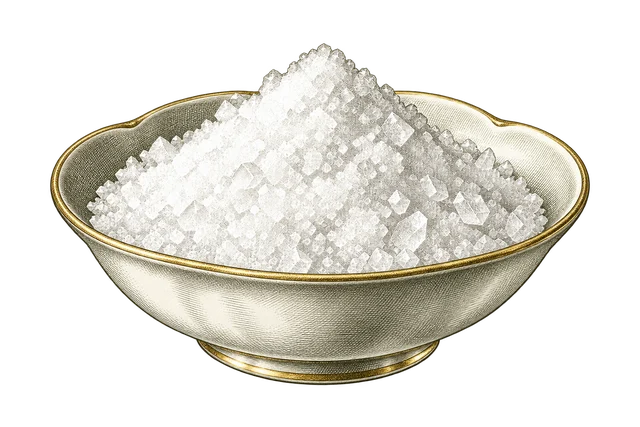
Key cautions
- Digestive upset and incomplete long-term/interaction data warrant care, especially during fertility or pregnancy care.
- MI, DCI, IP6 and inositol hexanicotinate are different materials.
What’s inside
MI and DCI contain the same atoms arranged differently in space. Inositol is used to build membrane phospholipids and signaling molecules; added folic acid, sweeteners or other vitamins belong to the particular product, not to inositol itself.
U.S. National Library of Medicine MeSH: Inositol · Fisher and colleagues, 2002: Inositol in neural tissues, historical overview · Myo-inositol to prevent pregnancy complications in PCOS, MYPP randomized clinical trial (2025)
Identity and the vitamin B8 nickname
Inositol is a cyclic alcohol/polyol, not a botanical remedy. MI and DCI are related stereoisomers with different three-dimensional arrangements. Inositol-containing molecules have important signaling roles, but biological importance does not automatically mean an essential dietary vitamin. The body can synthesize MI; NLM does not identify an established human deficiency syndrome, and the National Research Council did not establish an adult RDA.
U.S. National Library of Medicine MeSH: Inositol · National Research Council: Recommended Dietary Allowances, Other Substances in Food (1989) · Groenen et al.: Kinetics of myo-inositol loading in women of reproductive age (2003)
Uses in brief

- Studied for metabolic and menstrual outcomes in PCOS; shared decisions should acknowledge uncertainty.
- PCOS-related infertility use remains experimental in the international guideline.
History, folklore and reported uses
From muscle chemistry to a named compound
Inositol began its scientific life in a very different setting from today's supplement shelf. Johann Joseph Scherer reported a sugar-like substance from muscle in 1850. The name inosit reflected that origin; later chemistry distinguished myo-inositol from other arrangements of the same atoms and followed its presence through animal and plant tissues. This was the nineteenth-century effort to identify the components of living material, not the isolation of a traditional herbal remedy.
Scherer, 1850: Über eine neue aus dem Muskelfleisch gewonnene Zuckerart (original paper; bibliographic identification) · Fisher and colleagues, 2002: Inositol in neural tissues, historical overview · Teede et al.: 2023 International Evidence-based PCOS Guideline recommendations · NCCIH: Depression and complementary health approaches, inositol · International PCOS Guideline, 2023: Recommendations on inositol
From cell signaling to modern supplement practice
A newer chapter grew from discoveries about inositol-containing molecules in cell signaling. Researchers and supplement practitioners became interested in mood and, later, the metabolic and reproductive features of polycystic ovary syndrome. Those interests account for modern claims about emotional balance, cycles and fertility. They do not establish that old foods containing inositol were historically used for those purposes. Contemporary PCOS guidance treats possible use as a preference-sensitive option with limited clinical benefits and uncertain formulations; NCCIH does not find support for treating depression with it. The story is one of a body-made molecule gaining therapeutic hypotheses, not a lost essential B vitamin rediscovered from folklore.
Scherer, 1850: Über eine neue aus dem Muskelfleisch gewonnene Zuckerart (original paper; bibliographic identification) · Fisher and colleagues, 2002: Inositol in neural tissues, historical overview · Teede et al.: 2023 International Evidence-based PCOS Guideline recommendations · NCCIH: Depression and complementary health approaches, inositol · International PCOS Guideline, 2023: Recommendations on inositol
PCOS-related cycles and fertility
Contemporary complementary practice uses myo-inositol, D-chiro-inositol or mixtures for metabolic and reproductive concerns in PCOS. The 2023 international guideline acknowledges the practice but describes limited clinical benefits and insufficient evidence to recommend specific formulations.
International PCOS Guideline, 2023: Recommendations on inositol
Depression and emotional balance
Modern nutritional psychiatry has investigated oral inositol for depression, and the idea persists in mood-support supplementation. NCCIH records this use while finding that the evidence does not support inositol as a depression treatment.
NCCIH: Depression and complementary health approaches, inositol
Panic attacks
Benjamin and colleagues’ 1995 study explored inositol for panic disorder and agoraphobia. It records early clinical interest in a nutrient-based approach to recurrent panic attacks.
Benjamin and colleagues, 1995: Inositol treatment for panic disorder
Obsessive-compulsive symptoms
A small 1996 study by Fux and colleagues investigated inositol for obsessive-compulsive disorder. This became another modern psychiatric-nutrition hypothesis, separate from both PCOS use and panic disorder, without establishing a replacement for standard OCD care.
Fux and colleagues, 1996: Inositol treatment of obsessive-compulsive disorder
Gestational-diabetes prevention research
Twenty-first-century researchers have studied myo-inositol during pregnancy in hopes of preventing gestational diabetes; D’Anna’s 2013 trial is an early example. This is a supervised research application, not a traditional food remedy or a routine pregnancy recommendation.
D’Anna and colleagues, 2013: Myo-inositol and onset of gestational diabetes
Modern research use and terminology
Supplement use here is a modern nutritional/clinical research context, not a claimed herb-specific healing tradition. Much of the evidence uses the name polycystic ovary syndrome (PCOS). Monash’s current international guideline program uses polyendocrine metabolic ovarian syndrome (PMOS), following its 2026 naming update. PCOS is retained here as the familiar search term and in historical study descriptions; the terminology change does not itself improve the evidence for inositol.
Monash: International PCOS/PMOS Guideline and 2026 terminology update · Teede et al.: 2023 International Evidence-based PCOS Guideline recommendations
Food and nutrient context
A 1980 analytical study measured 487 foods and found substantial inositol in fruits, beans, grains and nuts. Food inositol may occur free or in bound compounds; processing and analytical methods affect the reported total. This review does not convert those data into a supplement-equivalent meal or a therapeutic diet. Beans with whole grains or fruit with nuts are ordinary food ideas, with no claimed special synergy.
Clements and Darnell: Myo-inositol content of 487 common foods (1980) · National Research Council: Recommended Dietary Allowances, Other Substances in Food (1989)
Absorption and look-alike compounds
A small oral-loading study in five healthy women demonstrated blood uptake of MI; it was a pharmacokinetic experiment, not a fertility trial or a comparison of meal pairings. Inositol hexanicotinate supplies a niacin-related compound, while IP6 is inositol hexaphosphate/phytic acid. Read the full ingredient name. Neither a higher absorption claim nor a shared word in the name makes these preparations clinically interchangeable.
Groenen et al.: Kinetics of myo-inositol loading in women of reproductive age (2003) · NIH ODS: Niacin, including inositol hexanicotinate · National Cancer Institute: Inositol hexaphosphate (IP6/phytic acid)
Reading a blend without prescribing a regimen
A product label should distinguish the amount of MI from the amount of DCI and state whether quantities refer to one capsule, one sachet or a full serving. A ratio describes their relative amounts; it does not by itself state the total dose. The guideline does not establish a universally recommended form, dose or blend, including for adolescents. Report all added ingredients when discussing a product with the care team.
Teede et al.: 2023 International Evidence-based PCOS Guideline recommendations
Identity & detailed reference
Identity
Inositol is a cyclitol, a cyclic polyol often called a sugar alcohol, involved in cell membranes and signaling. Myo-inositol is the predominant biological form; D-chiro-inositol is a stereoisomer. The body makes inositol. The nickname vitamin B8 does not make it an established essential vitamin.
Ingredient details, preparation and research
Source plant or material
No single botanical source. Inositol occurs in many foods and is made by the body; a commercial supplement’s feedstock and processing are manufacturer-specific.
Plant family / material: Not applicable to the isolated compound. The botanical family of a food containing it does not define the supplement.
Forms and route
Myo-inositol (MI), D-chiro-inositol (DCI), and mixtures in powders, capsules or sachets; some also contain folic acid or other ingredients. Inositol hexanicotinate and inositol hexaphosphate (IP6) are distinct compounds and must not be substituted by name.
Food sources
Fruits, beans, grains and nuts contain inositol. Ordinary combinations such as beans with whole grains, or fruit with nuts, can include these foods without chasing a supplement-like dose. No verified amount per everyday serving is assigned here.
Vitamins and minerals
There is no established adult inositol RDA used here, and no inositol deficiency diagnosis should be inferred from marketing language. Historical food analyses report inositol in different chemical forms; their totals are not necessarily equivalent to absorbed free MI from a supplement.
Absorption and preparation
A five-person human loading study showed MI entering the blood after oral ingestion. It did not test a health outcome or establish a best meal pairing. Greater blood exposure is not proof of better fertility, mood or metabolic benefit; no special oil, herbal blend or absorption stack is recommended.
Traditional and reported uses
- Biological role: building blocks for membrane lipids and intracellular signals, including pathways relevant to insulin action.
- PCOS research: possible metabolic or cycle-related effects; clinical benefit is limited and uncertain. The international guideline permits preference-based consideration but does not recommend a particular form, dose or combination.
- Fertility: use for PCOS-related infertility remains experimental in the guideline. Changes in insulin measurements or cycles are not proof of improved live-birth outcomes.
- Mood and pregnancy: depression benefit is not supported by NCCIH; a large 2025 pregnancy trial in PCOS did not improve its combined complication outcome.
Contraindications and cautions
- Gastrointestinal upset can occur. Long-term safety and interaction evidence are incomplete; extra ingredients and product quality also matter.
- Coordinate use with the treating team during fertility treatment, pregnancy/breastfeeding, or while taking glucose-lowering or psychiatric medicines. This is a review precaution, not a claim that every combination has a proven interaction.
- Do not replace established treatment or assume a 40:1 blend is universally superior. Check that the label specifies MI/DCI rather than a different inositol derivative.
Similar items and how they compare
- Myo-inositol and D-chiro-inositol
They are related stereoisomers studied alone or together.
A ratio is a formulation choice; evidence does not establish the same best ratio for every person or outcome.
- Inositol hexanicotinate and IP6
Their names can be confused with ordinary inositol supplements.
Hexanicotinate is a niacin-related compound; IP6 is phytic acid. MI/DCI trial findings do not automatically apply to either.
What the international guideline actually supports
The 2023 guideline allows consideration of inositol according to individual preferences, with possible metabolic improvements but limited clinical benefits for ovulation, excess hair growth or weight. It cannot recommend a specific type, amount or combination. Its June 2026 PMOS/PCOS version retains these limits. This is room for an informed discussion, not an endorsement of a hormone-balancing cure or evidence that everyone with the condition needs supplementation.
Fertility outcomes need their own evidence
For PCOS-related infertility, the international guideline considers inositol experimental: effects on ovulation, clinical pregnancy and live birth are uncertain, and safety information is incomplete. A laboratory change or more regular bleeding cannot be assumed to produce a healthy live birth. Decisions belong within the fertility plan, and an over-the-counter product should not delay an assessment or replace an established option.
Myo-inositol, D-chiro-inositol and the 40:1 claim
A frequently cited 2019 comparison assigned only 56 participants across seven formulations, eight per group, and reported favorable ovulation findings for 40:1 MI:DCI. That small, three-month result does not establish universal superiority or an optimal ratio for all outcomes. The later international guideline still declines to select a preferred formulation. A ratio on a label is not a substitute for population-, outcome- and product-specific evidence.
Newer metabolic results have limits
A 2026 randomized study in 192 women compared inositol, metformin, dietary restriction and their combination over 12 weeks. The combined approach had larger short-term changes in insulin-resistance and body-size measures and greater reported cycle regularity. This is relevant emerging evidence, but a combined intervention cannot isolate each ingredient’s contribution to its overall effect, and short follow-up does not establish lasting benefit, fertility success or a supplement regimen for everyone.
Pregnancy trial: no demonstrated complication prevention
The 2025 MYPP trial randomized 464 pregnant participants with PCOS. The combined endpoint of gestational diabetes, preeclampsia or preterm birth occurred in 25.0% of the MI group and 26.8% of controls, without a statistically significant difference. This trial does not support routine MI for that prevention goal in this population. It is not a blanket verdict on every pregnancy indication or proof of universal safety.
Mood, safety and medicine coordination
NCCIH does not support inositol as a depression treatment and notes sparse safety information and possible gastrointestinal upset. Evidence about other psychiatric uses is too limited to justify a general mood-treatment claim. Coordinate supplements with the treating clinician, especially alongside psychiatric or glucose-lowering medicines, and discuss fertility, pregnancy and breastfeeding use. These are precautionary checks rather than an assertion that all such medicines have established interactions.
Entry sources
- U.S. National Library of Medicine MeSH: Inositol
- Teede et al.: 2023 International Evidence-based PCOS Guideline recommendations
- Monash: International evidence-based guideline, PMOS/PCOS terminology update (June 2026)
- Myo-inositol to prevent pregnancy complications in PCOS, MYPP randomized clinical trial (2025)
- NCCIH: Depression and complementary health approaches, inositol evidence and safety
- Clements and Darnell: Myo-inositol content of 487 common foods (1980)
- National Research Council: Recommended Dietary Allowances, Other Substances in Food (1989)
- Nordio et al.: Seven myo-/D-chiro-inositol ratios in 56 PCOS participants (2019)
- Groenen et al.: Kinetics of myo-inositol loading in women of reproductive age (2003)
- NIH ODS: Niacin, including inositol hexanicotinate
- National Cancer Institute: Inositol hexaphosphate (IP6/phytic acid)
- Monash: International PCOS/PMOS Guideline and 2026 terminology update
- Irfan et al.: Metformin, inositol and diet, 12-week randomized PMOS trial (2026)
Reference entry 84 · Recorded content review: 2026-10-05 · Review scope and dates