


Key cautions
- Excess iodine can disturb thyroid function, especially with thyroid disease.
- Seaweed concentration varies widely; an upper limit is not a target.
- High iodine intake can add to the effect of antithyroid medicines such as methimazole and contribute to an underactive thyroid. Potassium iodide also warrants review with ACE inhibitors and potassium-sparing diuretics such as spironolactone because of possible high blood potassium. Bring all iodine-containing products to the review.
- Children have lower intake limits than adults. Infants, older adults, pregnant or breastfeeding people and those with existing thyroid disease can be particularly susceptible to excess. Tell the treating team about thyroid disease and iodine products before an iodine-containing contrast procedure; do not cancel a needed investigation without medical advice.
- For the cited 10% povidone-iodine solution, the label excludes eyes and large body areas and limits first-aid use beyond one week unless a doctor directs it. Deep punctures, animal bites and serious burns need medical advice. Avoid it if allergic or sensitive to the product, stop if irritation or redness develops, and consult a clinician if the condition persists beyond 72 hours. These instructions apply to that external product, not to oral nutritional iodide.
What’s inside
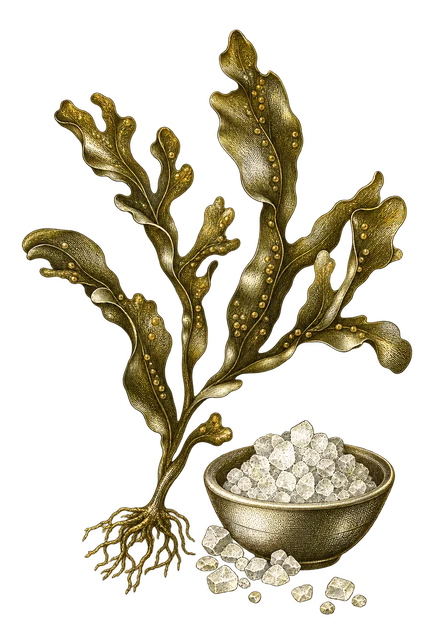
Iodine names the element; iodide is its negatively charged form, supplied in nutritional products as salts such as potassium iodide and sodium iodide. Seaweed contains iodine within a variable mixture of other biological components. Its species name and mass do not, by themselves, tell the iodine dose.
NIH ODS: Iodine, health-professional fact sheet
Purpose and source identity
The established nutritional purpose is adequate production of the thyroid hormones thyroxine (T4) and triiodothyronine (T3). Iodized salt has a public-health role in preventing deficiency-related goiter. Potassium iodide is a defined chemical source; “kelp” or “sea iodine” alone tells little about the iodine amount. A botanical family is not applicable to iodine itself.
Reading a product declaration
A label’s micrograms of iodine describe the nutrient contribution, not the weight of the kelp powder or of the entire iodide salt. Compare the declared amount per serving with the actual number of servings taken. Molecular iodine, often written I2, is a different chemical preparation from an iodide salt; results from a particular medical preparation cannot simply be assigned to edible seaweed.
NIH ODS: Iodine, health-professional fact sheet · Kessler, 2004: The Effect of Supraphysiologic Levels of Iodine on Patients with Cyclic Mastalgia
Food form matters
The food examples below describe cooked fish flesh, fluid milk and boiled egg, each with its own portion weight. They do not describe extracts or oils. Iodine in milk can vary with farming practices, and amounts in crops depend on their growing environment; a single database average is not a guarantee for every meal.
NIH ODS: Iodine, health-professional fact sheet · USDA, FDA and ODS-NIH: Iodine Content of Common Foods, Release 4.0, per serving, October 2024
Uses in brief

- Meet iodine needs through suitable foods and, when indicated, an appropriately selected supplement.
- Prevent or correct iodine deficiency under appropriate nutritional or clinical guidance.
History, folklore and reported uses
Planning an iodine-containing diet
People who avoid fish, eggs and dairy, including many vegans, need particular attention to iodine sources. An alternative plant drink is not nutritionally equivalent to milk unless its iodine contribution is established. Prenatal products also differ: some contain iodine and others do not. Review food choices and product labels together rather than assuming that a multivitamin or a salty diet covers the need.
Pregnancy research and deficiency prevention
Severe iodine deficiency can harm fetal and infant development. That established risk is different from proving that additional iodine improves development in every pregnancy. NIH summarizes two randomized trials that supplied potassium iodide from early pregnancy until delivery and assessed children at about 1.5–2 years: cognitive, language and motor scores did not improve. One trial also found no developmental benefit at age 5–6. These results do not establish that supplementation is unnecessary for someone at risk of deficiency; the broader evidence remains inconclusive for these developmental outcomes. Nutritional planning should therefore address the person’s diet and local guidance, not promise a developmental advantage from extra iodine.
Seaweed and sponge for goitre
Chinese medical writing associated seaweed with goitre, a visible swelling of the thyroid gland in the neck. Lee and Chiu’s historical review describes remedies attributed to the fourth-century physician Ge Hong and formulas recorded by Sun Simiao in 652. In medieval Europe, the Salerno medical tradition in southern Italy used marine sponge and dried seaweed for similar complaints. Stories assigning the remedy to Shennong, a legendary figure in Chinese medical origins, are not verified third-millennium-BCE prescriptions. These traditions predated today’s understanding of thyroid hormones.
Lee and Chiu (2021): Goiter disease in traditional Chinese medicine: Modern insight into ancient wisdom (historical review) · Stefan Slater, James Lind Library (2010): The discovery of thyroid replacement therapy (full original history, Chinese mythology distinction) · Michael B. Zimmermann (2008): Research on Iodine Deficiency and Goiter in the 19th and Early 20th Centuries (historical research) · Royal Society of Chemistry: Iodine, tinctures and disinfectant history
External antiseptic preparations
Following iodine’s nineteenth-century identification, alcohol-based solutions, called tinctures, became familiar disinfectants; later iodine-containing products continued that antiseptic role. These externally used chemical preparations have a different history and safety profile from dietary iodide or edible seaweed.
Royal Society of Chemistry: Iodine, tinctures and disinfectant history · DailyMed: Povidone Iodine Prep, 10% topical solution
Fibrocystic-breast advocacy
Contemporary holistic physician David Brownstein devotes a chapter of his iodine book to fibrocystic breast changes, which can involve lumpiness and discomfort, and breast cancer. This documents his iodine-centered approach. Separately, a 2004 randomized, double-blind trial studied oral molecular iodine against placebo in 111 otherwise healthy women with normal thyroid function, recurrent breast pain and breast fibrosis. Some pain and examination measures improved in the higher-dose groups during the six-month trial. It was a symptom trial in selected patients, not a cancer-prevention trial, and the author was affiliated with a pharmaceutical company.
David Brownstein: Iodine: Why You Need It, Why You Can’t Live Without It (primary source for modern holistic claims) · Kessler, 2004: The Effect of Supraphysiologic Levels of Iodine on Patients with Cyclic Mastalgia · NIH ODS: Iodine, health-professional fact sheet
“Detoxification” and competing halides
Brownstein’s modern iodine advocacy includes chapters on bromide and fluoride, chemical ions in the same elemental family as iodide, and detoxification. This attributed wellness framework goes beyond correcting an iodine deficiency.
David Brownstein: Iodine: Why You Need It, Why You Can’t Live Without It (primary source for modern holistic claims) · American Thyroid Association: Potential risks of excess iodine ingestion and exposure
Broader hormone and immune claims
Brownstein also promotes iodine for whole-body hormonal and immune support, extending the story beyond the thyroid gland. These are his stated holistic claims, distinct from the established public-health use of iodized salt against iodine deficiency.
Iodine in early portrait photography
The National Portrait Gallery records iodine’s role in making light-sensitive the silver surface of daguerreotype photographic plates, the commercial photographic process introduced in Paris in 1839. This is chemical-material history, not a dietary use.
From seaweed ash to iodine chemistry
In 1811, French saltpetre manufacturer Bernard Courtois noticed violet vapour while investigating seaweed-ash residues. Gay-Lussac and Davy helped establish the new element, whose name recalls the Greek word for violet. In Geneva, Switzerland, Jean-François Coindet connected iodine with older seaweed-and-sponge remedies and published treatment observations in 1820. The European Thyroid Association’s history also records a subsequent enthusiasm for iodine and reports of harm from uncontrolled use, an early reminder that treating an enlarged thyroid and preventing dietary deficiency are different problems.
Royal Society of Chemistry: Discovering iodine (Courtois, Davy’s period account and the naming of iodine) · European Thyroid Association: Jean-François Coindet, his 1820 reports and subsequent debate · Royal Society of Chemistry: Iodine, tinctures and disinfectant history
From the dispensary to iodized salt
Salt iodization began in Switzerland and the United States in the early 1920s. In Michigan, pediatrician David Murray Cowie drew on Swiss experience and worked with salt makers, physicians and public audiences. Retail iodized salt arrived in 1924. Fortifying a familiar ingredient made prevention easier to sustain than periodically giving a separate medicine. This history supports choosing suitable iodized salt within an existing sodium allowance, not increasing salt consumption.
Leung, Braverman and Pearce (2012): History of U.S. Iodine Fortification and Supplementation · Howard Markel: A Grain of Salt, Milbank Quarterly (Michigan’s 1924 salt-iodization history) · Royal Society of Chemistry: Iodine, tinctures and disinfectant history
Emergency thyroid blocking
Potassium iodide used after a radioactive-iodine release saturates the thyroid with nonradioactive iodine, reducing uptake of radioactive iodine. It protects only the thyroid against that specific exposure, not the whole body or all forms of radiation. Timing and suitability are determined by public-health or clinical instructions; shelter and other emergency measures still matter.
Identity & detailed reference
Identity
Iodine is an essential trace element used to make thyroid hormones. “Sea iodine” does not specify a seaweed species, chemical form or standardized iodine amount.
Ingredient details, preparation and research
Source plant or material
No single plant source. Isolated iodide salts are chemical ingredients; seaweed products need a species and iodine-content declaration.
Plant family / material: Not applicable to the element or isolated iodide salts; a seaweed ingredient requires its own species identification.
Forms and route
Potassium iodide, sodium iodide, multivitamins and seaweed-derived products. Sea salt supplies useful iodine only if it is iodized.
Food sources
Fish, dairy, eggs and labeled iodized salt; seaweed varies sharply by species and product. Many plant drinks contain little iodine unless fortified.
Vitamins and minerals
Reference examples: baked cod, 85 g (3 oz), about 146 mcg; skim milk, 245 g (1 cup, about 240 mL), 84 mcg; one large boiled egg, 50 g, 31 mcg. See the portion and variability notes below.
Absorption and preparation
Iodide is readily absorbed. A special fat, herb or mineral pairing is unnecessary; a seaweed source does not establish better absorption or safety.
Combination context
Ordinary meals can supply iodine without a special absorption blend. If salt is already used, an iodized version can contribute iodine within the same sodium allowance; increasing salt is not the goal.
Nutritional role and uses
Adequate iodine prevents iodine-deficiency disorders and supports thyroid-hormone production and early brain development. Extra iodine is not an established energy booster or general hormone treatment.
Contraindications and cautions
- Both deficiency and excess can disrupt thyroid function; existing thyroid disease can increase susceptibility to excess.
- Kelp and other seaweeds can supply unexpectedly high, variable amounts. Count all iodine-containing supplements.
- Review iodine products with antithyroid medicine. High-dose potassium iodide also warrants review with potassium-raising drugs.
- High iodine intake can add to the effect of antithyroid medicines such as methimazole and contribute to an underactive thyroid. Potassium iodide also warrants review with ACE inhibitors and potassium-sparing diuretics such as spironolactone because of possible high blood potassium. Bring all iodine-containing products to the review.
- Children have lower intake limits than adults. Infants, older adults, pregnant or breastfeeding people and those with existing thyroid disease can be particularly susceptible to excess. Tell the treating team about thyroid disease and iodine products before an iodine-containing contrast procedure; do not cancel a needed investigation without medical advice.
- For the cited 10% povidone-iodine solution, the label excludes eyes and large body areas and limits first-aid use beyond one week unless a doctor directs it. Deep punctures, animal bites and serious burns need medical advice. Avoid it if allergic or sensitive to the product, stop if irritation or redness develops, and consult a clinician if the condition persists beyond 72 hours. These instructions apply to that external product, not to oral nutritional iodide.
Similar items and how they compare
- Potassium iodide
This defined salt supplies iodide for the same thyroid-hormone synthesis function as iodine obtained from seaweed or other foods.
A defined salt identifies the chemical form; a seaweed product also contains a variable biological matrix.
- Kelp / seaweed preparations
These are biological iodine sources within this entry, historically consumed as foods and now also incorporated into supplements.
Species and growing conditions affect iodine concentration; “kelp” does not establish standardized iodine content.
Adult reference intakes and limits
U.S. total-intake RDAs at age 19 and older are 150 mcg/day, rising to 220 mcg in pregnancy and 290 mcg in lactation. The U.S. adult UL is 1,100 mcg/day from all sources, including pregnancy/lactation. EFSA’s adult total-intake UL is 600 mcg/day. These jurisdiction-specific limits are not intake goals or personal supplement doses. Micrograms may be written mcg or µg; 1 mg equals 1,000 mcg. These units are not interchangeable.
Realistic food portions
The 2024 USDA/FDA/NIH iodine database reports about 146 mcg in baked cod, 85 g (3 oz); 84 mcg in skim milk, 245 g (1 cup, about 240 mL); and 31 mcg in a large boiled egg, 50 g. These are food-content averages, not absorbed quantities. Cod samples ranged from 75 to 281 mcg per portion and milk from 38 to 160 mcg.
Iodized salt without extra sodium
The same database gives 78 mcg iodine for 1.5 g iodized table salt (1/4 teaspoon). That portion also brings roughly 580 mg sodium. It illustrates a contribution within an existing salt allowance, not a reason to add salt. Specialty salts are not reliably iodized. Read the label rather than assuming “sea” or “natural” means iodine-containing.
Seaweed variability and labeling
NIH describes iodine concentrations from 16 to 2,984 mcg per gram in commercial whole/sheet seaweeds. A generic gram amount is therefore unsafe as a universal iodine-dose guide; species, batch and processing matter. Read declared iodine per serving, and do not assume an absent iodine line on an ordinary food label means zero.
Absorption and everyday foods
Iodide is rapidly and nearly completely absorbed; maximizing uptake is seldom the nutritional problem. Reasonable amounts of soy and cruciferous vegetables need not be avoided by people eating a varied diet with adequate iodine. Their thyroid-uptake effects are not evidence that everyone needs a blocker-removal diet or extra iodine.
Excess and medicines
High intake can provoke hypothyroidism, hyperthyroidism or thyroid inflammation. The American Thyroid Association advises against routine iodine/kelp supplements exceeding 500 mcg/day; that caution is not a recommended dose below the threshold. Antithyroid medicine and high-dose potassium iodide with potassium-raising drugs need review. Pregnancy requires adequacy while avoiding excess. People with autoimmune thyroid disease may be sensitive even to intakes tolerated by the general population.
What cannot be inferred
Nonspecific fatigue or hair loss does not establish iodine deficiency. One spot urine iodine result is useful mainly for population assessment, not reliable individual diagnosis. Extra iodine should not be used to self-treat thyroid symptoms or replace prescribed thyroid care. Medical radioactive iodine and emergency thyroid-blocking protocols are separate uses. An unresolved thyroid assessment is a reason to review any proposed iodine supplement with the clinician first.
Nutritional, medical and topical preparations are different
Microgram-dose oral iodide in a nutritional product is different from high-dose medical iodine use. Lugol’s solution and saturated potassium iodide solution (SSKI) have selected, closely supervised medical uses; they are not routine nutritional replacements. Emergency KI is taken only when public-health officials or a clinician direct it for radioactive-iodine exposure; food and ordinary supplements are not substitutes. Topical povidone-iodine is an antiseptic for its labeled external route. Do not swallow it or use skin application to meet iodine needs. The product, concentration, route and intended purpose all matter.
Cod liver oil, selenium and NAC are not iodine safeguards
The food-composition estimate for cod refers to the fish flesh, not cod liver oil. Cod liver oil supplies omega-3 fats and vitamins A/D; do not count it as a measured iodine source unless that product’s iodine content is established. No guidance cited here recommends selenium or NAC as protection that makes excess iodine safe. Do not use either to justify high iodine intake; iodine adequacy and each other supplement’s purpose need separate assessment.
Evidence limits
- Adult population references only; no individual thyroid diagnosis, laboratory interpretation or dose is inferred.
- Food iodine varies substantially. Salt is shown for portion literacy, not to encourage sodium intake. Seaweed amounts are not standardized iodine doses.
Entry sources
- NIH ODS: Iodine, health-professional fact sheet
- NIH ODS: Iodine, consumer fact sheet
- American Thyroid Association: statement on excess iodine ingestion and exposure
- USDA, FDA and ODS-NIH: Iodine Content of Common Foods, Release 4.0, per serving, October 2024
- FDA: Sodium in Your Diet
- EFSA: Overview of tolerable upper intake levels and safe levels, version 11, August 2025
- USDA FoodData Central: SR Legacy records 173468
- American Thyroid Association: full statement on excess iodine, including medically supervised Lugol’s solution and SSKI
- CDC: Potassium Iodide (KI), January 30, 2025
- DailyMed: Povidone iodine topical solution label, external use only
- NIH ODS: Omega-3 Fatty Acids, cod liver oil supplies omega-3s and vitamins A and D
- National Portrait Gallery: Daguerreotype
Reference entry 54 · Recorded content review: 2026-10-06 · Review scope and dates