


Key cautions
- Use authenticated Equisetum arvense; avoid unverified foraged or raw material and species substitution.
- Do not use for urinary flushing when fluids must be restricted. Kidney disease, diuretics, lithium, pregnancy and breastfeeding require particular caution.
What’s inside
Silicic acid/silicates, partly water-soluble; kaempferol and quercetin glycosides; caffeic-acid-related phenolics and mineral salts. Trace pyridine alkaloids are variably reported. Composition varies. Fresh or unprocessed dried material may retain thiaminase, an enzyme that breaks down vitamin B1.
Identity, shoots and species control
Kew places Equisetum arvense in Equisetaceae. The usual medicinal shoots are sterile in the botanical sense: they do not bear spores. This does not mean microbiologically sterile. E. palustre and other horsetails may contaminate poorly identified material, so visual familiarity or the name horsetail grass is insufficient quality assurance.
Kew: Equisetum arvense, accepted name and Equisetaceae family · EMA: Horsetail assessment
Constituents and extraction
Silicates, flavonoid glycosides and mineral salts occur in the aerial material. Only part of its silicon is water-extractable. Raw-plant composition, a strained drink and a standardized dry extract therefore cannot be treated as identical exposures or assigned the same nutritional value.
EMA: Horsetail assessment · Waterstradt et al. (2022; online 2021): Silicon absorption from horsetail tea, 12-person pilot
Dry-herb percentages are not a tea serving
EMA’s assessment summarizes approximately 5–7.7 g of silicic acid or silicates per 100 g of dried sterile aerial herb, with only about a tenth of that fraction described as water-soluble. This is a dry-material composition range, not elemental silicon per cup, an absorbed amount or a recommended intake. Extraction method and the finished preparation matter; the figure cannot supply a vitamin or mineral Daily Value for an ordinary tea.
Thiaminase requires a processing distinction
EMA’s assessment reports thiaminase in fresh and dried plant and its inactivation by heat or certain industrial extraction processes. Animal poisoning and laboratory enzyme findings cannot quantify risk from every finished human product. Unheated powder deserves separate consideration; a home heating step does not authenticate the species or guarantee removal of all hazards.
Uses in brief

- Traditional urinary-flushing use; limited human diuretic evidence.
- Separate topical tradition for superficial wounds, with preliminary research on a prepared ointment.
History, folklore and reported uses
A brush-like plant in European herbal history
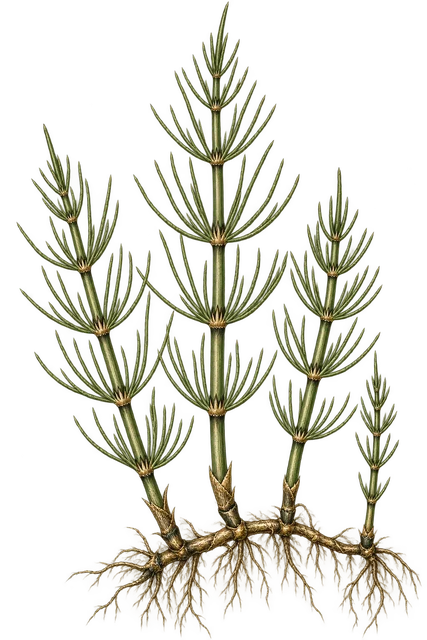
Field horsetail’s jointed stems and whorls of slender branches give it the appearance of a little green brush. It is a spore-bearing plant rather than a flowering herb, and its place in European natural medicine has had its own cycles of fashion. The EMA assessment, drawing on the physician and herbal writer Gerhard Madaus, describes horsetail in sixteenth-century herbals, a later decline in attention, and a nineteenth-century revival through Sebastian Kneipp’s nature-cure practice.
EMA: Horsetail assessment · EMA: Horsetail herb, adopted traditional-use conclusions and review status · Gerhard Madaus (1938): Equisetum arvense and E. hiemale, including Zinnkraut and pewter-scouring history · Oregon State University Horticulture: Field Horsetail
From remedy cupboard to cleaning cupboard
That revival connected a very ordinary field plant with care of the urinary tract and external washing or bathing traditions. Older pharmaceutical books gathered a much wider range of uses, from wounds and rheumatic complaints to brittle nails and hair loss. These are records of how herbalists understood the plant, rather than a single timeless European recipe. Madaus also preserves a very practical use behind its German name Zinnkraut, or “tin herb”: people used it to scour pewter. The stiff plant could belong to both the remedy cupboard and the cleaning cupboard.
EMA: Horsetail assessment · EMA: Horsetail herb, adopted traditional-use conclusions and review status · Gerhard Madaus (1938): Equisetum arvense and E. hiemale, including Zinnkraut and pewter-scouring history · Oregon State University Horticulture: Field Horsetail
Urinary tea and water elimination
European horsetail practice used the green aerial herb in infusions or decoctions for urinary complaints and increased water elimination. EMA traces this thread through early herbals and Kneipp’s nineteenth-century revival.
Wound washes and compresses
Kneipp’s nature-cure practice made external washing a prominent horsetail use. Later European compendia recorded aerial-herb decoctions as supportive washes for poorly healing wounds.
Baths for rheumatic discomfort
Twentieth-century European herbal textbooks preserved horsetail baths for rheumatic complaints and gout. Here the aerial herb supplied a bath preparation, distinct from drinking its urinary tea.
Brittle nails and hair loss
EMA’s historical survey records horsetail preparations as adjuncts for splitting nails and loss of hair in European pharmaceutical textbooks. The material was the herb; those summaries do not preserve one standard cosmetic recipe.
Historical bleeding-control remedies
European pharmaceutical texts summarized by EMA record field-horsetail herb for nosebleeds and excessive menstrual bleeding, within a wider blood-staunching tradition. These historical uses should not delay assessment of significant or unexplained bleeding.
Scouring household pots
Oregon State University records the former use of field horsetail, Equisetum arvense, for scrubbing and cleaning pots. Silica in its stems supplied the abrasive texture behind the name scouring rush, giving the aerial plant a practical household role beyond herbal preparations.
Traditional use and present regulatory status
EMA recognizes urinary flushing for minor complaints and external superficial-wound use on a traditional-use basis, not established clinical efficacy. The agency’s current page still displays the adopted 2016 monograph and a 2025 call for review data. A request for new evidence is not a newly approved indication.
EMA: Horsetail herb, adopted traditional-use conclusions and review status
Two kinds of seasonal shoots
Field horsetail grows from underground rhizomes and produces two visually different shoots. Pale, unbranched fertile stems carry spore-bearing cones early in the year; the later green shoots have the familiar branching form. These life-cycle features explain the word sterile on medicinal-material descriptions, but they are not a field-identification key. Related horsetails cannot be substituted on the basis of a common name.
Oregon State University Horticulture: Field Horsetail · EMA: Horsetail assessment
Identity & detailed reference
Identity
Equisetum arvense L. is a spore-bearing horsetail, not a true grass. The medicinal material is chiefly dried sterile green aerial shoots; other Equisetum species are not equivalent.
Ingredient details, preparation and research
Source plant or material
Equisetum arvense L.; usually the dried, sterile green aerial shoots. Sterile means non-spore-bearing, not microbiologically sterilized.
Plant family / material: Equisetaceae, the horsetail family; not Poaceae, the true grasses.
Forms and route
Comminuted herb for oral tea; manufactured juice, liquid and dry extracts, and powders/capsules. Separate skin preparations include infusions, decoctions and ointments. A defined silicon supplement or silica-standardized extract is not whole herb.
Vitamins and minerals
Silicon has no established RDA or Adequate Intake. Total plant silica does not equal the amount extracted into tea or absorbed. Usual horsetail teas/extracts should not be counted as reliable calcium, magnesium or vitamin sources; a skin preparation is not dietary supplementation.
Absorption and preparation
In a 12-man pilot, specific horsetail teas raised serum silicon. The stronger preparation caused diarrhea in four participants. This demonstrates absorption under study conditions, not a beneficial dose or hair/bone outcome; capsules, tinctures and purified silicon products may behave differently.
Practical preparation
Choose a product specifying Equisetum arvense, plant part, processing and intended route. Follow its instructions; do not turn a trial extract into spoonfuls of wild plant or use raw powder as a nutritional booster. Heating and extraction can remove enzyme activity, but no universal home recipe or species-safety guarantee follows. Use skin-labeled products only as directed.
Combination notes
Urinary blends may include nettle or other herbs. More ingredients do not prove greater benefit and may add fluid-balance risks. Hair/nail blends and purified-silicon trials cannot identify a horsetail effect; assess the actual formulation and avoid duplicate supplements.
Traditional and reported uses
- European traditional use includes increasing urine output for minor urinary complaints and separate external use for superficial wounds.
- Small trials have studied an oral dry extract for acute diuresis and blood pressure, and a specific ointment after episiotomy. These do not establish routine self-treatment with tea.
- Hair, nail and bone-support marketing exceeds direct evidence for ordinary horsetail preparations; silicon absorption is not proof of regrowth, fracture prevention or osteoporosis treatment.
Contraindications and cautions
- Select quality-controlled Equisetum arvense. Toxic/confusable species, including E. palustre, and inadequately processed raw material are not substitutes.
- Urinary-flushing use is contraindicated when reduced fluid intake is advised, including severe heart or kidney disease. Other kidney problems also warrant professional review.
- Do not combine casually with diuretics, lithium or blood-pressure treatment; altered fluid balance or additive effects are concerns, not quantified interactions proven for every preparation.
- EMA does not recommend medicinal use under 12, oral use during pregnancy/breastfeeding, or cutaneous use during pregnancy because evidence is inadequate. For breastfeeding, its separate cutaneous guidance says not to apply to the breast; this does not establish safety for every skin product.
- Allergy and mild stomach/gut symptoms can occur. Fever, painful urination, blood in urine, infected wounds or symptoms persisting beyond a week need assessment. Oral products are not substitutes for wound care.
- Avoid prolonged high-dose use, particularly with liver disease. LiverTox reports uncertain liver-test signals without a convincing link to jaundiced liver injury.
Similar items and how they compare
- Stinging nettle leaf
Shares traditional European use for increased urine output in minor urinary complaints.
It is a different plant, with leaves rather than horsetail shoots; neither is suitable during required fluid restriction.
- Silicon and silica
Shares silicon-containing chemistry and interest in hair, nails and connective tissue.
Defined silicon formulations differ from whole horsetail; their trial results cannot establish benefits for horsetail tea or capsules.
Human diuresis evidence
A 2014 randomized crossover trial in 36 healthy men tested a standardized dry extract, placebo and hydrochlorothiazide in four-day periods. The extract increased urine output relative to placebo without significant electrolyte changes in that short study. This does not establish treatment of edema, urinary infection or chronic kidney disease, or long-term electrolyte safety.
The later blood-pressure trial
A 2022 trial compared standardized horsetail extract with hydrochlorothiazide in 58 adults with stage-I hypertension over three months. Blood pressure fell in the extract group, with no statistically significant between-group difference reported. Small active-comparator data do not prove therapeutic equivalence, long-term cardiovascular protection or that an ordinary tea can replace a prescribed antihypertensive.
Topical human research is separate
A 2015 placebo-controlled trial in 108 women after episiotomy reported better wound-healing and pain scores with a specific 3% horsetail ointment. This was a manufactured study preparation for a defined setting; one trial does not validate home decoctions on surgical wounds or establish oral-use safety during breastfeeding.
Silicon absorption and hair/bone claims
The silicon pilot involved 12 healthy men and specially prepared teas, not treatment of hair loss or osteoporosis. Serum silicon rose; diarrhea occurred in four participants on the more concentrated tea. The frequently cited hair study instead used choline-stabilized orthosilicic acid. Its results cannot be assigned to horsetail. No RDA or Adequate Intake for silicon has been established.
Fluid balance, kidney disease and medicines
The key contraindication for flushing is a medical need to restrict fluids. Kidney impairment warrants individual review. Some licensed Canadian products specifically prohibit use with lithium, digitalis or other diuretics. EMA reports no established clinical interactions for its assessed preparations; a cited lithium-toxicity blend contained a different horsetail species, so it does not prove an E. arvense interaction.
Other safety and practical limits
EMA advises against medicinal use under 12, oral use during pregnancy/breastfeeding, and cutaneous use during pregnancy because data are inadequate. Its cutaneous guidance for breastfeeding specifically excludes application to the breast; it is not a general safety clearance for all skin products. Stop for allergy or significant gastrointestinal symptoms. LiverTox considers liver injury unconvincingly established but urges caution with high-dose, prolonged exposure, especially in liver disease. Urinary warning symptoms and worsening wounds require clinical assessment.
Nutrition, similar items and combinations
Nettle leaf shares a urinary-use tradition but is chemically different. Purified silicon products share an element, not a clinically interchangeable botanical. A mineral-rich dry plant does not establish meaningful vitamin or mineral delivery from a normal strained tea, and applying horsetail to skin does not supply dietary nutrients.
Entry sources
- Kew: Field horsetail
- EMA: Horsetail assessment
- EMA: Horsetail monograph
- NIH LiverTox: Horsetail
- EMA: Nettle leaf
- Silicon formulation hair trial
- Human pilot study of silicon absorption from horsetail tea
- National Academies: Silicon, dietary reference intake assessment
- EMA: Horsetail herb, adopted traditional-use conclusions and review status
- Carneiro et al. (2014): Acute diuresis crossover trial in 36 healthy men
- Carneiro et al. (2022): Three-month horsetail-extract hypertension trial
- Asgharikhatooni et al. (2015): Horsetail ointment after episiotomy, placebo-controlled trial
- National Academies: Dietary Reference Intakes, silicon summary
- Health Canada: Licensed horsetail tea example, product-specific contraindications
- Oregon State University Horticulture: Field Horsetail
Reference entry 83 · Recorded content review: 2026-10-05 · Review scope and dates