


Key cautions
- Avoid gums and soft tissues; repeated contact can burn, ulcerate or cause allergy. Do not use for teething or swallow as a home remedy.
- Seek product-specific advice for children, pregnancy/breastfeeding and anticoagulants. Toothache needs a dentist even if temporarily numbed.
- Do not copy concentrated-oil test conditions onto skin. Concentrated clove oil can cause burns, eugenol allergy and poisoning.
What’s inside
Eugenol predominates, accompanied by eugenyl acetate and beta-caryophyllene, with smaller related volatiles. Bud, leaf and stem oils differ; origin and extraction change the proportions.
Unequivocal Identification of 1-Phenylethyl Acetate in Clove Buds and Clove Essential Oil · Simultaneous determination of aromatic and terpenic constituents of cloves · Srivastava et al. (2005): Bud and leaf essential-oil composition of Syzygium aromaticum
Uses in brief

- Traditional temporary relief of cavity-related toothache while arranging dental care.
- Selected formulated products have a traditional mouth/throat use; a household aromatherapy bottle is not a dental medicine by default.
- Mosquito-repellent research: clove essential oil deterred bites in a laboratory study using human volunteers. This experimental use concerns oil, not culinary cloves or clove tea. The cited abstract does not specify the oil’s plant part; its findings should not be assigned to every bud, leaf or stem oil.
History, folklore and reported uses
Temporary toothache relief
The European Medicines Agency’s clove-bud-oil assessment records specified preparations used for temporary toothache relief. This household association continues alongside professional dental uses of clove constituents.
European Medicines Agency: Final assessment report on clove flower and clove-bud oil · EMA: Clove-bud oil monograph · MedlinePlus: Eugenol oil overdose
Minor mouth and throat inflammation
The assessment also records clove-bud oil in preparations for minor inflammation of the mouth and throat. These are formulated local medicines, distinct from chewing a culinary clove.
European Medicines Agency: Final assessment report on clove flower and clove-bud oil · EMA: Clove-bud oil monograph · MedlinePlus: Eugenol oil overdose
Muscular and rheumatic comfort
AromaWeb’s profile, drawing on aromatherapy author Valerie Ann Worwood, lists clove-bud oil in preparations for muscle pain, rheumatic discomfort and tired limbs. Its warming reputation concerns formulated aromatic care.
AromaWeb: Clove bud essential oil, uses attributed to aromatherapy authors
Digestive discomfort in aromatherapy
Worwood’s uses, reproduced by AromaWeb, include nausea, flatulence and abdominal cramping. This documents an aromatherapy repertoire rather than providing a home oral dose of the concentrated oil.
AromaWeb: Clove bud essential oil, uses attributed to aromatherapy authors · EMA: Clove-bud oil monograph · MedlinePlus: Eugenol oil overdose
Cold-season and chest blends
The same practitioner record includes clove-bud oil in blends intended for flu symptoms and bronchitis. This is a reported respiratory-care purpose of the bud distillate, not a claim for every clove leaf or stem oil.
AromaWeb: Clove bud essential oil, uses attributed to aromatherapy authors · EMA: Clove-bud oil monograph · MedlinePlus: Eugenol oil overdose
Carnation and spicy perfume accords
Givaudan identifies steam-distilled Indonesian clove-bud oil as a perfume ingredient for spicy and leathery notes, and for blends recreating the scent of carnations. Its product record specifies dried Syzygium aromaticum flower buds.
Mosquito repellency in research
Clove oil has also been investigated as a mosquito repellent; see the detailed research and its preparation-specific limitations.
Trongtokit et al. (2005): Comparative repellency of 38 essential oils against mosquito bites · EMA: Clove-bud oil monograph · MedlinePlus: Eugenol oil overdose
A flower bud caught in the spice trade
A clove is an unopened flower bud from a tree originating in Indonesia’s Maluku islands. Kew describes the Dutch East India Company destroying trees outside its strongholds to control production and trade. Later movement of trees to other tropical islands reshaped that trade. The culinary spice’s warm scent carries a history of long-distance exchange and coercion; this history of whole buds is separate from that of concentrated clove oil.
Royal Botanic Gardens, Kew: Syzygium aromaticum, spice-trade history and dentistry
From the spice cupboard to dentistry
Kew connects clove’s longstanding toothache reputation with later professional use of eugenol, one of its constituents, in dental materials. Culinary buds, steam-distilled bud oil, leaf oil and isolated eugenol are different materials, even when their characteristic scent seems familiar.
Royal Botanic Gardens, Kew: Syzygium aromaticum, spice-trade history and dentistry · European Medicines Agency: Final assessment report on clove flower and clove-bud oil
Regional reading paths
These sourced notes describe cultivation, trade, food traditions or material history. A regional connection does not claim exclusive origin.
Asia
Cultivated source plant: Indonesia and India; distillation yields a distinct concentrated material.
Fragrance and regulated formulated uses; no ingestion or neat-skin recommendation.
Identity & detailed reference
Identity
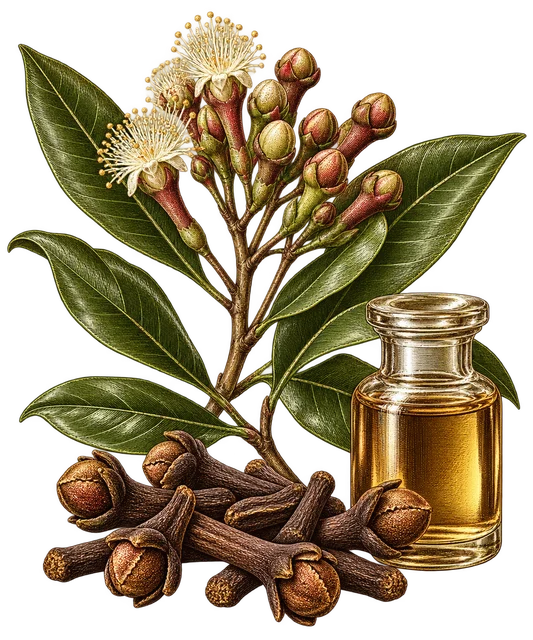
Syzygium aromaticum (L.) Merr. & L.M.Perry (older names include Eugenia caryophyllata and Eugenia caryophyllus). Medicinal clove-bud oil is steam-distilled from dried flower buds; clove leaf/stem oils and culinary buds are different preparations.
Ingredient details, preparation and research
Source plant or material
Syzygium aromaticum (L.) Merr. & L.M.Perry; distilled dried flower buds.
Plant family / material: Myrtaceae (myrtle family).
Forms and route
Specifically labeled dental/oral-care medicines and carefully formulated external products. A household aromatherapy bottle is not automatically an appropriate dental preparation; no home ingestion or mouthwash recipe is provided here.
Vitamins and minerals
Not a dietary vitamin or mineral source. Clove essential oil does not provide the manganese associated with whole ground cloves; dental products are medicines, not nutrient supplements.
Absorption and preparation
Clove oil's eugenol can act locally in properly formulated dental products; that is different from nutritional absorption. Use only a product labelled for the intended site and follow its directions. Concentrated oil can injure oral tissues, and swallowing it is not a way to improve delivery.
Traditional and reported uses
- Traditional dental use: temporary numbing of toothache associated with a cavity, while arranging dental care.
- European traditional medicinal use: formulated preparations for minor mouth or throat inflammation. This does not authorize applying concentrated oil to gums.
- Mosquito-repellent research: clove essential oil deterred bites in a laboratory study using human volunteers. This experimental use concerns oil, not culinary cloves or clove tea. The cited abstract does not specify the oil’s plant part; its findings should not be assigned to every bud, leaf or stem oil.
Contraindications and cautions
- Clove oil can burn or ulcerate mouth tissues, damage gums with repeated contact and cause contact allergy. Avoid with clove/eugenol or Peru-balsam allergy; do not use for teething. Swallowing concentrated oil can cause serious liver injury, seizures and clotting problems. A UK product label warns of possible enhanced platelet inhibition with anticoagulants such as warfarin; this is not a proven effect of every exposure. EMA does not establish medicinal use below age 18, while some national dental labels have different age limits; get product-specific professional advice for a child. Medicinal use is not recommended during pregnancy/breastfeeding without professional guidance. Seek dental attention for toothache, and urgent poison-service advice after accidental ingestion.
- Do not copy concentrated-oil test conditions onto skin. Concentrated clove oil can cause burns, eugenol allergy and poisoning.
Similar items and how they compare
- Clove spice
The same plant supplies the dried culinary buds and the eugenol-rich bud oil.
Spice retains the whole food matrix; distilled oil concentrates volatiles and does not supply its manganese or fiber.
- Tea tree essential oil
Both are concentrated Myrtaceae oils used in formulated topical products, with aromatic chemistry quite different from fatty carrier oils.
Tea tree emphasizes terpinen-4-ol; clove emphasizes eugenol and has distinct dental cautions.
- Ylang-ylang essential oil
Both can contain beta-caryophyllene and contribute strong fragrance to formulated products, although their leading aroma molecules differ considerably.
Clove is spicy and eugenol-rich; ylang-ylang is floral with fraction-dependent esters.
Plant, part and names
The source is Syzygium aromaticum, family Myrtaceae; Eugenia caryophyllata and E. caryophyllus are older synonyms. The medicinal material addressed by EMA is oil distilled from dried flower buds. Products labeled clove leaf or clove stem oil have different source material and composition; they should not inherit bud-oil directions automatically.
Constituents and concentration
Eugenol is usually the leading constituent, accompanied by beta-caryophyllene, eugenyl acetate and smaller aroma compounds. An analytical study’s bud oil contained 86.3% eugenol, but this is one sample, not a guarantee for every bottle. The distillate is chemically and nutritionally different from ground spice or a fatty carrier oil.
Traditional role and limits
EMA’s traditional-use monograph covers selected oromucosal preparations for minor mouth/throat inflammation and dental preparations for temporary pain from a cavity. The UK Clove Oil BP product is labeled for temporary toothache relief. These narrow local uses do not establish swallowed oil as a treatment for systemic infections or digestive disease.
Human evidence must match the preparation
A small dental experiment in 73 volunteers found that a clove gel reduced needle-stick pain compared with placebo. A gel is not an undiluted essential-oil bottle, and this endpoint is not treatment of tooth decay or an abscess. Antimicrobial results from laboratory testing do not replace dental source control or prescribed treatment.
Route, formulation and local action
Choose only a product explicitly labeled for the intended dental or skin use and follow its directions. A mouthwash, dental solution, finished skin product and diffuser oil are not equivalent. Local numbing at the application site is not nutritional absorption. No concentrated oral recipe, home mouthwash recipe or general drop-count dilution is provided here.
Irritation and allergy
Keep dental oil off gums and surrounding soft tissues unless an appropriate finished product specifically directs otherwise. Repeated use can damage gums; contact dermatitis, lip inflammation and mouth ulceration are described. Avoid clove/eugenol or Peru-balsam hypersensitivity. Stop a product that causes burning, swelling or rash rather than interpreting irritation as evidence that it is working.
Swallowing and accidental exposure
Swallowed concentrated oil has caused severe poisoning, including seizures, low blood sugar, clotting abnormalities and liver injury, particularly in young children. Store securely. Following an accidental ingestion, seek prompt poison-service or emergency guidance; do not induce vomiting unless specifically directed. LiverTox distinguishes these overdoses from lower exposures not convincingly linked to liver injury.
Children, pregnancy and breastfeeding
EMA states that medicinal use below age 18 is not established because data are inadequate; the particular UK dental label permits older children under different directions but excludes teething and children under two. These are different product/regulatory scopes, not a universal home-use age rule. Seek professional advice for children; medicinal pregnancy/breastfeeding safety is not established.
Interactions without exaggerating certainty
EMA’s monograph lists no reported interactions, while Clove Oil BP warns about possible additional platelet inhibition with anticoagulants such as warfarin. Preserve that warning and check the exact product with a pharmacist, but do not present it as a quantified or inevitable interaction. The precaution should not automatically be transferred to a pinch of culinary spice.
Absorption and nutrient distinction
Human research on administered eugenol demonstrates rapid absorption and extensive metabolism, but does not justify ingesting concentrated clove oil. Proper dental products act locally. Distilled essential oil is not a useful dietary vitamin/mineral source and should not be credited with the manganese, protein or fiber values of whole ground cloves.
Similar items and evidence status
Clove spice is the closest botanical comparison. Tea tree is another Myrtaceae essential oil, but has different leading constituents and indications; ylang-ylang shares some aroma constituents without sharing clove’s dental role. EMA’s 2020 periodic review, published in 2021, found no evidence requiring revision of its traditional-use monograph.
Mosquito repellency in research
Laboratory human-bite screening. Clove ranked strongly among screened oils. The best results involved highly concentrated oil; that is not evidence for a safe DIY skin product or a commercial-product duration. The abstract does not establish equivalence across bud, leaf and stem oils.
Entry sources
- EMA: Clove-bud oil monograph
- Clove Oil BP: Product information
- Kew: Syzygium aromaticum
- Unequivocal Identification of 1-Phenylethyl Acetate in Clove Buds and Clove Essential Oil
- Simultaneous determination of aromatic and terpenic constituents of cloves
- EMA: Clove flower oil monograph
- NCI: Essential-oil composition and routes of use
- Srivastava et al. (2005): Bud and leaf essential-oil composition of Syzygium aromaticum
- Alqareer et al. (2006): Clove gel versus benzocaine/placebo before needle insertion
- Machado et al. (2011): Clove oil and eugenol against Giardia; in-vitro study
- MedlinePlus: Eugenol oil overdose
- NIDDK LiverTox: Eugenol (Clove Oil), reported uses and overdose toxicity
- Fischer et al. (1990): The metabolism of eugenol in man
- USDA FoodData Central: Spices, cloves, ground (FDC 171321)
- EMA: Clove-bud oil periodic review (2020; published 2021), no revision required
- Givaudan: Clove Bud Oil Indonesia
- Trongtokit et al. (2005): Comparative repellency of 38 essential oils against mosquito bites
Reference entry 38 · Recorded content review: 2026-10-05 · Review scope and dates