


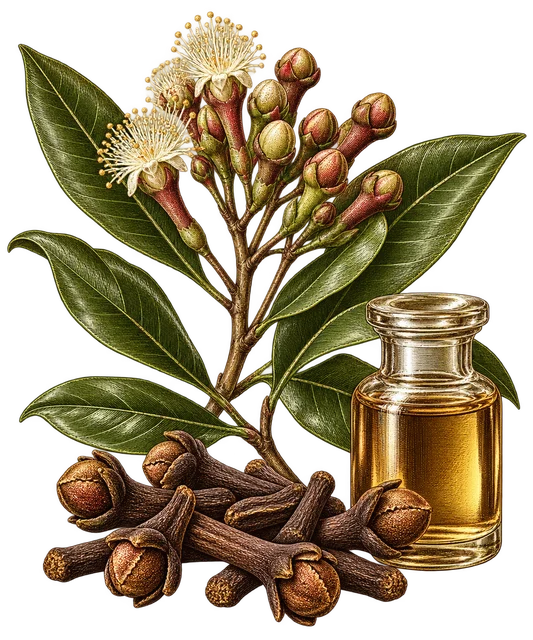
Key cautions
- Avoid with clove/eugenol allergy, and stop if mouth irritation occurs.
- Do not substitute essential oil for the spice. Concentrated medicinal use needs extra care with anticoagulants, pregnancy, breastfeeding and children.
- Do not replace diabetes treatment with cloves or a clove extract. If considering a medicinal extract while taking glucose-lowering medicine, ask a clinician or pharmacist to review the specific product. The small pilot does not establish a clinically important interaction from ordinary seasoning.
- If a child swallows clove oil, or an unintended ingestion or poisoning is suspected, seek urgent poison-service or medical advice. Do not induce vomiting. These are concentrated-oil precautions, not a description of ordinary culinary exposure.
What’s inside
Whole ground buds provide nutrients and a mixture of aromatic and nonvolatile plant compounds. A water infusion extracts only part of the bud; alcohol extracts and distilled oil concentrate different mixtures. None is nutritionally or medically interchangeable with a pinch of spice.
USDA FoodData Central: primary SR Legacy food, nutrient and portion data · Gassenmeier et al. (2017): Clove buds and the composition of clove-bud oil
Nutrients in a small seasoning portion
USDA lists a teaspoon of ground cloves as 2.1 g. A quarter teaspoon is about 0.53 g. Most nutrient amounts are small at this portion, although manganese is appreciable. This is a ground-clove measure, not a spoon measure for every herb; use amounts for flavor rather than increasing intake to chase nutrients.
- Energy: about 1.4 kcal
- Carbohydrate: 0.34 g, including about 0.18 g fiber
- Protein: 0.03 g; total dietary fat: 0.07 g
- Manganese: 0.32 mg, about 14% of the Daily Value
- Calcium: 3.3 mg; iron: 0.06 mg
- Magnesium: 1.4 mg; potassium: 5.4 mg
USDA FoodData Central: primary SR Legacy food, nutrient and portion data · FDA: Daily Values for nutrition labels
Eugenol and the aromatic oil
Eugenol is the principal aromatic constituent of clove-bud oil, accompanied by eugenyl acetate and beta-caryophyllene. Chemical analysis also confirmed a much smaller aroma compound, 1-phenylethyl acetate, in the buds themselves. Oil percentages describe the distilled volatile fraction, not the concentration in a bud, food or tea. Culinary cloves are buds; a bottle labeled clove-leaf oil comes from a different plant part.
Gassenmeier et al. (2017): Clove buds and the composition of clove-bud oil
Phenolic acids, flavonoids and tannins
The EMA assessment records nonvolatile constituents including gallic and ellagic acids, flavonoids such as quercetin and kaempferol derivatives, and ellagitannins, a group of tannins that includes eugeniin. Some flavonoids occur as glycosides, molecules with sugars attached. These chemical groups help describe the bud, but their presence alone does not establish a health benefit or a medicinal dose.
EMA (2011): Assessment report on clove flower buds and clove-bud essential oil
Uses in brief

- Seasoning in savory dishes, baking and spiced drinks.
- Reported traditional digestive and breath-freshening uses; dental pain relief depends on the preparation and does not treat infection.
History, folklore and reported uses
From Maluku to tropical cultivation
Native to Indonesia’s Maluku Islands, clove is cultivated in Zanzibar, part of Tanzania, Madagascar and Sri Lanka. Kew connects its spread with international trade and colonial competition.
Kew: Syzygium aromaticum, geography and uses, accessible Colplanta profile
An everyday spice
Cloves season stews, rice, curries, baked goods and hot drinks. Garam masala, Chinese five-spice and European winter drinks, including mulled wine, show the bud’s reach across cuisines.
Kew: Syzygium aromaticum, geography and uses, accessible Colplanta profile
Digestion and the household apothecary
Asian traditions, including Ayurveda, used clove for digestive cramps and wind. LiverTox also records nausea, abdominal pain and diarrhea. Preparations moved between kitchen, perfumery and apothecary.
Kew: Syzygium aromaticum, geography and uses, accessible Colplanta profile · NIH LiverTox: Eugenol and clove-oil poisoning
Toothache and breath freshening
Clove preparations addressed toothache and mouth inflammation; fragrant buds separately freshened breath. Eugenol later entered professional dental materials.
Kew: Syzygium aromaticum, geography and uses, accessible Colplanta profile · EMA (2011): Assessment report on clove flower buds and clove-bud essential oil
Gargles and minor-wound cleansing
Kew records clove gargles for sore throats and external minor-wound cleansing.
Kew: Syzygium aromaticum, geography and uses, accessible Colplanta profile
Fragrant keepsakes from the Spice Islands
The Horniman Museum describes miniature tea sets made from dried cloves in Maluku. They were scented souvenirs, not working tableware. The museum also records an ongoing craft tradition on Ambon, one of the Maluku Islands, making miniature boats and other decorative objects.
A jewel intended to protect its wearer
A sixteenth-century German pomander in the Metropolitan Museum has a compartment labeled for clove. Pomanders were containers for aromatic materials, sometimes worn as jewelry. The museum connects them with historical beliefs about cleansing air and warding off disease, not proven infection prevention.
Metropolitan Museum of Art: Sixteenth-century German pomander
An early blood-glucose extract study
A 2019 open-label pilot gave a standardized clove-bud extract to 13 otherwise healthy volunteers for 30 days, without a placebo group. The extract was made with alcohol and water, then dried. Post-meal glucose readings fell; pre-meal readings fell only in the group with higher starting values. Those pre-meal measurements were not overnight fasting tests. The small uncontrolled study cannot establish diabetes treatment or effects from culinary cloves. The manufacturer funded the work, and some authors worked for the manufacturer or sellers.
Mohan et al. (2019): Open-label clove-polyphenol extract glucose pilot
Regional reading paths
These sourced notes describe cultivation, trade, food traditions or material history. A regional connection does not claim exclusive origin.
Africa
Introduced/cultivated: Madagascar, Comoros and Tanzania’s Zanzibar islands.
Dried flower buds used as spice; not essential oil.
Asia
Cultivated: Indonesia and southern India.
Unopened dried flower buds used as spice.
Identity & detailed reference
Identity
Syzygium aromaticum (L.) Merr. & L.M.Perry; dried unopened flower buds sold whole or ground. Older synonyms include Eugenia caryophyllata and Eugenia caryophyllus. This is the culinary spice, distinct from the distilled essential oil in entry 38.
Ingredient details, preparation and research
Source plant or material
Syzygium aromaticum (L.) Merr. & L.M.Perry; dried unopened flower buds, native to the Maluku Islands.
Plant family / material: Myrtaceae (myrtle family).
Forms and route
Whole dried buds, ground spice, culinary infusions and commercial extracts. An infusion, an alcohol extract and distilled clove oil have different compositions and concentrations; they are not dose-equivalent.
Traditional and reported uses
- Food use: a strong, warm spice for rice dishes, curries, stews, baked goods and spiced drinks. Whole buds infuse flavor; ground cloves disperse through the food.
- Traditional/reported use: digestive discomfort, including nausea, abdominal discomfort and diarrhea, and freshening the breath. These are attributed uses, not established treatments.
- Traditional dental use: clove-derived eugenol has been used for temporary local toothache relief. Appropriate dental products and their cautions are covered in entry 38; chewing cloves or using spice does not treat a dental infection.
- Popular herbal practice: clove appears in parasite-cleansing blends, sometimes with claims that it kills parasite eggs. Laboratory studies of clove oil/eugenol, including a Giardia study, do not establish that swallowing clove spice or a blend eliminates human parasites or their eggs. Suspected infection needs diagnosis and organism-specific treatment.
Contraindications and cautions
- Ordinary seasoning and concentrated medicinal products involve different exposures. Avoid with clove/eugenol allergy; prolonged direct contact or repeated chewing may irritate the mouth.
- Concentrated clove oil can injure oral tissues, and swallowing it can cause severe poisoning, including liver injury, seizures and clotting problems, particularly in children. Do not substitute an essential-oil bottle for culinary cloves.
- A clove-oil medicine label warns of possible added platelet inhibition with anticoagulants such as warfarin. The magnitude of any interaction from ordinary seasoning is uncertain; discuss concentrated extracts or regular medicinal use with a pharmacist, especially with bleeding disorders or before surgery.
- Safety of concentrated medicinal use during pregnancy or breastfeeding is not established. Food use does not establish the safety of supplements, strong extracts or children's home remedies.
- Do not replace diabetes treatment with cloves or a clove extract. If considering a medicinal extract while taking glucose-lowering medicine, ask a clinician or pharmacist to review the specific product. The small pilot does not establish a clinically important interaction from ordinary seasoning.
- If a child swallows clove oil, or an unintended ingestion or poisoning is suspected, seek urgent poison-service or medical advice. Do not induce vomiting. These are concentrated-oil precautions, not a description of ordinary culinary exposure.
Similar items and how they compare
- Clove essential oil
The same botanical source and eugenol-rich aroma connect the spice with the oil.
Spice is the dried bud; essential oil is a concentrated distillate with much greater irritation and poisoning risks. They are not interchangeable.
- Ginger
Both are warming culinary spices with traditional digestive uses and are used in foods or infusions.
Ginger uses a rhizome rich in gingerols and shogaols; clove uses flower buds with eugenol-rich volatile oil. Similar culinary roles do not imply the same clinical effects.
Identity, family and plant part
Syzygium aromaticum belongs to Myrtaceae and is native to the Maluku Islands. The familiar nail-shaped spice is an unopened flower bud that has been dried. Older literature and labels may use Eugenia caryophyllata or Eugenia caryophyllus; the accepted botanical name and plant part help distinguish a food bud from leaf oil or other extracts.
Human dental research is preparation-specific
In a randomized, subject-blinded experiment with 73 adult volunteers, a clove-powder gel prepared for the study and a benzocaine gel reduced needle-stick pain compared with their placebos. This was topical use before needle insertion, not swallowed cloves, a trial of clove essential oil, or treatment of an abscess. The comparison does not establish that cloves replace dental anesthesia or care, and it is not a do-it-yourself gel recipe.
Parasite and antimicrobial claims
Clove oil and isolated eugenol showed activity against Giardia trophozoites, the actively feeding form of the parasite, in laboratory culture. The experiment did not test people eating cloves, a three-herb cleanse or the claim that cloves kill parasite eggs. Laboratory activity does not establish a human parasite treatment; suspected infection needs diagnosis and organism-specific care.
Practical food use and absorption
Use whole or ground cloves to the recipe’s taste; remove or strain whole buds before serving where appropriate. Grinding disperses flavor but is not proven to improve a clinical effect. A small human study found rapid absorption and extensive metabolism of administered eugenol, which does not establish the efficacy of clove tea or supplements. No special absorption-enhancing food pairing is established, and taking essential oil is not an appropriate absorption strategy.
Food-level combinations
Ground clove pairs with ginger and cinnamon for flavor in food; a USDA-hosted couscous-and-chickpea recipe uses this combination, and Kew notes clove in garam masala and Chinese five-spice. This is a culinary pairing, not proven therapeutic synergy or an absorption booster. Use a food recipe rather than translating the blend into medicinal doses.
Food exposure versus concentrated-product cautions
Clove/eugenol can irritate tissues or cause allergy; repeated direct mouth contact can be troublesome. Severe liver injury, seizures and clotting problems are reported after concentrated-oil overdose, especially in children. Those poisoning reports are not evidence that normal seasoning causes the same injury. Keep essential oils out of children’s reach.
Medicines, pregnancy and children
The Clove Oil BP label warns of possible increased platelet inhibition with anticoagulants such as warfarin. This is a concentrated-product warning, not a measured interaction from occasional culinary use. Ask before regular medicinal extracts, particularly with bleeding risk. Pregnancy, breastfeeding and child-safety evidence for such products is insufficient; food use does not establish a safe home-remedy dose.
Similar items
Clove essential oil comes from the same plant but is a concentrated distillate with different dosing and safety limits. Ginger shares culinary and traditional digestive roles, but uses a rhizome with gingerols and shogaols rather than clove’s flower buds. Their flavor roles are useful comparisons, not evidence of interchangeable medicinal effects.
Entry sources
- NIH LiverTox: Eugenol (Clove Oil), traditional uses and toxicity
- Clove Oil BP: product safety and interaction information
- Primary laboratory study: clove oil and eugenol against Giardia
- Kew: Syzygium aromaticum identity, family and uses
- Primary chemical analysis of clove buds and clove essential oil
- Primary human study: metabolism of eugenol
- USDA FoodData Central, SR Legacy: Spices, cloves, ground (FDC 171321; official downloadable dataset)
- FDA: Daily Values and interpreting nutrient amounts per serving
- Kew Plants of the World Online: Syzygium aromaticum, family and synonyms
- Kew: Syzygium aromaticum, general information and uses
- USDA FoodData Central: Spices, cloves, ground (FDC 171321)
- Alqareer et al. (2006): Clove gel versus benzocaine/placebo before needle insertion
- Machado et al. (2011): Clove oil and eugenol against Giardia; in-vitro study
- CDC: Diagnosis of parasitic diseases
- MedlinePlus: Eugenol oil overdose
- EMA: Community herbal monograph on clove-bud essential oil (2011)
- EMA: Clove-bud essential oil, published monograph and review documents
- USDA/MyPlate: Healthy Lunchtime Challenge cookbook, clove/ginger/cinnamon culinary example
- Horniman Museum: Maluku clove souvenir collection
- Metropolitan Museum of Art: German pomander
Reference entry 88 · Recorded content review: 2026-10-05 · Review scope and dates