


Key cautions
- Use appropriately processed, correctly identified products. Avoid raw/unripe berries and leaves, stems or bark; alcohol extraction is not a verified safety shortcut.
- Medicinal use in pregnancy, breastfeeding or children needs professional guidance. Review medicines and do not delay care for significant illness.
What’s inside
Ripe fruit contains anthocyanins, especially cyanidin-3-glucoside and cyanidin-3-sambubioside, other flavonoids, organic acids and sugars. Flowers instead emphasize flavonols such as rutin/isoquercitrin and hydroxycinnamic acids. Cyanogenic constituents in unsafe plant material and processing are separate safety concerns.
EMA (2014): Elderberry fruit assessment, official report hosted by e-lactancia · EMA: Sambucus nigra flower assessment, revision 1 (2018)
Uses in brief

- Traditional berry use: cold/flu-like symptoms; processed fruit also flavors syrups, juices and preserves.
- Separate flower tradition: oral elderflower preparations for early common-cold symptoms.
History, folklore and reported uses
Colds, coughs and winter chills
European households used cooked elderberry syrups and the thickened berry juice called a rob for colds and coughs. Dried elderflower tea had a related sweating-and-cold tradition, but flowers and berries were separate preparations. NCCIH also records the berry’s folk-medicine reputation for flu, still reflected in modern syrups and supplements.
Maud Grieve: A Modern Herbal (1931), Elder · NCCIH: Elderberry · EMA: Elderflower
Bowel remedies
Grieve’s 1931 herbal records concentrated berry juice as an aperient or laxative, while dried-berry tea was used for colic and diarrhoea. The different preparations and opposing aims belong to the historical record, not to one interchangeable elderberry medicine.
Rheumatic complaints
Grieve’s 1931 herbal records elderberries and thickened berry juice as internal remedies for rheumatic complaints. The concentrated juice was described as an alterative, the period’s term for a remedy intended to improve an underlying unhealthy state.
Chapped skin and wound ointments
Elderflower ointment was a British household application for chapped hands, chilblains, burns and wounds; Grieve also records its use in wartime care of horses. This concerns infused flowers, rather than a modern berry supplement.
Protection of home and household
British and northern European lore treated elder near a house as protection against evil, yet burning its wood could invite trouble. In Danish tradition the Elder Mother inhabited the tree, and anyone cutting it was expected to ask her permission. Witches, spirits and restrictions on cutting belong to this folklore, not to demonstrated protective powers.
Berry wine-making
Kew records a longstanding wine-making tradition for the fruits of Sambucus nigra, separate from elderflower drinks and medicinal berry preparations.
Berry colour for cloth and ink
The survey in Ancona, Italy, records elder fruits as blue-violet cloth colourants and an ink-making material.
Lucchetti et al. (2019): Ethnobotanical uses in the Ancona district, Table 1
Health topics: evidence and cautions
These notes describe a specific research context and preparation. A topic link is not a treatment recommendation.
Viruses: prevention, symptoms and research · No benefit or possible harm
Form and route: manufactured oral berry extract · oral
An 87-person influenza trial found no improvement in symptom duration or severity.
Evidence: randomized placebo-controlled trial
Participants aged five and older had PCR-confirmed influenza; use of oseltamivir was allowed.
Limits
Small study; earlier positive studies conflict. It does not justify calling elderberry an antiviral treatment.
Cautions
- Do not delay time-sensitive flu care or substitute raw berries, stems or leaves.
Read the full Viruses: prevention, symptoms and research topic record
Regional reading paths
These sourced notes describe cultivation, trade, food traditions or material history. A regional connection does not claim exclusive origin.
Europe
Native and cultural: Kew documents elder across the British Isles and mainland Europe, with a longstanding elderberry wine-making tradition.
Properly cooked ripe berries in food preparations and historical berry wines; raw/unripe berries, leaves and stems are unsafe. Elderflower is a different material.
Identity & detailed reference
Identity
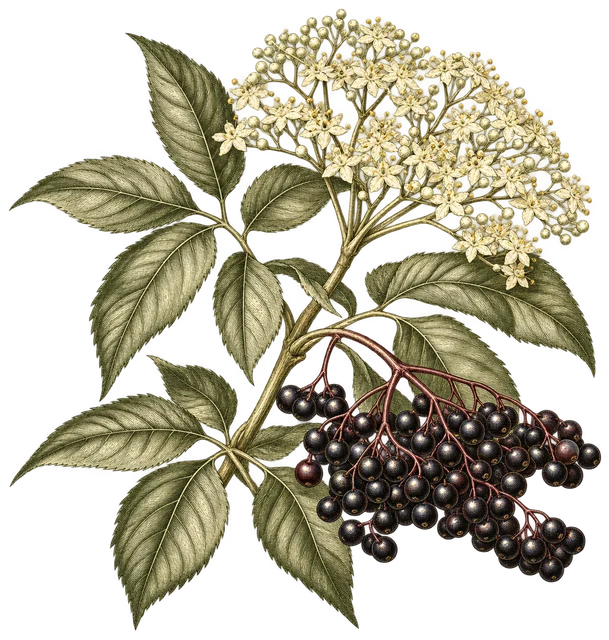
Sambucus nigra L., principally appropriately processed ripe dark berries. Elderflower is the distinct dried-flower material from the same species. Leaves, bark and stems are not berry substitutes.
Ingredient details, preparation and research
Source plant or material
Sambucus nigra L.; processed ripe fruit for elderberry foods/extracts, with flowers identified separately as Sambuci flos.
Plant family / material: Viburnaceae in current Kew classification; older literature often uses Adoxaceae or Caprifoliaceae.
Forms and route
Processed berry juice, syrup, preserves, powders, capsules, gummies and manufactured extracts; some alcohol liquids are sold as tinctures. Separately, identified dried elderflower is used in oral tea and flower extracts. Raw fruit, cold-soaked preparations and homemade tinctures should not be presumed safe merely because they are called elderberry.
Vitamins and minerals
Whole berries contain vitamin C and fiber, but the USDA raw-fruit record is not a safe serving recommendation or a nutrient analysis of cooked syrup. Cooking, straining, dilution and added sugar change the result. A spoonful of syrup, a gummy or a tincture should not be counted as a meaningful vitamin/mineral serving without a product-specific label; added vitamin C or zinc is separate.
Absorption and preparation
A small study in four older women detected berry anthocyanins and their metabolites in urine after an extract. This confirms some absorption/metabolism, not a whole-body absorption percentage or proof of respiratory benefit. It does not justify raw berries, stronger extracts or absorption-enhancing combinations. Flower pharmacokinetics cannot be inferred from berry pigments.
Practical preparation
For berry foods, choose an appropriately processed food-grade product and follow storage directions. Heat processing and safe preservation are separate questions; a homemade syrup is not automatically shelf-stable. For flower tea, use correctly identified dried elderflower or a labeled tea bag and follow its infusion directions. Do not swap in leaves or transfer flower-tea directions to raw berries.
Combination notes
Elderberry may appear with Echinacea, vitamin C, zinc or sweeteners. Blend studies cannot identify which ingredient caused an effect. Count added nutrients and sugar from the actual serving label rather than treating all “elderberry” products as the same fruit preparation.
Traditional and reported uses
- European folk use of berry preparations includes common-cold and flu-like symptoms; historical sources also record sweating-promoting, laxative and diuretic uses.
- Properly prepared berries have a food tradition in syrups, juices and preserves.
- Elderflower has a separate documented European tradition for relief of early common-cold symptoms, including sweating-promoting teas.
- Human berry-extract trials give mixed symptom results. Elderberry is not an established infection cure or a substitute for vaccination or indicated antiviral care.
Contraindications and cautions
- Do not eat raw or unripe elderberries or use leaves, stems or bark in remedies. Cyanide-producing substances can cause vomiting, severe diarrhea and serious illness; species identification and processing matter.
- Cooking or industrial processing addresses toxic constituents, but no universal home time/temperature or alcohol-extraction shortcut is established by this entry. Select food-grade, appropriately processed products; do not improvise a raw-berry smoothie or tincture.
- Clinically important interactions are inadequately characterized. Immunosuppressant concerns are theoretical; a medication review is prudent, particularly with immunosuppressive or glucose-lowering treatment.
- Medicinal pregnancy/breastfeeding safety is unknown. Children need product-specific professional advice; the elderflower medicinal guidance is for adults and adolescents over 12, not an age rule for every berry product.
- Stop for allergy or significant digestive symptoms. Breathing difficulty, dehydration, persistent fever or worsening flu-like illness need assessment rather than continued self-treatment.
Similar items and how they compare
- Echinacea
Both have respiratory-use traditions and appear in modern cold-season blends.
Elderberry is processed fruit; Echinacea uses particular species and root/aerial extracts with different precautions.
- Hibiscus
Both can make tart, deeply colored beverages containing anthocyanins and organic acids.
Hibiscus commonly uses calyces; elderberry uses fruit with important raw-material and processing safety limits.
Species, family and the flower–fruit distinction
This entry centers on European black elder, Sambucus nigra, placed by Kew in Viburnaceae. American elderberry, S. canadensis, is accepted separately by Kew, although alternative taxonomic names occur in commerce. Do not assume that every wild elder or cultivated species matches the safety/composition of a studied S. nigra product. Fruit and flower are different medicinal materials.
Traditional berry and flower uses
EMA’s fruit assessment records European historical use against colds and as a remedy to promote sweating, relieve constipation or increase urination. These are attributed traditions, not modern prescriptions. Its fruit review did not lead to an EU herbal monograph. By contrast, dried flower and certain flower extracts have a traditional-use monograph for early cold symptoms; this distinction concerns defined regulatory evidence and does not erase berry traditions.
Constituents and laboratory evidence
The dark berry pigments include cyanidin-3-glucoside and cyanidin-3-sambubioside. Flowers have a different flavonol/phenolic profile, including rutin, isoquercitrin and chlorogenic acid. Antiviral, antioxidant or cytokine findings in cells help generate hypotheses, but concentrations used in a laboratory do not establish what a spoonful of syrup accomplishes in the human respiratory tract.
Human berry-extract trials
A 312-person air-travel trial studied a standardized filtered extract. There was no significant reduction in who caught a cold; among the small group who became ill, duration and symptom scores favored the extract. A later placebo-controlled trial in 87 patients with confirmed influenza found no reduction in illness duration or severity. These different products and settings support uncertainty, not a dependable prevention or treatment claim.
What can be said about elderflower
The elderflower indication rests on long-standing use rather than established clinical efficacy. EMA’s 2024 periodic review, published in 2025, found no new evidence requiring a change to the monograph. Berry-extract flu trials should not be cited as proof for flower tea, and flower tradition should not be used as a raw-berry preparation instruction.
Raw-material safety and household preparation
Raw/unripe berries and nonfruit material may release cyanide from cyanogenic compounds. Appropriate preparation matters, but the broad observation that cooking reduces this hazard is not a validated universal recipe for any species, ripeness or batch. Use a correctly identified, appropriately processed food/product. Alcohol steeping, cold infusion or blending raw berries is not a verified detoxification method. Separately, cooking does not prove a syrup is shelf-stable: Extension guidance warns against transferring ordinary high-acid berry canning recipes to elderberries or their juice.
Absorption and realistic nutrient portions
The four-person human pigment study detected parent anthocyanins and conjugated metabolites after an extract; brief urinary recovery does not measure every absorbed metabolite or predict a benefit. USDA’s raw-berry composition cannot be transferred to a small serving of strained syrup, gummy or tincture. A prepared food’s label is more useful than a raw-fruit figure quoted per 100 g.
Interactions and special populations
Human interaction evidence is sparse. Suggested interaction with immunosuppressants derives largely from possible immune effects, rather than demonstrated transplant outcomes. NIH ODS also advises caution with diabetes because glucose/insulin effects are possible. Medicinal pregnancy and lactation safety remains insufficient. Elderflower’s over-12 traditional-use guidance must not be generalized to all fruit supplements or taken as proof from pediatric trials.
Practical forms, comparisons and blends
A berry syrup, anthocyanin-standardized capsule and flower infusion have different compositions and purposes. Use their own labels for route, serving and storage. Echinacea shares respiratory traditions; hibiscus shares the colored, tart beverage character. These similarities do not establish equivalent medicinal action, safe preparation or benefit from stacking products.
Entry sources
- NCCIH: Elderberry, usefulness and safety (updated November 2024)
- EMA: Elderberry fruit assessment status; no EU herbal monograph adopted
- EMA: Elderflower traditional-use conclusions
- Kew: Sambucus nigra, accepted name and Viburnaceae family
- Kew: Sambucus canadensis is an accepted, separate species
- EMA (2014): Elderberry fruit assessment, official report hosted by e-lactancia
- EMA: Sambucus nigra flower assessment, revision 1 (2018)
- EMA: Elderflower periodic-review addendum (adopted 2024, published 2025)
- Tiralongo et al. (2016): Elderberry extract trial in 312 air travellers
- Macknin et al. (2020): Placebo-controlled elderberry trial in laboratory-confirmed influenza
- Wu et al. (2002): Human absorption and metabolism of elderberry anthocyanins
- University of Wisconsin Extension (2025): Elderberry and elderberry-juice canning cautions
- NIH ODS: Dietary Supplements for Immune Function and Infectious Diseases
- USDA FoodData Central: Elderberries, raw, SR Legacy FDC 171727, downloadable source dataset
- FDA: Daily Value on the Nutrition and Supplement Facts labels
- Kew: Elder power (2019)
- Lucchetti et al. (2019): Ethnobotanical uses in the Ancona district, Table 1
Reference entry 04 · Recorded content review: 2026-10-05 · Review scope and dates