

Research draft · Editorial review pending. Sources are linked below; these reports have not been approved as treatment advice.
Herbal leaf infusion
Honeybush
Cyclopia genistoides, C. intermedia and C. subternata
Read cautions first · Check the sources
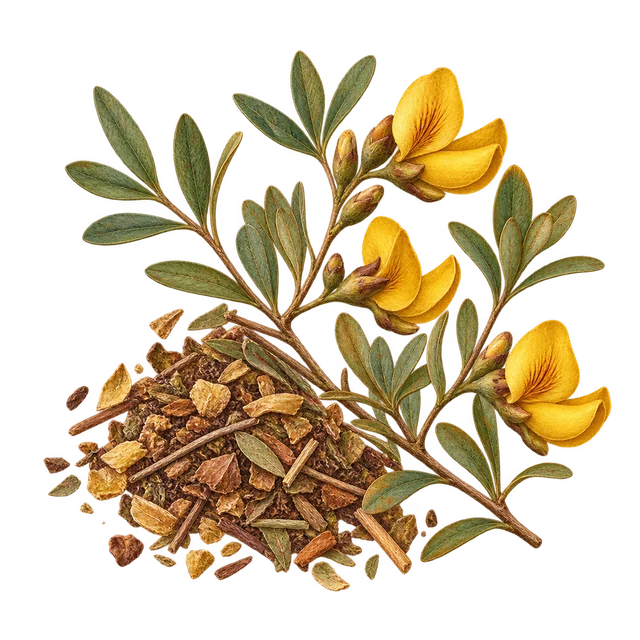
Several South African Cyclopia species are used for honeybush. Their histories are kept together here rather than counted as separate regional selections. SANBI identifies Cyclopia genistoides, C. intermedia and C. subternata as principal commercial honeybush species. Its C. genistoides account also records a belief that honeybush tea increases milk flow during lactation; this is not a clinical finding or a breastfeeding recommendation.
History, folklore, traditional and unusual uses
Only source-documented traditions are included; no unsourced legends have been added.
Africa
Documented regional herbal tradition
Honeybush was a household tea of South Africa’s Cape before becoming a commercial crop. Chopped leaves and stems are oxidised and dried for a sweet-smelling infusion, sometimes simmered.
- Caffeine-free household beverage
Africa
Documented regional herbal tradition
This South African species is one of the principal plants used for honeybush tea. Leaves and stems are processed for an infusion within the Cape’s broader honeybush tradition.
- Caffeine-free honeybush beverage
Africa
Documented regional herbal tradition
Valley honeybush is another South African species harvested and cultivated for honeybush tea. Its leaves and stems form a caffeine-free infusion, distinct botanically from coastal and mountain honeybush.
- Caffeine-free honeybush beverage
Sources
- pza.sanbi.org · source 1
- arc.agric.za · source 2
- pza.sanbi.org · source 3
- redlist.sanbi.org · source 4
- www.wrc.org.za · source 5
- www.gov.za · source 6
Research selection updated 2026-10-15. Historical and traditional reports do not establish clinical effectiveness.