


Key cautions
- Introduce gradually; stop for allergy or marked discomfort.
- A large increase may be uncomfortable; food tolerance varies.
What’s inside
Prunes contain dietary fiber, sorbitol and chlorogenic acids. A primary analysis found substantial variation between origins and food databases.
Uses in brief

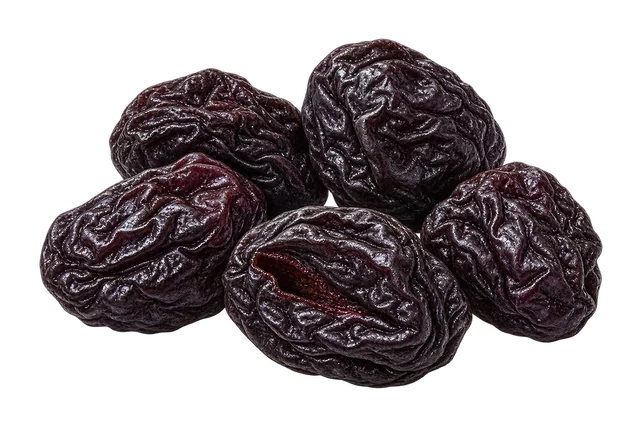
- Prunes are dried plums with fiber and sorbitol, and have human research for constipation symptoms.
History, folklore and reported uses
History, folklore and traditional uses
University of California extension describes European plum varieties selected for drying and the importance of prune orchards before Napa became famous for grapes. The dried fruit is a preserved food, not a new botanical species.
Prunes are a versatile stored fruit. Whole pieces fit snack and savory or sweet dishes, while cooking makes a soft dessert and puree can change the texture of baked goods. These uses are distinct from clinical constipation research.
Traditional, historical and reported uses
- Snacks and mixed dishes
Food or household practiceWhy this label?
Documented culinary use or food research; no disease-treatment claim and no transfer of whole-food clinical findings to processed forms.
Oregon State lists dried prunes as a snack and as an ingredient in breads, fillings, salads and fruit soups. Their sweetness and chewy texture serve ordinary culinary purposes beyond a bowel-health use.
- Stewed fruit
Food or household practiceWhy this label?
Documented culinary use or food research; no disease-treatment claim and no transfer of whole-food clinical findings to processed forms.
University of Maine includes stewed prunes among its economical desserts. This is a soft cooked-fruit food tradition, distinct from juice and from swallowing a standardized laxative.
- A fruit-based baking ingredient
Food or household practiceWhy this label?
Documented culinary use or food research; no disease-treatment claim and no transfer of whole-food clinical findings to processed forms.
The Maine extension bulletin describes prune puree as a way to replace some fat in suitable baked products. This is a recipe-dependent ingredient function; it does not make every prune-containing baked food nutritionally equivalent to whole prunes.
Food history, household uses and clinical research are kept separate. Processed culinary forms are context, not substitutes for the exact whole-food form studied clinically. Recipes and preservation procedures are not reproduced.
Health topics: evidence and cautions
These notes describe a specific research context and preparation. A topic link is not a treatment recommendation.
Colon and bowel health · Symptom support
Form and route: Dried fruit · oral
Prunes (dried plums) may ease chronic constipation.
Evidence: Small comparative human trial
A four-week, partly randomized study found more complete bowel movements and less straining.
Limits
Small study, mostly women; no cancer outcome was measured.
Cautions
- Introduce gradually; stop for allergy or marked discomfort.
Identity & detailed reference
Identity
Dried edible fruit of Prunus domestica, usually from varieties selected for drying, with the pit removed.
Ingredient details, preparation and research
Also known as: Dried plums
Source plant or material
Dried edible fruit of Prunus domestica, usually from varieties selected for drying, with the pit removed.
Plant family / material: Rosaceae
Forms and route
Whole dried fruit; prune juice, powders and concentrated extracts are different forms.
Vitamins and minerals
Dried fruit provides carbohydrate and fiber; composition varies. It is not nutritionally identical to an equal weight of fresh plum or prune juice.
Absorption and preparation
The constipation trial evaluated whole dried fruit. It does not show that any isolated constituent or juice gives the same result.
Traditional and reported uses
- Prunes are dried plums with fiber and sorbitol, and have human research for constipation symptoms.
- Dried prunes serve as snacks and ingredients in breads, fillings, salads and fruit soups.
- Stewed prunes provide a softer fruit dish; prune puree can serve a recipe-dependent baking role.
Contraindications and cautions
- Introduce gradually; stop for allergy or marked discomfort.
- A large increase may be uncomfortable; food tolerance varies.
- Persistent constipation, blood in stool or unexplained weight loss needs assessment.
Constipation comparison
In a small four-week partly randomized study, prunes improved bowel frequency, stool consistency and straining. This was symptom research, with no colorectal-cancer endpoint.
Composition is variable
A laboratory study compared fruit from four countries. Fiber, sorbitol and chlorogenic-acid measurements differed by source and analysis, so a single value should not be treated as universal.
Evidence limits
- Small study, mostly women; no cancer outcome was measured.
Entry sources
- Chey et al. Green kiwifruit, psyllium and prunes
- UC Agriculture and Natural Resources: Plums and Prunes
- Gill et al. Prune nutrient, fiber, sorbitol and chlorogenic-acid analysis
- Oregon State University Extension: Preserving plums and prunes
- University of Maine Extension: Thrifty Recipes
Reference entry 591 · Recorded content review: 2026-10-11 · Review scope and dates