


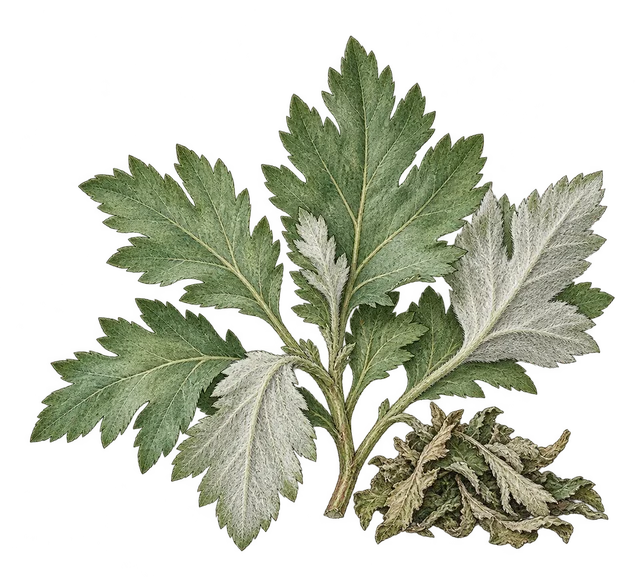
Key cautions
- Pregnancy and breastfeeding safety is not established by this traditional record. Do not self-prescribe medicinal preparations when pregnant, trying to conceive, or breastfeeding; obtain clinician review.
- Separate from Artemisia vulgaris, A. annua and A. absinthium. No essential-oil or moxibustion instructions are supplied.
- Do not self-treat vaginal bleeding, especially in pregnancy.
What’s inside
The leaves contain volatile compounds; a decoction also contains nonvolatile constituents. No single oil profile, isolated compound or laboratory pathway proves clinical benefit.
Uses in brief

- Traditional menstrual and external itching-related leaf uses.
- Modern cited pain research is in rats, not proof in people.
History, folklore and reported uses
History, folklore and traditional uses
Ai ye is a Chinese leaf medicine associated with warming traditional patterns and with menstrual pain or abnormal bleeding. The university record distinguishes leaves from the separately named fruit material.
Traditional, historical and reported uses
- menstruation
Traditional accountWhy this label?
A 2026 study investigated a leaf decoction in a rat dysmenorrhea model; that does not establish clinical benefit or pregnancy safety in people.
Recorded for painful or irregular menstruation and uterine-bleeding complaints. A 2026 study investigated a leaf decoction in a rat dysmenorrhea model; that does not establish clinical benefit or pregnancy safety in people.
- External skin-use history
Traditional accountWhy this label?
HKBU records external leaf uses for itching and skin complaints within Chinese traditional medicine. That historical record does not establish a safe modern cream or treatment for infected skin, and no steaming or application recipe is supplied.
HKBU records external leaf uses for itching and skin complaints within Chinese traditional medicine. That historical record does not establish a safe modern cream or treatment for infected skin, and no steaming or application recipe is supplied.
Coverage reflects verified sources, without a minimum use quota.
Women’s Health: traditions, evidence and cautions
Historical use does not establish benefit or safety. Pregnancy, breastfeeding and fertility care require particular caution: food, tea, essential oil and concentrated extract are not interchangeable. These records are not treatment, dosing or pregnancy-management instructions. Discuss supplements with a qualified clinician or pharmacist; do not delay evaluation of persistent symptoms.
Chinese mugwort / ai ye
Artemisia argyi H.Lév. & Vaniot
- Plant part / material
- Leaves
- Preparation studied or reported
- Dried-leaf preparations in traditional medicine; moxa and volatile essential oil are different materials/routes.
One exact-material card. Dried-leaf preparations in traditional medicine; moxa and volatile essential oil are different materials/routes.. Keep preparations distinct; do not transfer findings from a named extract to every tea or powder.
Ai ye is a Chinese leaf medicine associated with warming traditional patterns and with menstrual pain or abnormal bleeding. The university record distinguishes leaves from the separately named fruit material.
menstruation
Traditional account
Reported or traditional useRecorded for painful or irregular menstruation and uterine-bleeding complaints. A 2026 study investigated a leaf decoction in a rat dysmenorrhea model; that does not establish clinical benefit or pregnancy safety in people.
What the evidence supportsA 2026 study investigated a leaf decoction in a rat dysmenorrhea model; that does not establish clinical benefit or pregnancy safety in people.
Pregnancy and breastfeeding safety is not established by this traditional record. Do not self-prescribe medicinal preparations when pregnant, trying to conceive, or breastfeeding; obtain clinician review. Separate from Artemisia vulgaris, A. annua and A. absinthium. No essential-oil or moxibustion instructions are supplied. Do not self-treat vaginal bleeding, especially in pregnancy. Medicinal pregnancy and breastfeeding safety is not established. Do not swallow concentrated essential oil or infer that vaginal steaming is equivalent to the historical leaf record.
External skin-use history
Traditional account
Reported or traditional useHKBU records external leaf uses for itching and skin complaints within Chinese traditional medicine. That historical record does not establish a safe modern cream or treatment for infected skin, and no steaming or application recipe is supplied.
What the evidence supportsHKBU records external leaf uses for itching and skin complaints within Chinese traditional medicine. That historical record does not establish a safe modern cream or treatment for infected skin, and no steaming or application recipe is supplied.
Pregnancy and breastfeeding safety is not established by this traditional record. Do not self-prescribe medicinal preparations when pregnant, trying to conceive, or breastfeeding; obtain clinician review. Separate from Artemisia vulgaris, A. annua and A. absinthium. No essential-oil or moxibustion instructions are supplied. Do not self-treat vaginal bleeding, especially in pregnancy. Medicinal pregnancy and breastfeeding safety is not established. Do not swallow concentrated essential oil or infer that vaginal steaming is equivalent to the historical leaf record.
One exact-material card. Dried-leaf preparations in traditional medicine; moxa and volatile essential oil are different materials/routes.. Keep preparations distinct; do not transfer findings from a named extract to every tea or powder.
- Pregnancy and breastfeeding safety is not established by this traditional record. Do not self-prescribe medicinal preparations when pregnant, trying to conceive, or breastfeeding; obtain clinician review.
- Separate from Artemisia vulgaris, A. annua and A. absinthium. No essential-oil or moxibustion instructions are supplied.
- Do not self-treat vaginal bleeding, especially in pregnancy.
- Medicinal pregnancy and breastfeeding safety is not established.
- Do not swallow concentrated essential oil or infer that vaginal steaming is equivalent to the historical leaf record.
- HKBU: Artemisia argyi
- Artemisia argyi leaf in a rat dysmenorrhea model (2026)
- HKBU: Artemisia argyi plant record
- Wei et al. 2026: Artemisia argyi rat-model study
Read the complete historical reference and its material distinctions
Identity & detailed reference
Identity
Artemisia argyi H.Lév. & Vaniot; Leaves.
Ingredient details, preparation and research
Also known as: ai ye; Artemisia argyi leaf; Argy’s wormwood
Source plant or material
Artemisia argyi H.Lév. & Vaniot — Leaves
Plant family / material: Asteraceae (daisy family)
Forms and route
Dried-leaf preparations in traditional medicine; moxa and volatile essential oil are different materials/routes.
Vitamins and minerals
No nutrient quantities or daily-value claims are assigned to this medicinal material. Do not borrow the food nutrient profile of another plant part or use an extract as a dietary substitute.
Absorption and preparation
Preparation and route matter. A tea, whole powder, alcohol extract and isolated constituent can give different exposures. No food pairing or absorption-enhancement technique is established by the sources reviewed.
Traditional and reported uses
- Recorded for painful or irregular menstruation and uterine-bleeding complaints. A 2026 study investigated a leaf decoction in a rat dysmenorrhea model; that does not establish clinical benefit or pregnancy safety in people.
- HKBU records external leaf uses for itching and skin complaints within Chinese traditional medicine. That historical record does not establish a safe modern cream or treatment for infected skin, and no steaming or application recipe is supplied.
Contraindications and cautions
- Pregnancy and breastfeeding safety is not established by this traditional record. Do not self-prescribe medicinal preparations when pregnant, trying to conceive, or breastfeeding; obtain clinician review.
- Separate from Artemisia vulgaris, A. annua and A. absinthium. No essential-oil or moxibustion instructions are supplied.
- Do not self-treat vaginal bleeding, especially in pregnancy.
- Medicinal pregnancy and breastfeeding safety is not established.
- Do not swallow concentrated essential oil or infer that vaginal steaming is equivalent to the historical leaf record.
Similar items and how they compare
- Common mugwort
Similar name
Artemisia vulgaris is a different taxon.
- Wormwood / sweet wormwood
Same genus
A. absinthium and A. annua cannot stand in for A. argyi leaf.
- Moxa
May use processed Artemisia leaf fibre
Burning and inhalation create a different route and risk profile.
Identity and composition
Artemisia argyi H.Lév. & Vaniot; Leaves. The leaves contain volatile compounds; a decoction also contains nonvolatile constituents. No single oil profile, isolated compound or laboratory pathway proves clinical benefit.
menstruation: what evidence can say
A 2026 study investigated a leaf decoction in a rat dysmenorrhea model; that does not establish clinical benefit or pregnancy safety in people. Do not self-treat bleeding in pregnancy. Medicinal pregnancy and breastfeeding safety is not established. Essential oil ingestion and vaginal steaming are not equivalent to documented leaf use.
Exact material and preparation boundaries
One exact-material card. Dried-leaf preparations in traditional medicine; moxa and volatile essential oil are different materials/routes.. Keep preparations distinct; do not transfer findings from a named extract to every tea or powder.
Medicines, pregnancy and breastfeeding
No reliable preparation-specific clinical interaction profile was established in the checked sources. A long list of laboratory activities is not a safety assessment. Review allergies and all concurrent medicines before a medicinal product; seek care for serious skin problems or bleeding.
A modern animal-study boundary
The 2026 decoction study used a rat model of dysmenorrhoea and explored compounds and pathways. It does not establish benefit, reproductive safety or a dose in people.
Source-supported safety summary
Pregnancy and breastfeeding safety is not established by this traditional record. Do not self-prescribe medicinal preparations when pregnant, trying to conceive, or breastfeeding; obtain clinician review. Separate from Artemisia vulgaris, A. annua and A. absinthium. No essential-oil or moxibustion instructions are supplied. Do not self-treat vaginal bleeding, especially in pregnancy. Medicinal pregnancy and breastfeeding safety is not established. Do not swallow concentrated essential oil or infer that vaginal steaming is equivalent to the historical leaf record.
Evidence limits
- This is a focused educational source review, not a systematic review or a treatment plan.
- Traditional use documents a practice; it does not establish clinical benefit. Laboratory findings and multi-ingredient trials cannot establish a single ingredient’s effects.
- Direct base HKBU URL returned403; a search-returned official filtered record opened and was read. Hazardous historical bleeding recipes were omitted.
Entry sources
- HKBU: Artemisia argyi
- Artemisia argyi leaf in a rat dysmenorrhea model (2026)
- HKBU: Artemisia argyi plant record
- Wei et al. 2026: Artemisia argyi rat-model study
Reference entry 536 · Recorded content review: 2026-10-11 · Review scope and dates