


Key cautions
- Use cultivated, identified culinary chives; resemblance or onion smell alone is not a field identification guarantee.
- Avoid if allergic to chives or related food Alliums. Ornamental flowers need food-growing provenance.
What’s inside
Sulfur-containing flavor chemistry is characteristic of chives and related Alliums; a garnish is not equivalent to garlic supplements.
Uses in brief

- Mild onion seasoning from leaves or flowers.
History, folklore and reported uses
History, folklore and traditional uses
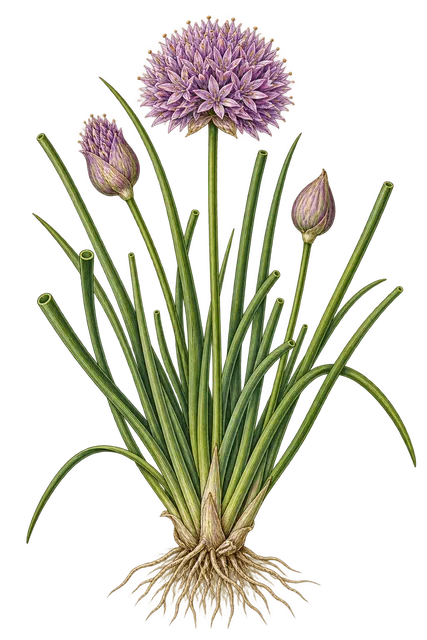
Maryland Extension describes a kitchen-door perennial that can season a meal for much of the growing season. Its hollow leaves and purple blooms give two distinct ways to bring a mild onion flavor to food. The familiar habit of snipping a little at a time makes sense of its role: chives are a seasoning, and the flower head is another seasoning part, not a new medicinal product.
Traditional, historical and reported uses
- Leaf seasoning
Food or household practiceWhy this label?
The claim documents leaf seasoning as a culinary, craft, gardening, or practical material use; it reports neither a treatment outcome nor measured nutrient content.
Maryland Extension records leaves in soups, sauces and salads.
- Flower garnish
Food or household practiceWhy this label?
The claim documents flower garnish as a culinary, craft, gardening, or practical material use; it reports neither a treatment outcome nor measured nutrient content.
The same guide records the purple flowers as a salad ingredient.
Only specifically supported uses are included; historical or culinary use is not clinical proof.
Regional reading paths
These sourced notes describe cultivation, trade, food traditions or material history. A regional connection does not claim exclusive origin.
Antarctica
Controlled Antarctic greenhouse research.
Cultivated food crop; not native Antarctic flora.
Identity & detailed reference
Identity
Common chives, Allium schoenoprasum; hollow leaves and purple flower florets are culinary parts. Garlic chives are a distinct species.
Ingredient details, preparation and research
Source plant or material
Allium schoenoprasum L.; Common chives, Allium schoenoprasum; hollow leaves and purple flower florets are culinary parts. Garlic chives are a distinct species.
Plant family / material: Amaryllidaceae
Forms and route
Fresh or frozen chopped leaves; fresh separated flower florets. Concentrated Allium products are outside scope.
Vitamins and minerals
Chives are generally used in small seasoning portions. This review does not assign the nutrients of a full vegetable serving to a spoonful of snipped leaves or flowers.
Absorption and preparation
No special fat, acid or supplement pairing is required by the evidence reviewed; use for flavor rather than a claimed medicinal absorption effect.
Practical preparation
Wash and snip the leaves. Separate clean flower heads into small florets for food use; remove tough stems. Fresh use preserves their delicate flavor.
Traditional and reported uses
- Mild onion seasoning from leaves or flowers.
Contraindications and cautions
- Use cultivated, identified culinary chives; resemblance or onion smell alone is not a field identification guarantee.
- Avoid if allergic to chives or related food Alliums. Ornamental flowers need food-growing provenance.
Similar items and how they compare
- Garlic chives
Another cultivated culinary Allium.
Allium tuberosum has a different flavor and flat leaves; it is not the species shown here.
- Onion
Related seasoning plant.
Common chives contribute mild leaf or flower flavor rather than a large bulb portion.
What the chemistry means
Agronomy literature includes chives among sulfur-dependent flavor crops. That shared chemistry does not establish that common chives provide garlic-like therapeutic effects.
Entry sources
- University of Maryland Extension: Chives
- Boyhan (2008): Sulfur, its role in onion production and related Alliums
Reference entry 186 · Recorded content review: 2026-10-07 · Review scope and dates