


Key cautions
- Non-food reference only. Do not substitute harakeke leaves, seeds or oils for edible Linum usitatissimum flaxseed/linseed; this card gives no ingestion, remedy or dosing instructions.
- Obtain landholder or collection permission before gathering. Learn the tikanga of the relevant place and weaving community; this reference does not authorise harvesting or reproduce iwi-specific protocols as universal rules.
- Historical cordage and rain-cape uses do not certify a homemade object for climbing, rescue, load-bearing construction or severe-weather protection. This card also supplies no food-contact or skin-product specification.
What’s inside
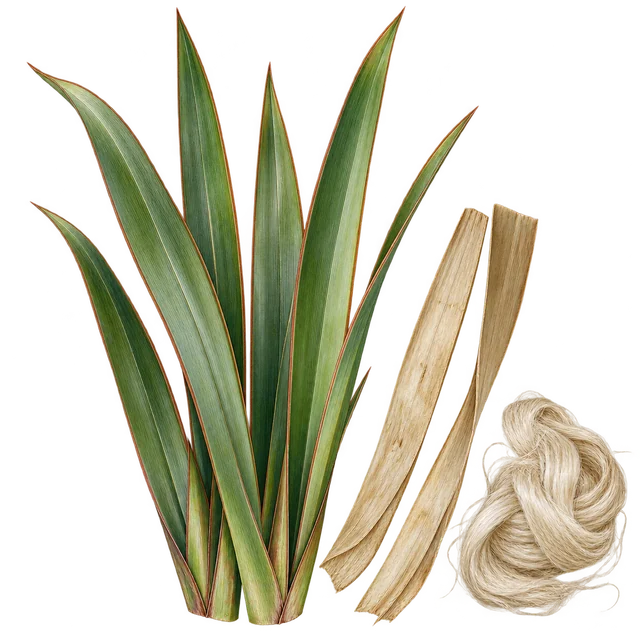
Strong leaf fibres, extracted as muka, within the fleshy leaf blade. The reviewed sources distinguish leaf and fibre quality among weaving varieties; no chemical percentages or dietary composition are assigned.
Uses in brief

- Kete and other plaited containers
- Whāriki and floor mats
- Muka for kākahu and cloak fabric
- Leaf elements in pākē rain capes
- Cordage, bindings and carrying straps
- Fishing nets and lines
- Selected leaf material for piupiu
History, folklore and reported uses
History, folklore and traditional uses
Harakeke belongs to the material history of Aotearoa New Zealand and to living Māori weaving traditions. Kahutoi Te Kanawa’s Te Ara account explains how ancestors arriving from warmer Polynesian islands adapted fibre work to a cooler climate, where aute, the paper-mulberry source of tapa cloth, grew poorly. Producing fine thread from harakeke muka helped provide a different foundation for garments and other textiles.
Māori weavers selected plants for the particular qualities of their leaves and fibre, rather than treating every bush as interchangeable. Te Papa describes their cultivation in pā harakeke and the association of a leaf fan with whānau. Its account also explicitly recognises that harvesting tikanga varied among iwi. This card preserves that attribution and does not turn one published description into universal rules for Māori communities.
The distinction between leaf and fibre shaped the work. Leaves could be prepared for plaited objects, while scraping away fleshy material released muka for finer construction. Te Ara describes washing and beating fibre for garments, followed by hand-rolling threads. The resulting objects carried practical functions as well as cultural meaning: Nancy Swarbrick’s account connects woven patterns with the transmission of stories and beliefs.
Harakeke also entered early international trade. Nancy Swarbrick records Māori provision of dressed fibre and rope to visiting European ships, followed by trade with Sydney merchants from the 1820s and a peak in the early 1830s. Exchange often involved muskets and had serious consequences for Māori communities. This history is more than a story of a useful export: it connects labour, specialised knowledge, trade and colonial-era disruption.
The tradition continued through changing clothing and material markets. DOC records the near-loss of some cultivated weaving forms and their preservation by growers. Manaaki Whenua’s Rene Orchiston Collection documents 50 selected harakeke varieties maintained for their different leaf and fibre qualities. Conservation of named plants and continued teaching sustain a living craft practice; the collection is not a claim that any ornamental Phormium has identical working properties.
Traditional, historical and reported uses
- Kete and other plaited containers
Food or household practiceWhy this label?
A documented material and container-making practice; neither leaf edibility nor a food-contact safety specification is inferred.
Te Ara identifies harakeke as a principal material for kete, the portable bags and baskets made by raranga. This entry concerns container-making; a woven object is not evidence that the leaf itself is edible.
- Whāriki and floor mats
Food or household practiceWhy this label?
A documented mat-making practice with named material forms; no clinical or universal product-performance claim is made.
Selected harakeke varieties supply material for whāriki. Te Ara describes the different floor and sleeping mats made through plaiting and their continuing place in meeting houses. These are distinct objects with their own techniques and purposes.
- Muka for kākahu and cloak fabric
Food or household practiceWhy this label?
A documented textile practice using extracted muka and whatu construction; it is not a treatment or safety-certification study.
Te Papa records extracted muka as the foundation material of cloaks. Te Ara describes whatu finger-weaving, using prepared threads to build the fabric. Fibre selection, dressing and skilled construction matter; an untreated leaf strip is not equivalent to cloak-ready muka.
- Leaf elements in pākē rain capes
Food or household practiceWhy this label?
A documented garment and leaf-layering practice; no modern waterproofness or protective-equipment rating is inferred.
Te Papa documents whole-leaf strips attached as the overlapping outer layer of pākē. Te Ara places rain capes within single-pair whatu construction. This describes a garment tradition, not a tested waterproofness rating for a homemade cape.
- Cordage, bindings and carrying straps
Food or household practiceWhy this label?
A documented cordage and carrying practice; historical use does not establish a safe working load.
DOC records ropes and lashings among harakeke applications. Te Ara describes whiri braiding for tough carrying straps. These material traditions do not establish a safe working load for newly made cord, climbing equipment or structural lashings.
- Fishing nets and lines
Food or household practiceWhy this label?
A documented fishing-gear craft practice; it supplies no modern permit, catch rule or certified equipment specification.
DOC records fishing lines and nets made from flax leaves and fibre. Te Ara describes net-making as a skilled, sometimes communal activity. The evidence concerns historical craft technology; it gives no modern fishing permission or certified equipment specification.
- Selected leaf material for piupiu
Traditional accountWhy this label?
An explicitly attributed Ngāti Porou cultivar-use account, supported by the collection’s piupiu-use context; it is not presented as a universal iwi practice.
Manaaki Whenua’s collection preserves varieties selected for piupiu as well as other weaving uses. Te Ara records Ngāti Porou use of Tākirikau for piupiu, an attributed example rather than a prescription for all iwi or every harakeke variety.
7 distinct documented leaf-and-fibre craft uses. Evidence labels describe cultural or household practice, not clinical efficacy, product certification or permission to harvest.
Historical-use additions reviewed 2026-10-09
Story sources
- Museum of New Zealand Te Papa Tongarewa: Harakeke – New Zealand flax
- Department of Conservation: Harakeke/flax
- Te Ara, Kahutoi Te Kanawa: The art of te whare pora
- Te Ara, Nancy Swarbrick: Māori use of flax
- Te Ara, Kahutoi Te Kanawa: Whāriki, raranga and whiri
- Te Ara, Kahutoi Te Kanawa: Kākahu – woven cloaks
- Te Ara, Nancy Swarbrick: The early flax trade
- Manaaki Whenua – Landcare Research: Rene Orchiston Collection Catalogue
- Manaaki Whenua – Landcare Research: Establishing a Pā Harakeke
Regional reading paths
These sourced notes describe cultivation, trade, food traditions or material history. A regional connection does not claim exclusive origin.
Australia & Oceania
Native New Zealand plant cultivated in pā harakeke and central to specifically attributed Māori weaving traditions.
Leaves and prepared muka fibre supply cloak, basket, mat, net and cordage materials; craft and cultural reference only.
Identity & detailed reference
Identity
Harakeke is Phormium tenax, the New Zealand leaf-fibre plant reviewed here for craft and cultural reference. It is distinct from edible flax/linseed (Linum usitatissimum) and from wharariki or mountain flax (Phormium cookianum). Muka is the fibre extracted from its leaves, not another species.
Ingredient details, preparation and research
Also known as: Harakeke; New Zealand flax; Common flax; Lowland flax; Swamp flax; Phormium tenax; Muka (prepared harakeke leaf fibre)
Source plant or material
Phormium tenax
Plant family / material: Asphodelaceae
Forms and route
Identified harakeke leaves, prepared leaf strips for plaiting, and extracted, cleaned muka for cordage and textiles. Whole leaves, dressed fibre and finished woven objects are different material forms. Seeds, oils, nectar, roots, sap, extracts and cosmetic products are outside this non-food card.
Vitamins and minerals
Not applicable: a non-food craft and cultural reference. No dietary nutrient values, edible-fibre recommendation or nutritional equivalence to flaxseed/linseed are assigned.
Absorption and preparation
Not applicable to this non-food material reference. Fibre extraction and textile preparation concern material properties, not digestion, nutrient absorption or detoxification.
Practical preparation
Identify the plant and obtain permission for the material first. Learn leaf selection, preparation and tool handling from an experienced local weaver, including local tikanga. Prepared strips for plaiting and cleaned, dressed muka for textile work are separate stages. The short processing history here is descriptive and is not a substitute for practical instruction.
Combination notes
Finished Māori textiles and other objects can combine harakeke with additional materials, but each needs its own identification and appropriate sourcing. No dye recipe, additive mixture, food combination or structural-use specification is provided.
Traditional and reported uses
- Kete and other plaited containers
- Whāriki and floor mats
- Muka for kākahu and cloak fabric
- Leaf elements in pākē rain capes
- Cordage, bindings and carrying straps
- Fishing nets and lines
- Selected leaf material for piupiu
Contraindications and cautions
- Non-food reference only. Do not substitute harakeke leaves, seeds or oils for edible Linum usitatissimum flaxseed/linseed; this card gives no ingestion, remedy or dosing instructions.
- Confirm the species and intended material with a knowledgeable grower or weaver. Wharariki (Phormium cookianum), ornamental hybrids and named weaving varieties must not be treated as interchangeable.
- Obtain landholder or collection permission before gathering. Learn the tikanga of the relevant place and weaving community; this reference does not authorise harvesting or reproduce iwi-specific protocols as universal rules.
- Use appropriate instruction and care with sharp cutting and scraping tools. Preserve the growing heart when gathering weaving leaves; Manaaki Whenua directs learners to local weavers for harvesting guidance.
- Historical cordage and rain-cape uses do not certify a homemade object for climbing, rescue, load-bearing construction or severe-weather protection. This card also supplies no food-contact or skin-product specification.
Similar items and how they compare
- Flax / linseed
The English word flax is shared.
Linum usitatissimum is the separate flax/linseed plant in card 160. This card concerns Phormium tenax leaf and muka; edible seeds and linseed oil are not substitutes for, or products established by, this entry.
- Wharariki / mountain flax
Another New Zealand Phormium used in fibre traditions.
Phormium cookianum is a separate species. It is not included in this Phormium tenax card, and its working properties should not be transferred without identification.
Botanical identity and misleading flax names
The current Flora of New Zealand profile places Phormium tenax J.R.Forst. & G.Forst. in Asphodelaceae. Some public heritage pages use older lily-family language; the family field follows the current flora. DOC distinguishes common flax from the smaller mountain flax, and Te Ara names the latter Phormium cookianum. Shared English names do not connect this craft material to edible Linum flaxseed.
Prepared leaf is different from extracted muka
Te Ara describes removing leaf margins and the midrib, then extracting fibre with a shell edge. Muka intended for soft garments was washed and beaten, and thread was hand-rolled. These are documented stages of skilled processing, not a complete workshop lesson. They do not imply that an unprocessed garden leaf is ready for any textile use.
Cultivars, provenance and living stewardship
Manaaki Whenua recommends choosing weaving varieties with local weavers and recording their names and whakapapa. Division preserves the parent plant’s properties more reliably than seed, whose offspring can differ. Its guidance also distinguishes productive cultivation from simply collecting a wild-looking plant. Species identity alone cannot establish the right material for a particular weaving project.
Scope of the evidence
The sources document botany, cultural practice, collection stewardship and material history. They do not test a remedy or establish a medical benefit. Accounts that also mention food, sap, roots or healing have been restricted here to relevant leaf-and-fibre material history; those other preparations are not endorsed or folded into this reference card.
Evidence limits
Species-bounded, non-food craft and cultural reference. No medicinal efficacy, ingestion dose, food preparation, nutrient ranking, cosmetic recipe or universal iwi harvesting protocol is supplied. Some collection sources cover Phormium more broadly; they support cultivar stewardship and named uses, not the transfer of every cultivar claim to all P. tenax plants.
Entry sources
- Flora of New Zealand: Phormium tenax taxon profile
- Museum of New Zealand Te Papa Tongarewa: Harakeke – New Zealand flax
- Department of Conservation: Harakeke/flax
- Te Ara, Kahutoi Te Kanawa: The art of te whare pora
- Te Ara, Nancy Swarbrick: Māori use of flax
- Te Ara, Kahutoi Te Kanawa: Whāriki, raranga and whiri
- Te Ara, Kahutoi Te Kanawa: Kākahu – woven cloaks
- Te Ara, Nancy Swarbrick: The early flax trade
- Manaaki Whenua – Landcare Research: Rene Orchiston Collection Catalogue
- Manaaki Whenua – Landcare Research: Establishing a Pā Harakeke
Reference entry 519 · Recorded content review: 2026-10-09 · Review scope and dates