


Key cautions
- Use identified food-grade fruit, not an ornamental or wild lookalike.
- Keep prepared foods under the storage conditions specified by the maker; a traditional ingredient does not make an unvalidated preserve shelf-stable.
What’s inside
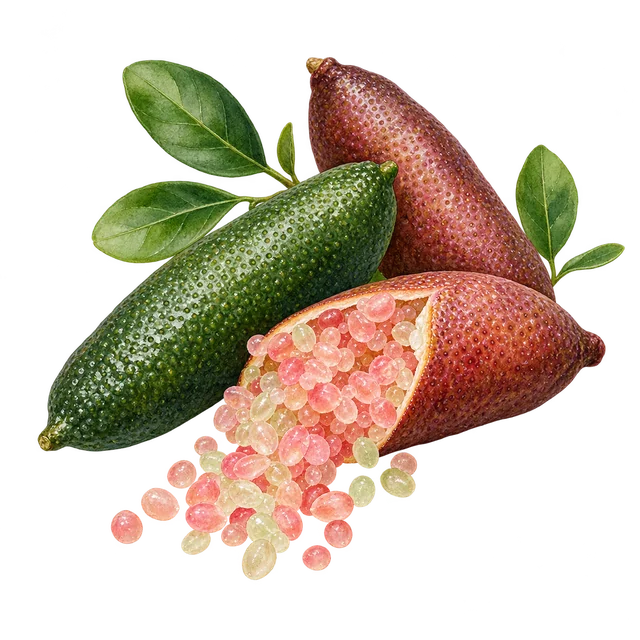
Juice-filled citrus vesicles contain water, acids and fruit solids. Their distinctive texture is a culinary feature rather than a health effect.
Uses in brief

- Fresh garnish
- Prepared culinary ingredient
History, folklore and reported uses
History, folklore and traditional uses
Finger lime is native to eastern Australian rainforest regions. NSW Parks specifically connects the fruit with Bundjalung people and contemporary regional cultivation; that attribution should not be generalized into a single tradition for every community.
Traditional, historical and reported uses
- Fresh garnish
Food or household practiceWhy this label?
Sources document this named food or material use; no therapeutic outcome is claimed.
NSW Parks records the vesicles as a garnish for seafood and other dishes, valued for their discrete bursts of citrus flavour.
- Prepared culinary ingredient
Food or household practiceWhy this label?
Sources document this named food or material use; no therapeutic outcome is claimed.
Finger lime is a distinct crop in AgriFutures’ native-food series and composition program, supporting use as a specified fruit ingredient in food-service products.
2 narrowly supported uses; no clinical efficacy or universal preparation is inferred.
Historical-use additions reviewed 2026-10-09
Regional reading paths
These sourced notes describe cultivation, trade, food traditions or material history. A regional connection does not claim exclusive origin.
Australia & Oceania
native; eastern Australia
Citrus vesicles as food garnish.
Identity & detailed reference
Identity
Citrus australasica; finger-lime fruit, especially the edible juice vesicles.
Ingredient details, preparation and research
Source plant or material
Citrus australasica; finger-lime fruit, especially the edible juice vesicles.
Plant family / material: Rutaceae
Forms and route
Fresh fruit, refrigerated/frozen vesicles and prepared culinary products.
Vitamins and minerals
No generic quantity is assigned across cultivars or preserved products; a garnish is not a full serving of another citrus fruit.
Absorption and preparation
Cooking, drying, straining and added ingredients change the food that is actually eaten. No special medicinal absorption claim or extract-to-food conversion is established.
Practical preparation
Use food-grade fruit, clean handling and the maker’s storage instructions. Separate the edible vesicles as the product or recipe specifies; do not add bottled essential oil as a substitute.
Traditional and reported uses
- NSW Parks records the vesicles as a garnish for seafood and other dishes, valued for their discrete bursts of citrus flavour.
- Finger lime is a distinct crop in AgriFutures’ native-food series and composition program, supporting use as a specified fruit ingredient in food-service products.
Contraindications and cautions
- Use identified food-grade fruit, not an ornamental or wild lookalike.
- Keep prepared foods under the storage conditions specified by the maker; a traditional ingredient does not make an unvalidated preserve shelf-stable.
Texture and cultivar distinctions
The edible vesicles, peel and seeds have different roles. Different commercial cultivars and processed presentations should not be treated as an identical analytical sample merely because all are called finger lime.
Food versus historical remedies
The NSW account contains both cultural and culinary context. This card adopts the food connection without turning historical wound-use accounts into instructions for applying fruit to broken skin.
Evidence limits
This is a food/material reference, not evidence of disease treatment. Geographic and customary-use records do not establish a medicinal dose. Nutrient quantities are omitted unless a matching food form and serving have been verified.
Entry sources
- AgriFutures: Focus on Finger Lime
- NSW National Parks: Bush tucker on the menu
- AgriFutures: Native Foods Compositional Data for FSANZ Nutritional Panel Calculator
Reference entry 485 · Recorded content review: 2026-10-09 · Review scope and dates