


Key cautions
- Use identified food-grade fruit, not an ornamental or wild lookalike.
- Keep prepared foods under the storage conditions specified by the maker; a traditional ingredient does not make an unvalidated preserve shelf-stable.
What’s inside
Fruit solids include carbohydrate, fibre and acids. Kernel fats and sandalwood aromatic oils are different plant parts and materials.
Uses in brief

- Fruit flesh foods
- Dried fruit ingredient
History, folklore and reported uses
History, folklore and traditional uses
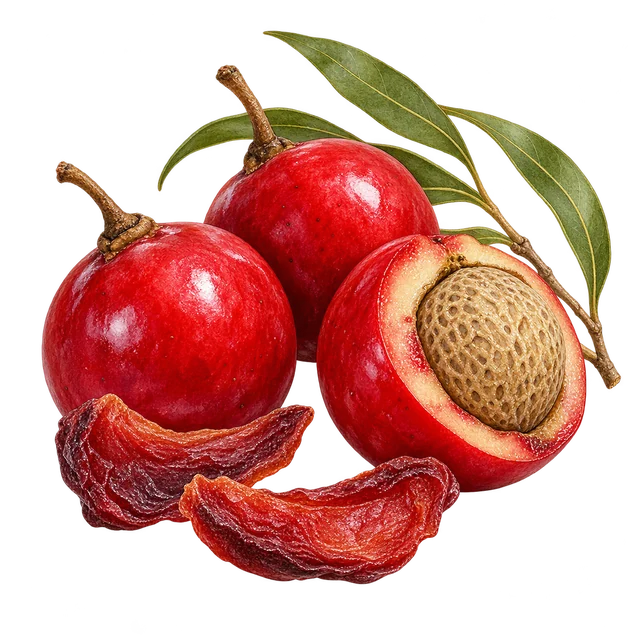
Quandong is associated with arid and semi-arid Australia and has a documented native-food research program. The shared Santalum genus with sandalwoods is not a basis for confusing edible fruit with fragrance wood or oil.
Traditional, historical and reported uses
- Fruit flesh foods
Food or household practiceWhy this label?
Sources document this named food or material use; no therapeutic outcome is claimed.
The named native-food crop supplies culinary fruit flesh. Keeping flesh separate from the hard stone makes the scope of the food reference explicit.
- Dried fruit ingredient
Food or household practiceWhy this label?
Sources document this named food or material use; no therapeutic outcome is claimed.
Prepared quandong fruit is included in Australian native-food use and food-composition resources. Water loss during drying changes concentration and portion comparison.
2 narrowly supported uses; no clinical efficacy or universal preparation is inferred.
Historical-use additions reviewed 2026-10-09
Regional reading paths
These sourced notes describe cultivation, trade, food traditions or material history. A regional connection does not claim exclusive origin.
Australia & Oceania
native; Australia, arid and semi-arid regions
Fruit flesh for culinary products.
Identity & detailed reference
Identity
Santalum acuminatum; edible quandong fruit flesh, not sandalwood essential oil or all plants called quandong.
Ingredient details, preparation and research
Source plant or material
Santalum acuminatum; edible quandong fruit flesh, not sandalwood essential oil or all plants called quandong.
Plant family / material: Santalaceae
Forms and route
Fresh or dried fruit flesh and culinary fruit preparations.
Vitamins and minerals
No kernel or oil nutrient values are assigned to fruit flesh. Dried fruit and sweetened dishes need form-specific composition.
Absorption and preparation
Cooking, drying, straining and added ingredients change the food that is actually eaten. No special medicinal absorption claim or extract-to-food conversion is established.
Practical preparation
Use commercially identified edible fruit flesh; follow the supplier’s instructions for dried or frozen material. This card does not teach collection or processing of kernels.
Traditional and reported uses
- The named native-food crop supplies culinary fruit flesh. Keeping flesh separate from the hard stone makes the scope of the food reference explicit.
- Prepared quandong fruit is included in Australian native-food use and food-composition resources. Water loss during drying changes concentration and portion comparison.
Contraindications and cautions
- Use identified food-grade fruit, not an ornamental or wild lookalike.
- Keep prepared foods under the storage conditions specified by the maker; a traditional ingredient does not make an unvalidated preserve shelf-stable.
A common name needs a botanical anchor
Different Australian trees have been called quandong. This entry is restricted to Santalum acuminatum and should not inherit descriptions or uses from blue-quandong species merely because a market name overlaps.
No sandalwood equivalence
The fruit, kernel, heartwood and extracted aromatic oil are separate materials. A botanical relationship does not supply evidence that a cosmetic oil is edible, or that food consumption reproduces laboratory extract effects.
Evidence limits
This is a food/material reference, not evidence of disease treatment. Geographic and customary-use records do not establish a medicinal dose. Nutrient quantities are omitted unless a matching food form and serving have been verified.
Entry sources
- AgriFutures: Native Foods Information Sheet No 1: Quandong
- DAFF: Australian native foods
- DAFF: Australian fruit, nut and vegetable composition cards
Reference entry 484 · Recorded content review: 2026-10-09 · Review scope and dates