


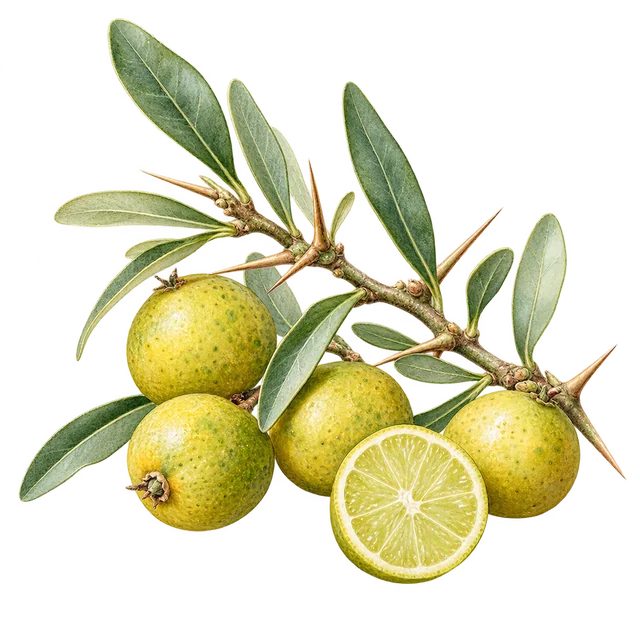
Key cautions
- Use identified food-grade fruit, not an ornamental or wild lookalike.
- Keep prepared foods under the storage conditions specified by the maker; a traditional ingredient does not make an unvalidated preserve shelf-stable.
What’s inside
Acidic citrus flesh and peel volatiles contribute flavour; peel oil is not the same material as whole fruit.
Uses in brief

- Citrus food ingredient
- Processed fruit applications
History, folklore and reported uses
History, folklore and traditional uses
Desert lime belongs to inland Australian food and horticultural landscapes. Government and AgriFutures sources treat it as a distinct native citrus crop, which is why it is not merged with existing key-lime or lemon cards.
Traditional, historical and reported uses
- Citrus food ingredient
Food or household practiceWhy this label?
Sources document this named food or material use; no therapeutic outcome is claimed.
The edible fruit supplies tart citrus flavour in native-food preparation. Species identity keeps it separate from imported lime cultivars.
- Processed fruit applications
Food or household practiceWhy this label?
Sources document this named food or material use; no therapeutic outcome is claimed.
The native-food industry researches desert lime for value-added food products. Product labels and recipes, rather than botanical reputation, determine the composition of the finished food.
2 narrowly supported uses; no clinical efficacy or universal preparation is inferred.
Historical-use additions reviewed 2026-10-09
Regional reading paths
These sourced notes describe cultivation, trade, food traditions or material history. A regional connection does not claim exclusive origin.
Australia & Oceania
native; inland Australia
Citrus fruit for food flavouring.
Identity & detailed reference
Identity
Citrus glauca; desert lime, distinct from key lime and finger lime.
Ingredient details, preparation and research
Source plant or material
Citrus glauca; desert lime, distinct from key lime and finger lime.
Plant family / material: Rutaceae
Forms and route
Food-grade fresh/frozen fruit and prepared citrus products.
Vitamins and minerals
No vitamin or mineral quantity is borrowed from key lime or lemon. A prepared preserve includes ingredients beyond the lime itself.
Absorption and preparation
Cooking, drying, straining and added ingredients change the food that is actually eaten. No special medicinal absorption claim or extract-to-food conversion is established.
Practical preparation
Use authenticated food fruit and follow a recipe suited to the whole-fruit or pulp product supplied. A sour taste alone does not establish a safe canning process.
Traditional and reported uses
- The edible fruit supplies tart citrus flavour in native-food preparation. Species identity keeps it separate from imported lime cultivars.
- The native-food industry researches desert lime for value-added food products. Product labels and recipes, rather than botanical reputation, determine the composition of the finished food.
Contraindications and cautions
- Use identified food-grade fruit, not an ornamental or wild lookalike.
- Keep prepared foods under the storage conditions specified by the maker; a traditional ingredient does not make an unvalidated preserve shelf-stable.
Comparing citrus correctly
Desert lime was specifically included in the native-food compositional-data project. This supports looking for a matched food record instead of assuming all limes have the same edible portion, water content and nutrient values.
Separate the peel fraction
A whole fruit includes water and nonvolatile solids that are absent from distilled peel oil. Concentrated citrus-oil handling or experimental extract findings must remain outside the ordinary fruit recommendation.
Evidence limits
This is a food/material reference, not evidence of disease treatment. Geographic and customary-use records do not establish a medicinal dose. Nutrient quantities are omitted unless a matching food form and serving have been verified.
Entry sources
- AgriFutures: Focus on Desert Lime
- DAFF: Australian native foods
- AgriFutures: Native Foods Compositional Data for FSANZ Nutritional Panel Calculator
Reference entry 483 · Recorded content review: 2026-10-09 · Review scope and dates