


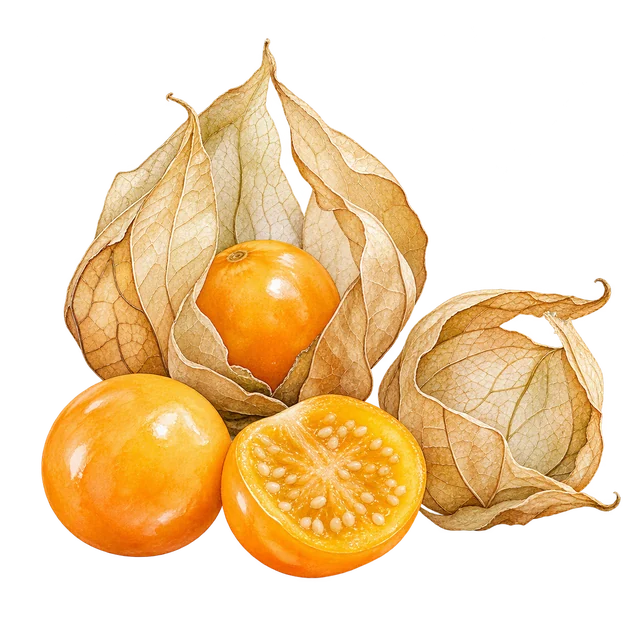
Key cautions
- Do not eat ornamental Physalis plants, unripe unknown fruits, leaves or husks on the strength of a common name.
- This description is not a wild-fruit identification guide; check mixed dried-fruit products for added sugar and allergens.
What’s inside
Water, carbohydrates, organic acids and fruit phytochemicals; ripeness and drying change composition.
Uses in brief

- Fresh ripe berries
- Processed fruit ingredient
History, folklore and reported uses
History, folklore and traditional uses
Cape gooseberry is an English market name for a fruit strongly connected with Andean agriculture. Colombian uchuva and Peruvian aguaymanto names keep that regional identity visible without implying that modern cultivation is geographically exclusive.
Traditional, historical and reported uses
- Fresh ripe berries
Food or household practiceWhy this label?
Source documents this specific material, culinary use or attributed practice; no clinical efficacy is inferred.
AGROSAVIA’s Colombian variety work and Andean crop accounts establish uchuva as a cultivated fruit food. Its ripe berry is the appropriate edible portion.
- Processed fruit ingredient
Food or household practiceWhy this label?
Source documents this specific material, culinary use or attributed practice; no clinical efficacy is inferred.
Primary research follows fruit quality during development, supporting maturity-sensitive processing decisions. Preserves and dried foods remain different preparations from the fresh berry.
2 bounded uses; regional records do not establish treatment effects.
Historical-use additions reviewed 2026-10-09
Regional reading paths
These sourced notes describe cultivation, trade, food traditions or material history. A regional connection does not claim exclusive origin.
South America
native and cultivated; Colombia, Peru
Ripe fruit.
Identity & detailed reference
Identity
Physalis peruviana; ripe edible berries of Physalis peruviana, uchuva or aguaymanto; unrelated to Ribes gooseberries and Caribbean star gooseberry.
Ingredient details, preparation and research
Also known as: Physalis peruviana
Source plant or material
Physalis peruviana
Plant family / material: Solanaceae
Forms and route
Ripe berries, dried food-grade berries, preserves and prepared fruit foods; papery husks are removed.
Vitamins and minerals
A dried berry has less water and may include added sugar. No universal vitamin C or mineral serving is assigned to every ecotype or product.
Absorption and preparation
Laboratory antioxidant measurements do not prove a special absorption advantage. Data from berry extracts should not be transferred to husks, leaves or medicinal preparations.
Practical preparation
Purchase ripe identified food fruit, remove the papery husk, wash and refrigerate as appropriate. Follow the label for dried or prepared products.
Traditional and reported uses
- Fresh ripe berries
- Processed fruit ingredient
Contraindications and cautions
- Do not eat ornamental Physalis plants, unripe unknown fruits, leaves or husks on the strength of a common name.
- This description is not a wild-fruit identification guide; check mixed dried-fruit products for added sugar and allergens.
Regional samples are not universal values
Research on northern Argentine Andean fruit and a Colombian ecotype measures composition and development. Neither study establishes that every product has identical nutrients or treats an illness.
Evidence limits
This is a food-form review, not a treatment recommendation. Composition and laboratory findings apply to the material actually studied; no medicinal dose, universal nutrient ranking or preservation guarantee is inferred.
Entry sources
- AGROSAVIA: Variedad Uchuva Andina
- Northern Argentine Andean Physalis peruviana fruits
- Colombian Cape-gooseberry fruit development
- FAO and ANPE: Guía de campo de los cultivos andinos
Reference entry 466 · Recorded content review: 2026-10-09 · Review scope and dates