


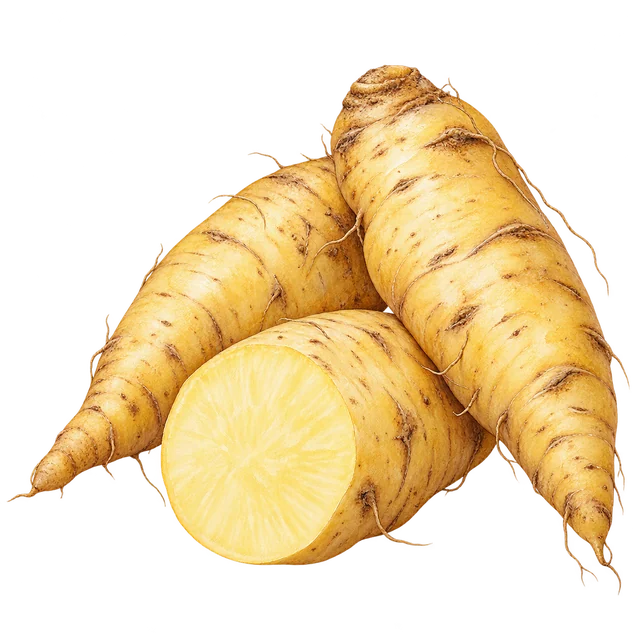
Key cautions
- Do not identify the plant from resemblance to other Apiaceae; this is not a wild-root identification guide.
- Root puree is not a complete infant formula.
What’s inside
Starch, water and smaller amounts of other root constituents; starch structure varies among accessions.
Uses in brief

- Cooked root and puree
- Food-starch applications
History, folklore and reported uses
History, folklore and traditional uses
Arracacha connects food agriculture in Colombia, Ecuador and Peru. Different market names can obscure the same root, while the similar name mandioquinha must not be confused with cyanogenic cassava.
Traditional, historical and reported uses
- Cooked root and puree
Food or household practiceWhy this label?
Source documents this specific material, culinary use or attributed practice; no clinical efficacy is inferred.
Andean crop records establish arracacha as a food root. Cooking and mashing provide a different texture from raw root or dry flour.
- Food-starch applications
Laboratory/animal researchWhy this label?
This use entry describes a laboratory, pilot-scale or nonhuman experiment; it does not establish an ordinary household practice, clinical benefit or safe home protocol.
Primary investigations characterize starch isolated from roots, including Colombian materials, for food-processing behavior. Isolated starch is a functional ingredient rather than a complete replacement for the whole root.
2 bounded uses; regional records do not establish treatment effects.
Historical-use additions reviewed 2026-10-09
Regional reading paths
These sourced notes describe cultivation, trade, food traditions or material history. A regional connection does not claim exclusive origin.
South America
native and cultivated; Colombia, Ecuador, Peru
Cooked storage roots.
Identity & detailed reference
Identity
Arracacia xanthorrhiza; the edible storage roots of Arracacia xanthorrhiza; called arracacha or mandioquinha in different markets, not carrot or cassava.
Ingredient details, preparation and research
Also known as: Arracacia xanthorrhiza
Source plant or material
Arracacia xanthorrhiza
Plant family / material: Apiaceae
Forms and route
Fresh roots, cooked puree, flour and isolated food starch; the latter two are not nutritionally identical.
Vitamins and minerals
Whole root retains components removed during starch isolation. No exact nutrient content or infant-feeding adequacy is inferred from the crop name.
Absorption and preparation
Gelatinization changes starch behavior when heated. An isolated-starch experiment is not a clinical test of digestibility in infants or people with illness.
Practical preparation
Buy food-grade roots, clean and peel as appropriate, and cook until suitable for the chosen recipe. Refrigerate prepared puree promptly.
Traditional and reported uses
- Cooked root and puree
- Food-starch applications
Contraindications and cautions
- Do not identify the plant from resemblance to other Apiaceae; this is not a wild-root identification guide.
- Root puree is not a complete infant formula.
Cultivar-specific starch properties
Research measures structural, thermal and other properties of arracacha starch. Differences between samples matter in formulation; they do not establish a uniquely superior carbohydrate for everyone.
Evidence limits
This is a food-form review, not a treatment recommendation. Composition and laboratory findings apply to the material actually studied; no medicinal dose, universal nutrient ranking or preservation guarantee is inferred.
Entry sources
- FAO: La mujer campesina y las semillas andinas
- Structure and properties of arracacha root starch
- Starches from four Colombian arracacha roots
Reference entry 452 · Recorded content review: 2026-10-09 · Review scope and dates