


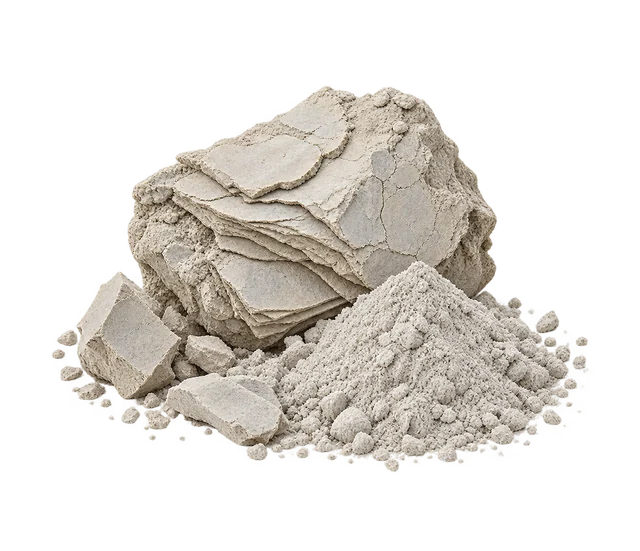
Key cautions
- Do not ingest or use raw mined clay as a detox remedy.
- Avoid breathing dust; use product-specific handling precautions and appropriate workplace controls.
- FDA has warned about lead contamination in a marketed bentonite product
What’s inside
Smectite minerals with exchangeable ions; natural deposits may contain quartz, other minerals and contaminants. Swelling and surface properties vary with composition.
Uses in brief

- Industrial absorbents
- Drilling and binding materials
History, folklore and reported uses
History, folklore and traditional uses
USGS documents US bentonite mining and industrial markets. The regional source set also records Argentine deposits, including Río Negro, and New Zealand clay resources at Harper Hills. These are geological connections, not evidence of shared medicinal practice.
Traditional, historical and reported uses
- Industrial absorbents
Food or household practiceWhy this label?
Label describes the stated practice or evidence, not an efficacy grade. Exact form and cautions remain attached.
USGS lists absorbent markets for bentonite. That includes engineered products whose composition and intended setting differ from cosmetic materials.
- Drilling and binding materials
Food or household practiceWhy this label?
Label describes the stated practice or evidence, not an efficacy grade. Exact form and cautions remain attached.
The same geological authority lists drilling mud and foundry-sand bonding among major uses. These applications depend on swelling and suspension behavior.
2 supported uses; records describe the named form and are not treatment recommendations.
Historical-use additions reviewed 2026-10-09
Regional reading paths
These sourced notes describe cultivation, trade, food traditions or material history. A regional connection does not claim exclusive origin.
North America
Geological/mined: United States.
Absorbent, industrial and drilling uses; geology does not establish ingestion safety.
South America
geological; Argentina, Río Negro
Absorbent and industrial material; no ingestion endorsement.
Australia & Oceania
geological; New Zealand, Harper Hills
Industrial absorbent and drilling material.
Identity & detailed reference
Identity
Bentonite is a clay-rich rock/material commonly dominated by montmorillonite. Sodium/calcium forms and accessory minerals vary; it is not one standardized pure chemical.
Ingredient details, preparation and research
Source plant or material
Smectite-rich clay, commonly montmorillonite
Plant family / material: Not applicable: mineral material
Forms and route
Industrial powders, granules and engineered mixtures. A cosmetic or processing product must meet specifications for that particular use; mine samples and litter are not body-care ingredients.
Food sources
Not a whole-food card.
Vitamins and minerals
No dietary nutrient value or ingestion recommendation. Total elemental content is not a measure of useful or safe nutritional availability.
Absorption and preparation
Adsorption onto clay surfaces is a material property, not proof that swallowed clay safely removes toxins from the body.
Practical preparation
Use only for the labeled material application and follow the supplier’s safety information. Do not convert industrial clay into a homemade skin or oral preparation.
Traditional and reported uses
- Industrial absorbents
- Drilling and binding materials
Contraindications and cautions
- Do not ingest or use raw mined clay as a detox remedy.
- Avoid breathing dust; use product-specific handling precautions and appropriate workplace controls.
- FDA has warned about lead contamination in a marketed bentonite product. Natural origin does not establish purity or cosmetic safety.
A name does not certify purity
FDA’s product-specific lead warning illustrates why a clay trade name cannot establish contaminant levels. It does not show every bentonite product is contaminated, but makes purity claims without testing inappropriate.
Evidence limits
Regional history and food/material practice do not establish treatment efficacy. Composition depends on the named species, part and preparation; no medicinal dose or universal nutrient ranking is inferred.
Entry sources
- USGS: Clays Statistics and Information
- FDA: Lead warning for Bentonite Me Baby clay
- SEGEMAR: Base de datos de yacimientos minerales de Argentina
- Serviço Geológico do Brasil: Utilidade dos minerais
- Te Ara: Types of clay
Reference entry 396 · Recorded content review: 2026-10-09 · Review scope and dates