


Key cautions
- Buy a prepared food product with trustworthy hygiene and storage guidance. Fermentation and strong customary odor do not by themselves prove safety.
- Check for soy or other substituted seeds and any allergy-relevant ingredients. Do not culture unknown Bacillus at home or infer probiotic safety from the genus name.
What’s inside
Seed protein and fat, fermentation-derived peptides and free amino acids, and a strong aroma. Salt, moisture and composition vary substantially among products.
Uses in brief

- Soup and stew seasoning
- Rice-dish condiment
History, folklore and reported uses
History, folklore and traditional uses
Traditional processing: West Africa, including Nigeria, Ghana and Burkina Faso.
A closer look at its history
Named condiments, household expertise and women’s trade
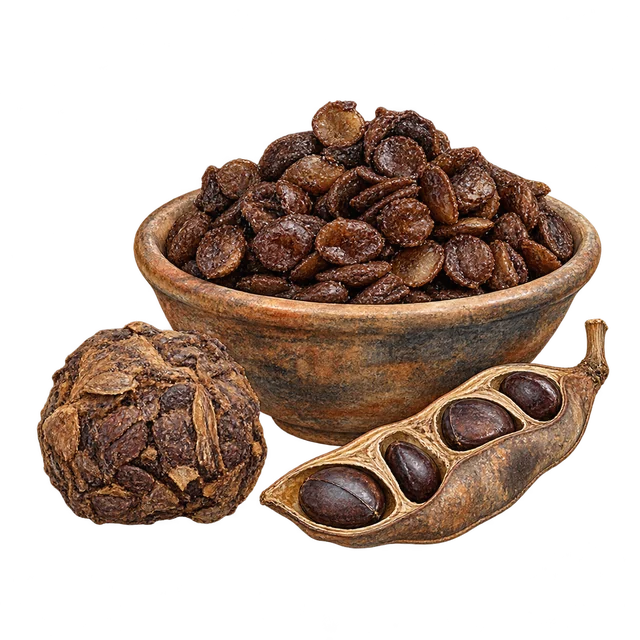
The National Research Council’s locust-bean account describes dawadawa as a Hausa trade name and soumbala among Bambara- and Malinké-speaking communities. Boiling, dehulling and fermenting Parkia seeds transformed a hard seed into a pungent savory seasoning sold as paste, cakes or balls. The report identifies making and selling it as important economic work for women, alongside preparation for household meals. The different regional names preserve language and food context; they should not imply that all producers use an identical recipe or that every product sold under these names has the same seed base.
The condiment explains the trees in the fields
Valued locust-bean trees were commonly spared during land clearance, producing the scattered-tree parklands associated with farming in West Africa. The 2006 account describes individual ownership rights and the commercial importance of seed harvests, making the trees more than unclaimed remnants of woodland. Small pieces of the fermented seasoning were added to soups and stews served with cereal dumplings or porridges. Its strong flavor helps explain its enduring culinary role: a condiment used by the pinch can have a major place in a cuisine without being eaten as a large standalone protein serving.
Additional history reviewed 2026-10-09
Traditional, historical and reported uses
- Soup and stew seasoning
Food or household practiceWhy this label?
The source supports the named food, cosmetic or material practice; no treatment effect is inferred and the card’s form and safety limits remain attached.
The National Research Council and a Mali protein study document fermented seed as a flavoring base. It contributes a savory character in ordinary meals rather than serving as a replacement for a varied protein intake.
- Rice-dish condiment
Food or household practiceWhy this label?
The source supports the named food, cosmetic or material practice; no treatment effect is inferred and the card’s form and safety limits remain attached.
The Mali study records use in regional rice dishes. The finished dish contains multiple foods, so its nutrients and safety cannot be inferred from the condiment alone.
2 sourced featured uses; cultural or material records are not clinical efficacy evidence.
Historical-use additions reviewed 2026-10-09
Regional reading paths
These sourced notes describe cultivation, trade, food traditions or material history. A regional connection does not claim exclusive origin.
Africa
Traditional processing: West Africa, including Nigeria, Ghana and Burkina Faso.
Alkaline-fermented locust-bean seasoning for soups and sauces.
Identity & detailed reference
Identity
A cooked, alkaline-fermented condiment made from Parkia biglobosa seeds. Iru, dawadawa and soumbala are overlapping regional names; products made from soybean or other seeds need separate labeling.
Ingredient details, preparation and research
Also known as: Iru; dawadawa; soumbala
Source plant or material
Fermented Parkia biglobosa seeds
Plant family / material: Fabaceae source plant; mixed fermentation microbiota
Forms and route
Prepared fresh, dried or otherwise commercially packed fermented locust-bean condiment. Raw seeds, fruit pulp and laboratory bacterial isolates are different materials.
Vitamins and minerals
The condiment can contribute protein and fat, but amounts eaten are usually much smaller than a staple-food portion. Salted versions also contribute sodium.
Absorption and preparation
Fermentation breaks down some proteins, but laboratory protein-quality measures are not a promise of identical absorption from all household batches or recipes.
Practical preparation
Use the purchased condiment as a seasoning in a cooked dish and follow its refrigeration or dry-storage instructions. No uncontrolled home-fermentation protocol is provided.
Traditional and reported uses
- Soup and stew seasoning
- Rice-dish condiment
Contraindications and cautions
- Buy a prepared food product with trustworthy hygiene and storage guidance. Fermentation and strong customary odor do not by themselves prove safety.
- Check for soy or other substituted seeds and any allergy-relevant ingredients. Do not culture unknown Bacillus at home or infer probiotic safety from the genus name.
Microbes and food quality are batch-specific
Research has assessed protein quality in Malian soumbala and screened particular Burkinabe Bacillus isolates. Properties of selected strains do not establish a probiotic health claim or certify the safety of an unscreened food batch.
Evidence limits
Prepared Parkia-seed condiment only; no starter-culture recommendation, infection benefit or guarantee for similarly named soybean products.
Entry sources
- National Research Council, Lost Crops of Africa: Locust Bean
- Protein quality of Parkia biglobosa seed and soumbala from Mali
- Assessment of Bacillus isolates from Burkinabe soumbala
Reference entry 314 · Recorded content review: 2026-10-09 · Review scope and dates