


Key cautions
- Do not identify or eat wild fungi using this card or an illustration. Use a trustworthy food supplier with competent species identification.
- Avoid raw or spoiled products and follow storage and cooking instructions. Do not put truffle juices or powders in the eyes.
What’s inside
Fungal carbohydrates, fiber and protein, plus minerals varying with species and growing conditions. Moisture content strongly affects comparisons between fresh and dried material.
Uses in brief

- Cooked couscous dishes
- Cooked porridge preparations
History, folklore and reported uses
History, folklore and traditional uses
Native/traditional food: Algerian Sahara, including Ouargla and Ghardaïa.
A closer look at its history
Preference is local, not universal
Interviews with 60 hunters in two northern Algerian Saharan regions found differing preferences among T. claveryi, T. arenaria and Tirmania nivea. The survey also recorded food, trade/tourism and medicinal beliefs. It demonstrates how a shared market label contains locally ranked foods, rather than one uniform North African tradition.
Traditional indications are records of belief
The same survey records uses linked to fatigue, fertility and eye complaints. These are ethnographic reports, not trials proving benefit; especially for the eye, an unsterile fungal preparation is not a safe medical treatment.
Additional history reviewed 2026-10-09
Traditional, historical and reported uses
- Cooked couscous dishes
Food or household practiceWhy this label?
The source supports the named food, cosmetic or material practice; no treatment effect is inferred and the card’s form and safety limits remain attached.
A direct interview study in Ouargla and Ghardaïa records desert truffles prepared with couscous and meat. The cultural account is evidence of food practice, not a safety test for a particular specimen.
- Cooked porridge preparations
Food or household practiceWhy this label?
The source supports the named food, cosmetic or material practice; no treatment effect is inferred and the card’s form and safety limits remain attached.
The same survey records porridge preparations. Cooking belongs to the documented culinary use, but it cannot be relied on to make a misidentified fungus safe.
2 sourced featured uses; cultural or material records are not clinical efficacy evidence.
Historical-use additions reviewed 2026-10-09
Features and lookalikes to study
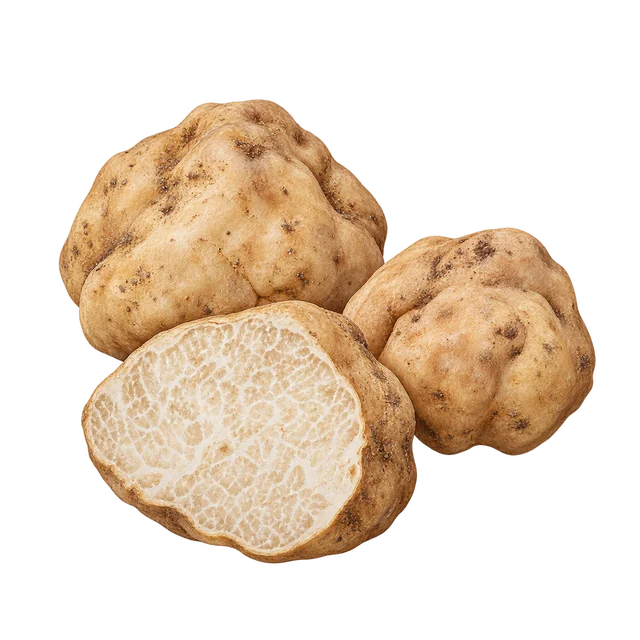
North African edible desert-truffle foods, anchored to Terfezia claveryi, T. arenaria and Tirmania nivea. These are underground fungal fruiting bodies, distinct from European Tuber truffles and Kalaharituber pfeilii.
Common names vary between regions and suppliers; the scientific scope above governs this card.
Morphology described in sources
- Terfez is a regional food category spanning Terfezia and Tirmania, including the named anchor species on this card. These are underground ascomycete fruiting bodies, not plant tubers.
- Habitat and substrate
- See the source-linked morphology and comparison notes below; a separate habitat summary has not been verified for this card.
- Geographic scope
- A complete regional range is not established here. Broad common names and commercial labels can span different species.
- Season in the cited region
- No region-specific fruiting season has been verified for this card. Do not infer a local season from trade availability.
Terfezia claveryi, T. arenaria, T. boudieri and Tirmania species
Specialists compare the peridium, internal tissue, asci and mature spore shape/ornamentation. Tirmania and Terfezia cannot be separated safely by a light-versus-dark exterior rule.
In a Libyan field study, immature or absent spores prevented morphological species identification. Modern North African work also recognises additional Tirmania diversity.
Scleroderma earthballs and other misnamed underground fungi
A round fungus is not automatically a culinary truffle; earthballs have caused poisoning after that assumption.
This is a general safety comparison rather than a claim of local incidence. Colour and soil position cannot replace trained regional assessment.
Limits and regional differences
- Microscopy of mature material is central; DNA can resolve difficult collections. Local names such as terfez or kamea do not specify one worldwide species. Do not apply truffle juice to eyes or use it to treat fertility problems.
- Educational comparison only. Neither this card, an illustration, a photograph, a spore-print colour nor a checklist establishes that a wild collection is safe to eat. A qualified local mycologist must assess uncertain material; do not taste an unknown fungus. Cooking does not reliably eliminate mushroom toxins.
- Primary North African Tirmania phylogeny study, 2023
- Primary study of Libyan desert-truffle habitats and diversity
- Bradai et al. 2015: Ethnomycological survey, Algerian Sahara
- Missouri Department of Conservation: Common earthball
- NAMA: Mushroom poisoning in North America, 2015–2016
- NC Poison Control: Mushrooms
Regional reading paths
These sourced notes describe cultivation, trade, food traditions or material history. A regional connection does not claim exclusive origin.
Africa
Native/traditional food: Algerian Sahara, including Ouargla and Ghardaïa.
Identified edible truffles cooked in regional dishes; distinct from Kalahari and European truffles.
Identity & detailed reference
Identity
North African edible desert-truffle foods, anchored to Terfezia claveryi, T. arenaria and Tirmania nivea. These are underground fungal fruiting bodies, distinct from European Tuber truffles and Kalaharituber pfeilii.
Ingredient details, preparation and research
Also known as: North African desert truffles; terfez
Source plant or material
Terfezia claveryi, T. arenaria and Tirmania nivea
Fungal family: Pezizaceae
Forms and route
Professionally identified fresh or commercially preserved food truffles intended to be cooked. An unidentified underground fungus, powder or medicinal extract is not equivalent.
Vitamins and minerals
No serving-specific nutrient figures are assigned to this multispecies group. A fresh Terfezia sample and dried Tirmania powder have different compositions.
Absorption and preparation
Laboratory antioxidant or mineral-content measurements cannot establish human absorption or medicinal benefit. No nutritional superiority over ordinary foods is inferred.
Practical preparation
Buy correctly identified food truffles, refrigerate as directed, clean the purchased product and cook using an established recipe. Never use cooking as a substitute for identification.
Traditional and reported uses
- Cooked couscous dishes
- Cooked porridge preparations
Contraindications and cautions
- Do not identify or eat wild fungi using this card or an illustration. Use a trustworthy food supplier with competent species identification.
- Avoid raw or spoiled products and follow storage and cooking instructions. Do not put truffle juices or powders in the eyes.
Ethnomycology is not clinical efficacy
The survey records preferences and traditional medicinal beliefs; those beliefs are not treatment trials. Algerian taxonomic research also demonstrates species diversity, reinforcing why a market common name is insufficient for identification.
Evidence limits
Food and cultural reference, not a foraging guide, eye remedy or blanket edibility statement for Terfezia, Tirmania or underground fungi.
Entry sources
- Bradai et al.: Ethnomycological survey among native Sahara Desert people of Algeria
- Zitouni: Algerian desert truffle diversity and mycorrhizal associations
- FAO: Wild useful fungi species list
Reference entry 313 · Recorded content review: 2026-10-09 · Review scope and dates