


Key cautions
- Water, milk, cream and oil are different foods.
- Check saturated fat, added sugar and product fortification.
- Follow individualized potassium/fluid restrictions.
What’s inside
Flesh supplies fat and fiber; coconut water contains sugars and electrolytes including potassium. Milk fat, protein and fortification depend strongly on dilution and product.
Uses in brief

- Flesh and water as foods
- Savory coconut-milk dishes
- Coconut desserts and fillings
History, folklore and reported uses
History, folklore and traditional uses
Coconuts have a long tropical cultivation history. Singapore Botanic Gardens discusses domestication centered in island Southeast Asia and the southern Indian subcontinent; a pantropical food presence should not be mistaken for one simple modern national origin.
Regional kitchens use the same source plant differently. Coconut milk enriches Jamaican rice and peas, Puerto Rican holiday puddings and Southeast Asian curries and sweets; these are food traditions, not interchangeable health remedies.
A closer look at its history
A palm supplied a household material system
Kew records coconut leaves woven into baskets and mats or used as roofing, husk fibre made into rope and brushes, and shells used as bowls. Flesh, extracted milk and the fruit’s water belong to a different set of kitchen uses. These are separate parts of one palm, not interchangeable names for the same drink.
Traditions travel with meanings as well as materials
Kew describes coconuts offered to the sea by Indian fishing communities at Narali Purnima, marking the new fishing season after the monsoon. It separately records Cambodian medicinal uses. Those place-specific traditions should not be relabeled as universal Caribbean customs, and their documentation does not establish medical efficacy.
Additional history reviewed 2026-10-10
Traditional, historical and reported uses
- Fresh flesh and coconut water
Food or household practiceWhy this label?
The specific claim documents a food preparation or recorded culinary practice; safety qualifications remain attached and no treatment effect is inferred.
NParks documents eating the white flesh and drinking the liquid inside the coconut. Maturity changes the flesh’s texture; commercial water products may have added ingredients.
- Milk in curries
Food or household practiceWhy this label?
The specific claim documents a food preparation or recorded culinary practice; safety qualifications remain attached and no treatment effect is inferred.
NParks records milk squeezed from coconut flesh as an ingredient in curries. This refers to a cooking ingredient, not necessarily the diluted beverage sold beside dairy alternatives.
- Jamaican rice and peas and run down
Food or household practiceWhy this label?
The specific claim documents a food preparation or recorded culinary practice; safety qualifications remain attached and no treatment effect is inferred.
Jamaica’s tourism board describes rice and kidney beans cooked in coconut milk with herbs, and run down made by reducing salted mackerel in coconut milk. These are particular savory Caribbean preparations.
- Puerto Rican tembleque and arroz con dulce
Food or household practiceWhy this label?
The specific claim documents a food preparation or recorded culinary practice; safety qualifications remain attached and no treatment effect is inferred.
Discover Puerto Rico documents coconut-milk tembleque thickened with cornstarch and coconut rice pudding as holiday foods. Their added sugar and starch belong to the finished dessert’s composition.
- Coconut in Singapore kueh
Food or household practiceWhy this label?
The specific claim documents a food preparation or recorded culinary practice; safety qualifications remain attached and no treatment effect is inferred.
Singapore Botanic Gardens records grated coconut as a topping or filling and coconut milk or cream in the starch base of kueh. Flesh and extracted milk contribute different textures.
5 supported featured uses; food practices are not claims of treatment benefit.
Historical-use additions reviewed 2026-10-09
Story sources
- Singapore NParks: Cocos nucifera
- UF/IFAS: Plant-Based Milks: Coconut
- Illinois Extension: Is it Worth Going Nuts for Coconut?
- Jamaica Tourist Board: Food
- Discover Puerto Rico: Iconic Puerto Rican Recipes to Bring the Spirit of Navidad Home
- Singapore Botanic Gardens Gardenwise 66: Tropical Treats and Sweets
- AAAAI: Food Allergy
Regional reading paths
These sourced notes describe cultivation, trade, food traditions or material history. A regional connection does not claim exclusive origin.
Australia & Oceania
cultivated; Samoa, Fiji, Vanuatu and Micronesia
Food flesh, beverage and culinary milk.
Identity & detailed reference
Identity
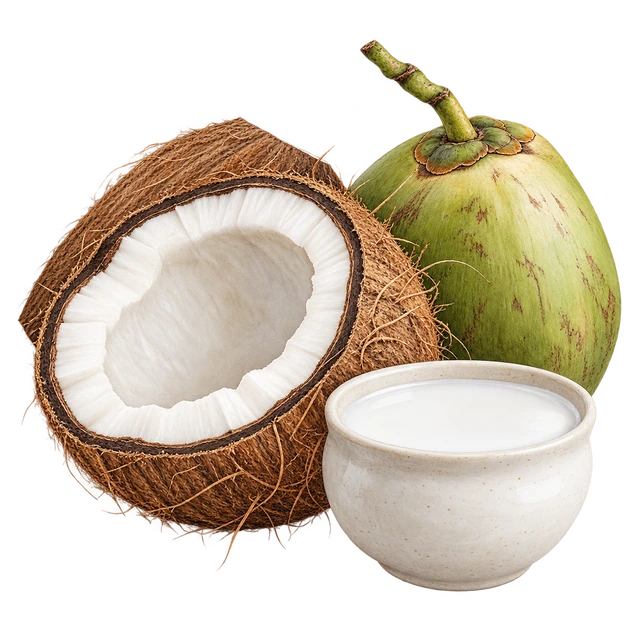
Food from the coconut palm: white seed flesh and the liquid naturally inside the fruit, plus milk extracted from grated flesh. Coconut oil already has its own card (27).
Ingredient details, preparation and research
Also known as: Coconut; Coconut meat; Coconut flesh; Coconut water; Coconut milk; Coconut cream; Desiccated coconut
Source plant or material
Cocos nucifera L.
Plant family / material: Arecaceae
Forms and route
Fresh young or mature flesh; unsweetened or sweetened dried coconut; coconut water; concentrated cooking milk or cream; diluted, sometimes fortified coconut beverages. Cream of coconut is often sweetened.
Vitamins and minerals
No single composition value covers coconut. Mature flesh, clear water, canned cooking milk and a diluted fortified beverage differ in fiber, fat, sugar and protein. Read the exact product label; fortification does not make a low-protein coconut drink equivalent to milk.
Absorption and preparation
No special coconut-based nutrient-absorption advantage is established. Adding coconut fat changes the meal’s fat content, while straining and dilution change what remains from the flesh.
Practical preparation
Use food-grade coconut and clean tools; opening a hard shell calls for a stable surface and care. Follow package instructions for cooking milk, beverages and refrigeration after opening.
Combination context
No medicinal pairing or standard therapeutic serving is established.
Combination notes
Coconut milk works with rice, beans, spices and starch-based desserts. Account for salt in savory dishes and sugar in sweets.
Traditional and reported uses
- Flesh and water as foods
- Savory coconut-milk dishes
- Coconut desserts and fillings
Contraindications and cautions
- Coconut flesh, concentrated milk and cream contribute saturated fat. Consider portion and the whole diet; none is established here as a heart-treatment food.
- Coconut water can supply substantial potassium. If you have a prescribed potassium or fluid limit, fit it into your clinician’s plan; it is not a prescribed rehydration solution.
- Diluted coconut beverages are generally low in protein and vary in fortification. They are not infant formula or automatically nutritionally equivalent to dairy milk.
- Avoid coconut if you have a diagnosed coconut allergy. Tree-nut allergy does not by itself establish coconut allergy; ask your allergist rather than testing a suspected allergy yourself.
- Refrigerate opened products and fresh prepared flesh as directed. Check added sugars, especially in sweetened shreds, cream of coconut and flavored drinks.
Similar items and how they compare
- Coconut oil (entry 27)
Extracted from the same source plant.
The separated fat does not retain the flesh’s fiber or the water’s nutrient profile.
- Coconut water
Liquid inside the coconut.
Naturally relatively clear; it is not milk squeezed from grated flesh.
- Coconut milk beverage versus cooking milk
Both may be sold as coconut milk.
A diluted carton beverage may be fortified; concentrated cooking milk or cream has a different fat and energy profile.
Milk is extracted; water is already inside
The distinction is physical, not a marketing preference. Concentration and added water further separate cooking milk, cream and beverages.
Read the product, not just the word coconut
Fortified drinks vary. Their protein and other nutrients cannot be assumed from dairy comparisons, while water requires attention to potassium where medically restricted.
Evidence limits
This card does not establish detoxification, weight-loss, infection treatment or an intravenous/oral rehydration substitute. Oil and isolated MCT products are outside its food-composition scope.
Entry sources
- Singapore NParks: Cocos nucifera
- UF/IFAS: Plant-Based Milks: Coconut
- Illinois Extension: Is it Worth Going Nuts for Coconut?
- Jamaica Tourist Board: Food
- Discover Puerto Rico: Iconic Puerto Rican Recipes to Bring the Spirit of Navidad Home
- Singapore Botanic Gardens Gardenwise 66: Tropical Treats and Sweets
- AAAAI: Food Allergy
- AAAAI: Everything You Need to Know About Tree Nut Allergy
Reference entry 284 · Recorded content review: 2026-10-09 · Review scope and dates