


Key cautions
- Rare serious allergy has been reported.
- Use food-grade seed colorant.
- Leaf and root remedies are separate from seasoning.
What’s inside
Seed-coat carotenoid pigments provide the characteristic color. A seasoning quantity or color extract is not automatically a meaningful vitamin serving or equivalent to a concentrated supplement.
Uses in brief

- Achiote seasoning paste
- Food coloring
- Pataxó body-paint tradition
- Textile dye
- Reported Trinidad remedy history
History, folklore and reported uses
History, folklore and traditional uses
Kew accepts Bixa orellana and records its native range from Mexico to southern tropical America. It has long been moved and cultivated beyond that range.
Caribbean names preserve distinct regional histories: Smithsonian’s West Indies flora records achiote and bija in several Spanish-speaking islands, annatto in Jamaica, and roucou in Haiti and parts of the Lesser Antilles. Shared names do not make every island’s recipe or remedy identical.
Traditional, historical and reported uses
- Yucatecan achiote seasoning paste
Food or household practiceWhy this label?
A Mexican government culinary account describes achiote paste in a named regional dish.
Mexico’s Secretariat of Agriculture describes achiote paste as a central ingredient in cochinita pibil, combined with citrus and other seasonings. This is a particular Yucatecan culinary tradition, not a claim that annatto by itself supplies the whole dish’s flavor or nutrition.
- Orange-red food coloring
Food or household practiceWhy this label?
Documents colorant function in foods, with regulatory scope separated from efficacy.
NParks records the seed-associated colorant in foods including rice, cheese, drinks and soup; FDA lists regulated annatto colorants for food use. The coloring function is distinct from a health benefit.
- Pataxó body painting with urucum
Traditional accountWhy this label?
First-person Pataxó testimony recorded by Smithsonian explains a living cultural practice; the label does not claim therapeutic skin effects.
At the 2024 Smithsonian Folklife Festival, Txatxu and Andwara Pataxó described body painting as part of their living heritage and cultural resurgence. The Smithsonian account identifies urucum/achiote seeds as a red-pigment source. This testimony is specific to the Pataxó, not a universal account of Indigenous peoples or a DIY skin-treatment recommendation.
- Textile dye
Food or household practiceWhy this label?
Describes a material dye application, not a clinical outcome.
NParks also records use of annatto pigment to color textiles. This is a material application; dyeing cloth does not establish that a dye preparation is edible or safe on skin.
- Reported roucou remedies in Trinidad
Traditional accountWhy this label?
Primary household interviews with voucher identification document intended medicinal use; no treatment was tested.
A vouchered 2007–2008 household survey, published in 2015, recorded oral decoctions listed as leaves, fruits and roots of Bixa orellana for diabetes and high blood pressure. These are reports of intended treatment from a particular survey, not evidence of benefit and not the culinary seed colorant.
Featured uses are distinct documented practices, not a quota. Cultural and medicinal accounts preserve their named place and material; they do not establish clinical benefit.
Historical-use additions reviewed 2026-10-09
Story sources
- Kew POWO: Bixa orellana, accepted name and native range
- Smithsonian West Indies flora: Bixa orellana, island names and distribution
- Mexico Secretariat of Agriculture (2026): Cochinita pibil and achiote paste
- Singapore NParks: Bixa orellana, seed colorant and separate medicinal materials
- FDA: Regulatory Status of Color Additives, Annatto Extract / Annatto
- Smithsonian Folklife Festival (2024): Reclaiming Land, Life, and Spirit: The Pataxó Art of Body Painting
- Clement, Baksh-Comeau and Seaforth (2015): An ethnobotanical survey of medicinal plants in Trinidad, Table 1, page 8
Regional reading paths
These sourced notes describe cultivation, trade, food traditions or material history. A regional connection does not claim exclusive origin.
North America
Cultivated/traditional processing: Mexico, especially Yucatán.
Seed-coat pigment colors and seasons pibil dishes.
South America
native and cultivated; Brazil, Peru
Seed coating used for culinary coloring.
Identity & detailed reference
Identity
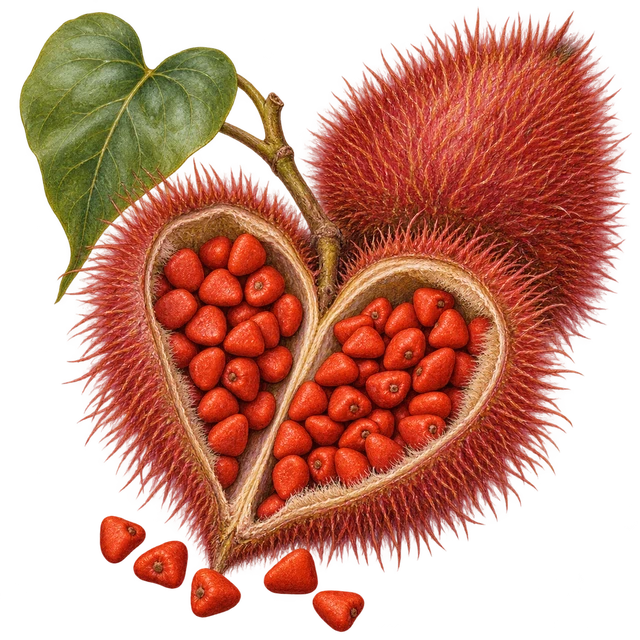
The orange-red colorant and seasoning obtained from the coating of Bixa orellana seeds. Whole culinary seeds, food-grade extracts and seasoning pastes differ from leaf, root or bark remedies and from cosmetic pigments.
Ingredient details, preparation and research
Also known as: Achiote; Achote; Roucou; Ruku; Bija; Onoto; Urucum; Annato; Bixa orellana
Source plant or material
Bixa orellana L.
Plant family / material: Bixaceae
Forms and route
Food-grade seeds, ground seasoning, achiote paste and seed-derived food colorants. Leaf/root decoctions and body-paint materials are separately attributed historical or cultural uses.
Vitamins and minerals
Annatto is primarily a colorant and seasoning in this card. No verified standard culinary-serving nutrient panel is supplied. Seed pigment chemistry, a supplement’s tocotrienol content and the nutrition of annatto-colored cheese or rice must not be treated as one food-composition claim.
Absorption and preparation
The color imparted to a dish does not establish the amount absorbed or a clinical antioxidant benefit. Different food-color formulations and supplements require their own evidence.
Practical preparation
Use food-grade seeds, powder, paste or colorant according to a culinary recipe and product instructions. Check blends for salt and other ingredients. Do not improvise medicinal root/leaf decoctions from this card.
Combination context
Coloring rice or cheese changes appearance; their nutrients come largely from the underlying food and recipe.
Combination notes
Achiote paste is a seasoning blend; citrus, garlic and other spices contribute their own flavor. No clinical synergy is established for a food combination.
Traditional and reported uses
- Achiote seasoning paste
- Food coloring
- Pataxó body-paint tradition
- Textile dye
- Reported Trinidad remedy history
Contraindications and cautions
- Annatto can rarely cause allergic reactions, including anaphylaxis. Avoid it if you have a known annatto allergy; seek urgent help for trouble breathing or faintness after an exposure.
- Use products labeled for food in the kitchen. Cosmetic pigment, body paint, leaf/root preparations and supplements are not interchangeable with culinary seed colorant.
- Traditional leaf and root uses do not establish an effective dose or clinical safety. Do not replace diabetes or blood-pressure treatment with annatto remedies.
- Food-color authorization does not approve medicinal effects, every homemade extract or every route of use.
Similar items and how they compare
- Saffron or turmeric
All can color foods yellow or orange.
They come from different plants and plant parts, with different flavors and evidence.
- Achiote paste
Contains annatto as a culinary ingredient.
Often includes other spices, salt and acidic ingredients; the label and recipe describe the blend.
- Annatto leaf/root remedies and supplements
Can originate from the same plant.
Plant part, extraction, dose and route differ from seed-coat coloring used in food.
The medicinal account is a survey, not a trial
Clement and colleagues interviewed 450 households in 50 rural Trinidad communities. The roucou row is a report of plant use; it did not establish efficacy or a safe dose, and the source itself cautions against extrapolating laboratory findings to clinical benefit.
A seed colorant is not a whole-plant preparation
FDA’s annatto substance record identifies a seed-derived carotenoid material. NParks separately describes root and leaf traditions. A claim about one of these materials should not be assigned to another.
Natural origin does not rule out allergy
A published case report describes an IgE-associated anaphylactic reaction to annatto dye. This demonstrates that a serious reaction is possible; one case cannot establish how common it is.
Food-color regulation has a specific scope
FDA lists annatto colorants for specified food, drug and cosmetic uses. This is a regulatory color-additive context, not approval to use the plant as a medicine or to consume cosmetic products.
Evidence limits
Culinary seed-coat use, textile dye, a named Indigenous body-paint tradition and a specific Trinidad medicinal survey are kept distinct. This review supplies no medicinal dose, treatment recommendation or nutrient ranking.
Entry sources
- Kew POWO: Bixa orellana, accepted name and native range
- Smithsonian West Indies flora: Bixa orellana, island names and distribution
- Singapore NParks: Bixa orellana, seed colorant and separate medicinal materials
- Mexico Secretariat of Agriculture (2026): Cochinita pibil and achiote paste
- Smithsonian Folklife Festival (2024): Reclaiming Land, Life, and Spirit: The Pataxó Art of Body Painting
- Clement, Baksh-Comeau and Seaforth (2015): An ethnobotanical survey of medicinal plants in Trinidad, Table 1, page 8
- FDA: Regulatory Status of Color Additives, Annatto Extract / Annatto
- FDA substance record: Annatto, Bixa orellana seed carotenoid fraction
- Nish and colleagues (1991): Anaphylaxis to annatto dye, a case report
Reference entry 281 · Recorded content review: 2026-10-09 · Review scope and dates