


Key cautions
- Keep to small recipe amounts.
- Large ingestions can poison; seek poison-service advice promptly.
- Keep away from children and avoid home medicinal dosing.
What’s inside
Aromatic oils include myristicin. A flavorful seasoning amount and a large or concentrated exposure have different safety implications; a constituent name is not a health claim.
Uses in brief

- Small-amount dessert seasoning
- Savory seasoning
- Grenadian nutmeg ice cream
History, folklore and reported uses
History, folklore and traditional uses
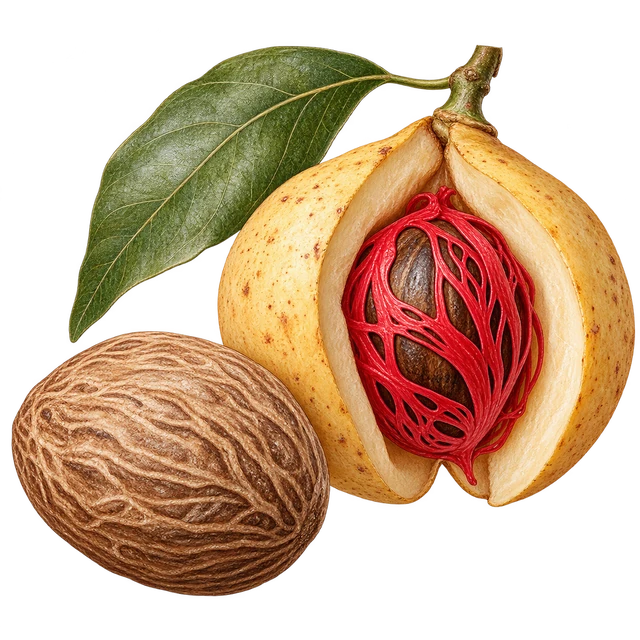
Kew places Myristica fragrans in the Banda Islands of Maluku. One fruit yields two distinct spices: the kernel called nutmeg and the aril called mace. The fleshy husk has its own preserving traditions.
Nutmeg also has a strong present-day Grenadian identity. The Grenada Tourism Authority lists nutmeg ice cream among local foods and, in 2025, announced a spice-syrup collaboration with the Grenada Cooperative Nutmeg Association. This is a documented culinary continuation, not a claim that the species originated in the Caribbean.
A closer look at its history
One fruit supplied two valuable spices
Nutmeg is the seed and mace the surrounding aril. Kew uses Marianne North’s Jamaican painting, made after her 1871 arrival, to show the opening fruit and red mace. The painting offers a dated Caribbean encounter with a crop whose older commercial heart lay in Indonesia’s Banda Islands.
Spice movement was also a history of coercion
Kew describes Dutch control after the 1621 invasion of Banda, destruction of excess harvests and attempts to prevent viable seeds escaping. French plant transfers through Mauritius helped break that control. The later Caribbean crop belongs within this history of colonial competition; a spice’s pleasant flavor should not obscure the power behind its movement.
Additional history reviewed 2026-10-10
Traditional, historical and reported uses
- Small-amount dessert seasoning
Food or household practiceWhy this label?
Records a specific culinary preparation of the named material; this is a food-practice category, not evidence of a medical benefit.
Culinary nutmeg is used in sweet foods. Poison Control gives cookies and eggnog as familiar examples while emphasizing that large ingestions can be harmful.
- Savory seasoning
Food or household practiceWhy this label?
Records a specific culinary preparation of the named material; this is a food-practice category, not evidence of a medical benefit.
UF/IFAS includes nutmeg among seasonings for ground meats, cheese dishes, soups and vegetables. This is a small flavoring role; it does not imply that a larger portion offers a larger benefit.
- Grenadian nutmeg ice cream
Food or household practiceWhy this label?
Records a specific culinary preparation of the named material; this is a food-practice category, not evidence of a medical benefit.
The Grenada Tourism Authority explicitly identifies nutmeg ice cream as part of the island’s culinary offering. The spice supplies flavor; the finished dessert has the nutrition of its complete recipe.
- Grenadian spice-syrup craft
Food or household practiceWhy this label?
Records a specific culinary preparation of the named material; this is a food-practice category, not evidence of a medical benefit.
A 2025 Grenada Tourism Authority announcement describes a syrup developed with the Grenada Cooperative Nutmeg Association using nutmeg, cinnamon and other spices. It documents a particular contemporary product initiative rather than a universal traditional recipe.
- Cosmetic and toiletry ingredient
Food or household practiceWhy this label?
A government economic-botany profile explicitly records oil use in cosmetics and toiletries. It is a material/cosmetic practice, not a clinical benefit or a recommendation to apply undiluted oil.
India’s Spices Board records nutmeg oil in cosmetics and toiletries. This use concerns a processed oil, separately from the seed kernel grated into food; the industrial application supplies no safe home skin preparation or medicinal dose.
- Caribbean household-remedy records
Traditional accountWhy this label?
TRAMIL links the nutmeg use rows to named, dated regional surveys. The record preserves location, route and reported purpose without promoting efficacy or reproducing medicinal recipes, doses or waiting periods before seeking care.
TRAMIL surveys record nutmeg applied externally for headaches in Saint Lucia (1988) and lung complaints in the Dominican Republic (1984), and taken orally for “juma,” described as vertigo and weakness, in Dominica (1988). These are attributed accounts of intended use, not established treatments. No remedy instructions are given because nutmeg can poison.
6 distinct supported uses are featured. Culinary, material and attributed historical practices are distinguished from medicinal efficacy; no fixed seven-use quota is imposed.
Historical-use additions reviewed 2026-10-09
Story sources
- Kew POWO: Myristica fragrans Houtt., native Banda Islands range
- Spices Board India: Nutmeg and Mace, seed kernel versus aril and fruit husk
- Singapore National Parks Board: Myristica fragrans, nutmeg, mace and fruit-husk foods
- Grenada Tourism Authority: Culinary, including nutmeg ice cream
- Grenada Tourism Authority (20 March 2025): Signature spice syrup developed with the Grenada Cooperative Nutmeg Association
- TRAMIL: Myristica fragrans, nutmeg-use surveys from Saint Lucia (1988), the Dominican Republic (1984) and Dominica (1988)
- Ehrenpreis et al. (2014): Nutmeg poisonings, Illinois Poison Center retrospective series
Regional reading paths
These sourced notes describe cultivation, trade, food traditions or material history. A regional connection does not claim exclusive origin.
Asia
Native: Indonesian Moluccas; cultivated in India.
Seed kernel used sparingly as spice.
Identity & detailed reference
Identity
The dried seed kernel of Myristica fragrans. Mace is the separate lacy aril surrounding the seed’s hard shell; the fleshy outer fruit is another food material and must not be confused with a serving of nutmeg spice.
Ingredient details, preparation and research
Also known as: Nutmeg seed kernel; Myristica fragrans; Jaiphal; Jathikka; Nuez moscada
Source plant or material
Myristica fragrans Houtt.
Plant family / material: Myristicaceae
Forms and route
A whole dried kernel grated in small amounts, or ground culinary nutmeg. Mace, preserved fruit husk, essential oil, oleoresin and medicinal mixtures are different preparations.
Vitamins and minerals
No numerical nutrient claim is assigned to a small grating of nutmeg. Nutmeg seed, mace, fruit-husk preserves and nutmeg-flavored ice cream have different compositions; the name of the spice cannot stand in for the nutrition of those foods.
Absorption and preparation
No clinically established nutrient-absorption advantage is claimed for nutmeg. Its aromatic constituents do not justify increasing the serving or using a concentrated extract.
Practical preparation
Grate a little whole culinary kernel or measure ground nutmeg into a food recipe. Store securely, and avoid deliberately increasing the quantity for a supposed therapeutic or psychoactive effect.
Combination context
No special absorption-enhancing combination is established.
Combination notes
Nutmeg can accompany cinnamon or other spices in food. A multi-spice recipe is still a food preparation, and adding ingredients does not make a large nutmeg exposure safe.
Traditional and reported uses
- Small-amount dessert seasoning
- Savory seasoning
- Grenadian nutmeg ice cream
- Grenadian spice-syrup craft
- Cosmetic and toiletry ingredient
- Caribbean household-remedy records
Contraindications and cautions
- Use small culinary amounts specified by a food recipe. Do not swallow spoonfuls, whole kernels or concentrated preparations as a remedy, sleep aid or intoxicant; nutmeg poisoning can be serious.
- Excess ingestion can cause nausea, vomiting, agitation, marked or prolonged drowsiness and other neurological effects. If a large amount is swallowed or concerning symptoms occur, contact a local poison service or seek urgent medical help.
- Keep nutmeg, mace and concentrated spice products away from children. Do not give home medicinal nutmeg preparations to infants.
- Mace and fruit-husk foods are different materials, not evidence that unlimited nutmeg seed is safe. Do not extrapolate a fruit preserve’s recipe or a laboratory extract to the seed spice.
Similar items and how they compare
- Mace
Comes from the same fruit as nutmeg.
It is the dried lacy aril around the seed shell, not the seed kernel. Use the culinary form and amount called for in the recipe.
- Nutmeg fruit husk
The fleshy outer fruit also has documented food uses.
NParks records it in preserved fruit and jelly. It is not ground nutmeg seed, and its use does not validate eating large amounts of the kernel.
- Nutmeg oil or oleoresin
Concentrates aromatic substances associated with the spice.
Industrial flavoring or fragrance uses do not create a home medicinal dose or permit substituting drops for ground-spice amounts.
Kernel, aril and husk are separate ingredients
The Spices Board and NParks distinguish nutmeg kernel, mace aril and the fleshy outer fruit. Preserve those distinctions when reading food uses or research; an effect or amount for one does not automatically apply to another.
Poisoning evidence is from actual exposures
A 2014 retrospective Illinois Poison Center study reviewed 32 reported nutmeg ingestions or exposures from 2001–2011, including intentional and accidental events. Some intentional cases involved other drugs. The study establishes a real poisoning concern; it does not supply a safe self-dosing threshold.
Surveyed medicinal traditions are not clinical proof
TRAMIL cites Jean-Pierre’s 1988 Saint Lucia survey, Germosén-Robineau and colleagues’ 1984 Dominican Republic survey, and Charles’s 1988 Dominica survey for the respective recorded uses. These are evidence of reported practice, not human treatment trials. The monograph’s medicinal dosing instructions are deliberately not reproduced.
Evidence limits
Culinary seed use is distinguished from mace, fruit-husk foods and extracts. No numeric “safe medicinal dose” is provided. A poison-center case series identifies harm but does not measure risk for every ordinary recipe or prove that a tiny seasoning amount causes poisoning. The dated Caribbean remedy accounts are retained as cultural evidence only; topical use is not assumed safe simply because it is external.
Entry sources
- Kew POWO: Myristica fragrans Houtt., native Banda Islands range
- Spices Board India: Nutmeg and Mace, seed kernel versus aril and fruit husk
- Singapore National Parks Board: Myristica fragrans, nutmeg, mace and fruit-husk foods
- Grenada Tourism Authority: Culinary, including nutmeg ice cream
- Grenada Tourism Authority (20 March 2025): Signature spice syrup developed with the Grenada Cooperative Nutmeg Association
- Ehrenpreis et al. (2014): Nutmeg poisonings, Illinois Poison Center retrospective series
- National Capital Poison Center: Kitchen surprises and cautions, nutmeg and alcohol-based extracts
- University of Florida IFAS: Shopping for Health, Herbs and Spices
- TRAMIL: Myristica fragrans, nutmeg-use surveys from Saint Lucia (1988), the Dominican Republic (1984) and Dominica (1988)
Reference entry 276 · Recorded content review: 2026-10-09 · Review scope and dates