


Key cautions
- Use properly handled food-grade huitlacoche, not arbitrary mouldy or spoiled corn.
What’s inside
Studies describe protein and amino acids, including lysine, dietary fibre and lipids in huitlacoche. Maturity, maize background and processing affect composition.
Uses in brief

- Culinary food traditions
- A value-added maize crop
- A model for cell biology and plant disease
- Experimental fermentation and biomanufacturing
History, folklore and reported uses
History, folklore and traditional uses
Huitlacoche turns a plant disease into a valued food. The young galls combine maize and fungal tissue, linking the ingredient directly with the milpa and Mexican market cooking. “Mexican truffle” is a culinary nickname rather than a taxonomic relationship to underground truffles.
Its present culinary importance is clear; the beginning of its food history is less certain. Scholarship questions the familiar story that it was a well-documented Aztec luxury, and the biocultural review acknowledges sparse evidence for the origins of consumption. Respecting the food’s heritage includes making that uncertainty visible.
A closer look at its history
Traditional does not automatically mean an Aztec delicacy
UNAM researcher Raúl Valadez Azúa questions the familiar pre-Hispanic delicacy story: he notes the absence of direct archaeological/iconographic proof and the unfavourable sixteenth-century description. His reconstruction treats the food’s later rise within Mexican cuisine as part of its history. Present this as a scholarly interpretation, not proof that no person ever ate it earlier.
A food, a crop disease and a model organism
Plant pathologists study U. maydis as a model for fungal biology and host infection, while farmers may view it as crop damage and cooks value selected galls. These are genuinely different uses and perspectives on one organism, not a contradiction to be removed.
Additional history reviewed 2026-10-09
Traditional, historical and reported uses
- Culinary food traditions
Food or household practiceWhy this label?
The claim documents culinary food traditions as a culinary, craft, gardening, or practical material use; it reports neither a treatment outcome nor measured nutrient content.
Cooked huitlacoche is used in quesadillas and other tortilla-based foods. Soup and cream preparations provide another established culinary setting for the ingredient. Pasta and contemporary restaurant dishes extend its culinary use beyond familiar tortilla preparations.
- A value-added maize crop
Food or household practiceWhy this label?
The claim documents a value-added maize crop as a culinary, craft, gardening, or practical material use; it reports neither a treatment outcome nor measured nutrient content.
Cultivation and sale can turn maize infection into a purposeful food product with market value.
- A model for cell biology and plant disease
Laboratory/animal researchWhy this label?
The exact claim concerns experimental fungal cell biology and maize interactions in laboratory strains, separate from food-gall use.
The fungus Ustilago maydis is used in laboratory research on fungal cell biology and interactions with maize. This scientific role concerns experimental fungal strains and the infection process, rather than a culinary use of harvested huitlacoche galls.
- Experimental fermentation and biomanufacturing
Laboratory/animal researchWhy this label?
The claim describes engineered fungal cultures and controlled fermentation experiments for chemical production, a nonclinical biotechnology research use.
Researchers have engineered U. maydis cultures to produce chemicals, including terpenoid compounds, and studied strains for itaconic-acid fermentation. These are controlled biotechnology applications of the fungus, distinct from food galls; the studies do not establish that huitlacoche meals deliver the manufactured products or that these processes are generally commercialized.
Four distinct roles are documented: culinary food, a cultivated value-added maize crop, a laboratory model for cell biology and plant disease, and experimental biomanufacturing. Different tortilla, soup and restaurant dishes remain examples of the same culinary role.
Story sources
- Huitlacoche biocultural review
- Arqueología Mexicana: El cuitlacoche, el hongo doméstico de la milpa
- Index Fungorum: Ustilago maydis, Ustilaginaceae
- Primary research: Ustilago maydis Serves as a Novel Production Host for the Synthesis of Plant and Fungal Sesquiterpenoids (2020)
- Primary research: Development of an itaconic acid production process with Ustilaginaceae on alternative feedstocks (2023)
Features and lookalikes to study
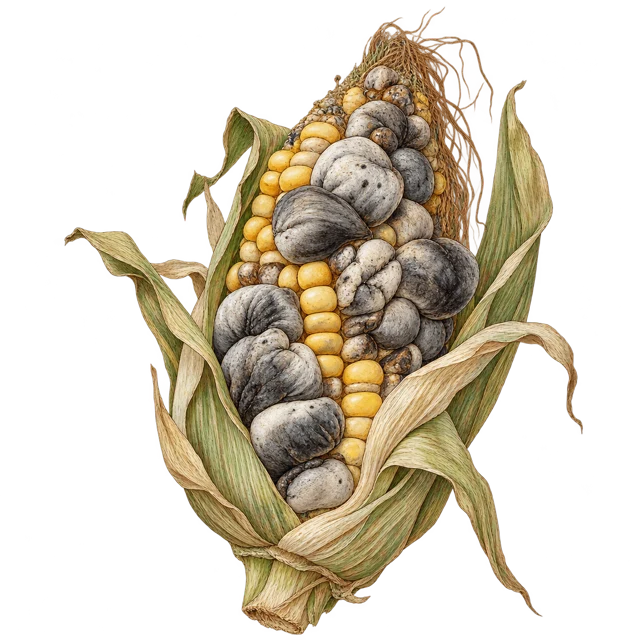
Ustilago maydis on maize (Zea mays); the food is the young infected gall, containing fungal and plant tissue.
Common names vary between regions and suppliers; the scientific scope above governs this card.
Morphology described in sources
- Ustilago maydis induces swollen galls on maize. The food consists of young infected plant-and-fungal tissue; mature galls break down into dark spores. Ordinary surface mould on stored maize is a different phenomenon.
- Habitat and substrate
- See the source-linked morphology and comparison notes below; a separate habitat summary has not been verified for this card.
- Geographic scope
- A complete regional range is not established here. Broad common names and commercial labels can span different species.
- Season in the cited region
- No region-specific fruiting season has been verified for this card. Do not infer a local season from trade availability.
Fusarium, Gibberella and Aspergillus ear moulds
Common smut produces discrete enlarged galls, unlike the other ear-mould diseases discussed by extension; those moulds can be associated with mycotoxins.
Mixed infection or spoiled material cannot be cleared by seeing a smut gall. “Black fungus on corn” is not a sufficient diagnosis or a licence to eat damaged grain.
Limits and regional differences
- If the diagnosis is uncertain, a plant-disease specialist should examine the crop; food quality and contamination assessment remain separate. No instruction to eat old powdery galls is implied.
- Educational comparison only. Neither this card, an illustration, a photograph, a spore-print colour nor a checklist establishes that a wild collection is safe to eat. A qualified local mycologist must assess uncertain material; do not taste an unknown fungus. Cooking does not reliably eliminate mushroom toxins.
Regional reading paths
These sourced notes describe cultivation, trade, food traditions or material history. A regional connection does not claim exclusive origin.
North America
Traditional processing/cultivated: Mexico.
Young maize galls cooked in quesadillas, soups and other dishes.
Identity & detailed reference
Identity
Ustilago maydis on maize (Zea mays); the food is the young infected gall, containing fungal and plant tissue.
Ingredient details, preparation and research
Also known as: Huitlacoche; Cuitlacoche; Corn smut; Mexican truffle (culinary nickname)
Source plant or material
Young edible galls produced by U. maydis on maize, containing both fungal and plant tissue; not arbitrary mouldy corn.
Fungal family: Ustilaginaceae
Forms and route
Fresh, chilled, frozen or canned food-grade galls and cooked dishes.
Vitamins and minerals
Huitlacoche can diversify the diet with protein, amino acids and fibre. Published analyses vary in moisture basis and material; no single nutrient number is applied to all fresh or canned products.
Absorption and preparation
Cook properly handled food-grade huitlacoche in ordinary dishes. Its history as edible maize smut does not make other moulds or damaged corn safe, and it establishes no medicinal absorption protocol.
Traditional and reported uses
- Culinary food traditions: Cooked huitlacoche is used in quesadillas and other tortilla-based foods. Soup and cream preparations provide another established culinary setting for the ingredient. Pasta and contemporary restaurant dishes extend its culinary use beyond familiar tortilla preparations.
- A value-added maize crop: Cultivation and sale can turn maize infection into a purposeful food product with market value.
- A model for cell biology and plant disease: The fungus Ustilago maydis is used in laboratory research on fungal cell biology and interactions with maize. This scientific role concerns experimental fungal strains and the infection process, rather than a culinary use of harvested huitlacoche galls.
- Experimental fermentation and biomanufacturing: Researchers have engineered U. maydis cultures to produce chemicals, including terpenoid compounds, and studied strains for itaconic-acid fermentation. These are controlled biotechnology applications of the fungus, distinct from food galls; the studies do not establish that huitlacoche meals deliver the manufactured products or that these processes are generally commercialized.
Contraindications and cautions
- Use properly handled food-grade huitlacoche, not arbitrary mouldy or spoiled corn.
Fungus, family and material
Ustilago maydis on maize (Zea mays). Ustilaginaceae. Young edible galls produced by U. maydis on maize, containing both fungal and plant tissue; not arbitrary mouldy corn.
Preparation and evidence
Cook properly handled food-grade huitlacoche in ordinary dishes. Its history as edible maize smut does not make other moulds or damaged corn safe, and it establishes no medicinal absorption protocol.
Constituents and nutrition
Studies describe protein and amino acids, including lysine, dietary fibre and lipids in huitlacoche. Maturity, maize background and processing affect composition. Huitlacoche can diversify the diet with protein, amino acids and fibre. Published analyses vary in moisture basis and material; no single nutrient number is applied to all fresh or canned products.
History and documented uses
Huitlacoche turns a plant disease into a valued food. The young galls combine maize and fungal tissue, linking the ingredient directly with the milpa and Mexican market cooking. “Mexican truffle” is a culinary nickname rather than a taxonomic relationship to underground truffles. Its present culinary importance is clear; the beginning of its food history is less certain. Scholarship questions the familiar story that it was a well-documented Aztec luxury, and the biocultural review acknowledges sparse evidence for the origins of consumption. Respecting the food’s heritage includes making that uncertainty visible.
Safety and interpretation
Use properly handled food-grade huitlacoche, not arbitrary mouldy or spoiled corn. Historical medicinal and childbirth-related reports are not treatment instructions.
Entry sources
- Huitlacoche biocultural review
- Arqueología Mexicana: El cuitlacoche, el hongo doméstico de la milpa
- Index Fungorum: Ustilago maydis, Ustilaginaceae
- Primary research: Ustilago maydis Serves as a Novel Production Host for the Synthesis of Plant and Fungal Sesquiterpenoids (2020)
- Primary research: Development of an itaconic acid production process with Ustilaginaceae on alternative feedstocks (2023)
Reference entry 230 · Recorded content review: 2026-10-08 · Review scope and dates