


Key cautions
- Concentrated products may increase bleeding risk with warfarin and may add to glucose-lowering medicines.
- Allergy is possible; food experience does not establish the safety of every extract.
What’s inside
Beta-glucan polysaccharides are prominent in extract research, including protein-associated fractions. Named D-fraction products are not simply ground whole mushroom.
Uses in brief

- Culinary food
- Diabetes tradition
- Blood-pressure tradition
History, folklore and reported uses
History, folklore and traditional uses
Maitake’s Japanese name is commonly rendered “dancing mushroom.” It is a prized food with a clustered growth form, also known in English as hen of the woods. Various origin stories surround the name, but the better-grounded history is its culinary use and the development of artificial cultivation in Japan.
Traditional accounts also record use for diabetes and high blood pressure, while modern investigators study selected polysaccharide fractions. These are different kinds of evidence, and neither tradition nor immune-cell measurements prove disease treatment. Contemporary crop studies using agricultural residues add an economic and cultivation dimension to the food-and-medicine story.
A closer look at its history
From a wild rosette to a crop
The name maitake is commonly translated as dancing mushroom. Stories explaining who danced and why are folk explanations, not a documented single origin. Twentieth-century cultivation work made the formerly seasonal woodland fungus a producible crop; distinguish this practical history from modern supplement claims.
Additional history reviewed 2026-10-09
Traditional, historical and reported uses
- Culinary food
Food or household practiceWhy this label?
The claim documents culinary food as a culinary, craft, gardening, or practical material use; it reports neither a treatment outcome nor measured nutrient content.
Young fruiting bodies are eaten fried or boiled and valued in Japanese cuisine.
- Diabetes tradition
Traditional accountWhy this label?
The claim is a recorded Asian diabetes-remedy tradition and expressly does not assert effective glucose control.
Traditional Asian use for diabetes is recorded; this is not proof of effective glucose control.
- Blood-pressure tradition
Traditional accountWhy this label?
The claim records hypertension as a traditional indication rather than a tested blood-pressure outcome.
Hypertension is another recorded traditional use.
- Immune/oncology extract research
Human researchWhy this label?
Specific preparations were studied in small human trials and immune responses varied; the label describes the evidence setting.
Specific polysaccharide preparations have been studied in small human trials; immune changes include both stimulation and inhibition.
- Cultivated crop on agricultural residues
Mixed/contextual sourcesWhy this label?
The claim combines commercial cultivation with experimental crop-residue substrates; this is agricultural production context, not medicinal efficacy.
Maitake is commercially grown on supplemented sawdust; primary experiments also evaluate corncobs and other crop residues as alternative substrates. Cultivation extends the mushroom’s role beyond seasonal wild collection.
Features and lookalikes to study
Grifola frondosa (Dicks.) Gray. Not chicken of the woods (Laetiporus species).
Common names vary between regions and suppliers; the scientific scope above governs this card.
Morphology described in sources
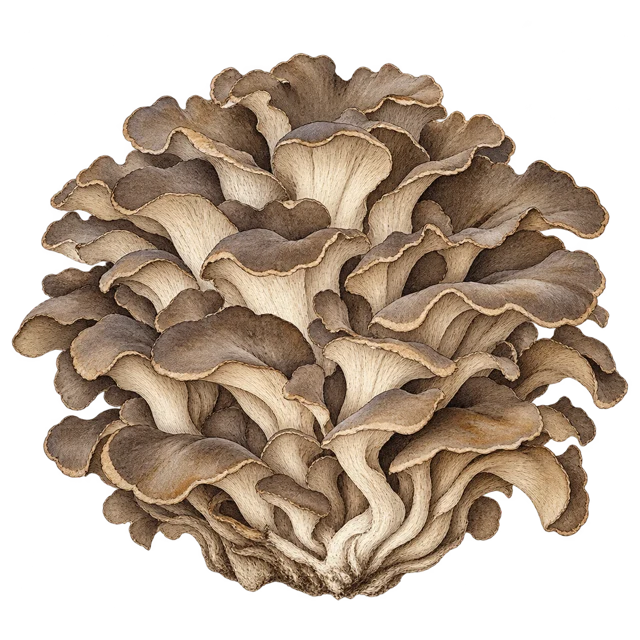
- Many smoky grey-brown fan-shaped caps form a rosette from a common branching base. The underside has pores, not gills. It is often associated with the bases of oaks in North American accounts.
- Habitat and substrate
- Near the bases of living oaks and other hardwoods, and on decaying wood; associated with white butt rot.
- Geographic scope
- The cited North American account reports broad occurrence east of the Rocky Mountains and rarity farther west; it is not a global range map.
- Season in the cited region
- Summer and autumn in the cited North American account.
Meripilus sumstinei / regional Meripilus relatives
Meripilus commonly has larger individual fans and blackening tissue or pore surfaces; Grifola frondosa has smaller overlapping fronds and does not characteristically blacken that way.
Age and damage affect staining. The comparison is regional, and a lack of blackening is not a species identification.
Polyporus umbellatus
Umbrella polypore has more separate, rounded caps with central little stems, while maitake has fan-like, irregular fronds.
Both are branched polypores, and incomplete clusters obscure the architecture. Microscopic features assist difficult comparisons.
Limits and regional differences
- Examine attachment, complete branching structure, pores and host; badly weathered fragments cannot be reliably named from colour. Hen of the woods is not chicken of the woods.
- Educational comparison only. Neither this card, an illustration, a photograph, a spore-print colour nor a checklist establishes that a wild collection is safe to eat. A qualified local mycologist must assess uncertain material; do not taste an unknown fungus. Cooking does not reliably eliminate mushroom toxins.
Regional reading paths
These sourced notes describe cultivation, trade, food traditions or material history. A regional connection does not claim exclusive origin.
North America
Native in North America; Illinois state biodiversity material documents its local occurrence.
An edible mushroom when professionally identified and appropriately cooked; use a trusted food supplier, not this shelf as a foraging guide.
Identity & detailed reference
Identity
Grifola frondosa (Dicks.) Gray. Not chicken of the woods (Laetiporus species).
Ingredient details, preparation and research
Also known as: maitake / dancing mushroom; hen of the woods; hui shu hua; Mataki mushrooms
Source plant or material
Grifola frondosa (Dicks.) Gray; Young clustered fruiting bodies; separate powders and named extract fractions.
Fungal family: Grifolaceae
Forms and route
Young cooked fruiting bodies; dried powders and concentrated extracts, including named beta-glucan fractions, are different products.
Vitamins and minerals
A culinary mushroom; nutrient contribution depends on serving size and processing. This card does not assign values from dry extracts to fresh food.
Absorption and preparation
Cook young fruiting bodies as food. A dried food, whole powder and standardized extract can differ substantially; published extract findings do not define an absorption recipe for meals.
Traditional and reported uses
- Young fruiting bodies are eaten fried or boiled and valued in Japanese cuisine.
- Traditional Asian use for diabetes is recorded; this is not proof of effective glucose control.
- Hypertension is another recorded traditional use.
- Specific polysaccharide preparations have been studied in small human trials; immune changes include both stimulation and inhibition.
- Maitake is commercially grown on supplemented sawdust; primary experiments also evaluate corncobs and other crop residues as alternative substrates. Cultivation extends the mushroom’s role beyond seasonal wild collection.
Contraindications and cautions
- Concentrated products may increase bleeding risk with warfarin and may add to glucose-lowering medicines.
- Allergy is possible; food experience does not establish the safety of every extract.
- This card is not a foraging identification guide. Unknown wild mushrooms should not be eaten.
Similar items and how they compare
- Shiitake
Both are foods and sources of studied polysaccharides.
Maitake’s clustered fruiting bodies and named extract fractions differ from shiitake fruiting bodies and lentinan.
Identity, fungal material and preparation
Grifola frondosa (Dicks.) Gray. Not chicken of the woods (Laetiporus species). Young clustered fruiting bodies; separate powders and named extract fractions. Cook young fruiting bodies as food. A dried food, whole powder and standardized extract can differ substantially; published extract findings do not define an absorption recipe for meals.
Constituents and food context
Beta-glucan polysaccharides are prominent in extract research, including protein-associated fractions. Named D-fraction products are not simply ground whole mushroom. A culinary mushroom; nutrient contribution depends on serving size and processing. This card does not assign values from dry extracts to fresh food.
Traditional uses and evidence boundaries
Food, D-fraction products and other extracts are different preparations. Immune-cell changes and small case series do not establish cancer treatment or justify changes to prescribed glucose or blood-pressure care.
Safety and product distinctions
Concentrated products may increase bleeding risk with warfarin and may add to glucose-lowering medicines. Allergy is possible; food experience does not establish the safety of every extract.
Entry sources
- MSK: Maitake
- Review: G. frondosa history, name and culinary tradition
- Mayuzumi, 1997: Cultivation methods of maitake
- NCBI Taxonomy: Grifola frondosa, Grifolaceae
- Primary study: maitake cultivation using crop residues, 2018
Reference entry 212 · Recorded content review: 2026-10-08 · Review scope and dates