


Key cautions
- Cook thoroughly; do not use raw as a garnish. Keep raw enoki away from ready-to-eat food.
- Follow recalls and storage directions: multiple Listeria outbreaks have involved enoki.
What’s inside
Extracted polysaccharides contain several sugars; their profiles depend on extraction and purification. These chemical studies do not establish a therapeutic effect from food.
Uses in brief

- Culinary mushroom
- Agricultural-residue food crop
History, folklore and reported uses
History, folklore and traditional uses
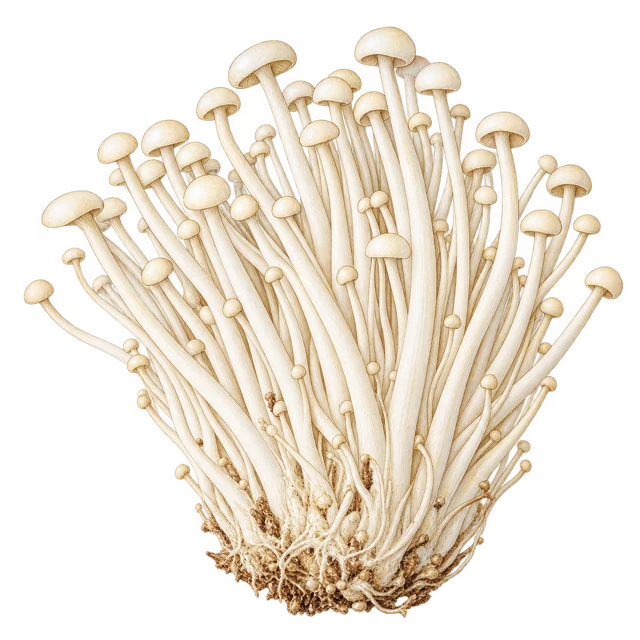
Enoki is a familiar East Asian cultivated food. Its pale, fine-stemmed commercial clusters are products of domestication and growing conditions, rather than a reliable picture of every wild Flammulina. Older culinary and scientific records frequently use F. velutipes broadly; modern species work distinguishes the principal East Asian crop as F. filiformis.
Cultivar identification and trials using soybean-straw substrates show the modern crop’s agricultural importance. Its value here is culinary and economic. Food-safety history also matters: enoki-associated Listeria outbreaks show why cultivated mushrooms still need appropriate storage, thorough cooking and separation from ready-to-eat foods.
A closer look at its history
A cultivated name revised by genetics
Integrative taxonomic research separated the principal East Asian cultivated enoki, F. filiformis, from European F. velutipes. Older cultivation and nutrition papers may use the latter name for material that would now receive the former; preserve that historical label when discussing the paper, rather than silently treating all velvet shanks as interchangeable.
Additional history reviewed 2026-10-09
Traditional, historical and reported uses
- Culinary mushroom
Food or household practiceWhy this label?
The claim documents culinary mushroom as a culinary, craft, gardening, or practical material use; it reports neither a treatment outcome nor measured nutrient content.
Cultivated enoki is used as a food in East Asian cuisine, where the slender fruiting-body clusters are valued as a cooked ingredient.
- Agricultural-residue food crop
Mixed/contextual sourcesWhy this label?
The source is a cultivation-substrate study supporting crop production; its setting is not specified enough to relabel it as a medical or laboratory efficacy experiment.
Modern cultivation studies grow authenticated F. filiformis on formulated substrates including soybean straw. This is a crop-production and residue-use application, not evidence for medicinal benefit.
The documented roles here are culinary mushroom, agricultural-residue food crop. Fewer than five distinct uses are listed because additional medical claims are not needed to explain this fungus’s importance.
Story sources
- Wang et al., 2018: integrated Flammulina species delimitation
- Chinese edible-fungi cultivation history, Mycosphere 16 (2025)
- FDA: enoki mushroom outbreak investigation and consumer advice
- Enoki cultivar identification and Physalacriaceae, 2023
- Primary study: F. filiformis polysaccharide extraction, 2022
- Primary study: F. filiformis cultivation on soybean straw, 2025
Features and lookalikes to study
Flammulina filiformis (Z.W. Ge et al.) P.M. Wang et al., the principal East Asian cultivated enoki; European F. velutipes is a distinct species.
Common names vary between regions and suppliers; the scientific scope above governs this card.
Morphology described in sources
- The long-stemmed, very pale cultivated enoki form is not a reliable model for wild Flammulina appearance. Wild velvet-shank fungi are coloured, wood-inhabiting mushrooms, and the traditional F. velutipes name covers material now separated taxonomically.
- Habitat and substrate
- See the source-linked morphology and comparison notes below; a separate habitat summary has not been verified for this card.
- Geographic scope
- A complete regional range is not established here. Broad common names and commercial labels can span different species.
- Season in the cited region
- No region-specific fruiting season has been verified for this card. Do not infer a local season from trade availability.
Galerina marginata (potentially lethal)
Wood-inhabiting Galerina can occur in the same kinds of places as wild Flammulina. Galerina typically has a rusty deposit and a ring or ring zone; Flammulina has pale spores and a velvety lower stem.
The Galerina ring may vanish. Shared substrate, winter occurrence, cap colour or a single spore print cannot establish safety. This is a comparison with wild Flammulina, not a claim that wild F. velutipes is the cultivated F. filiformis card.
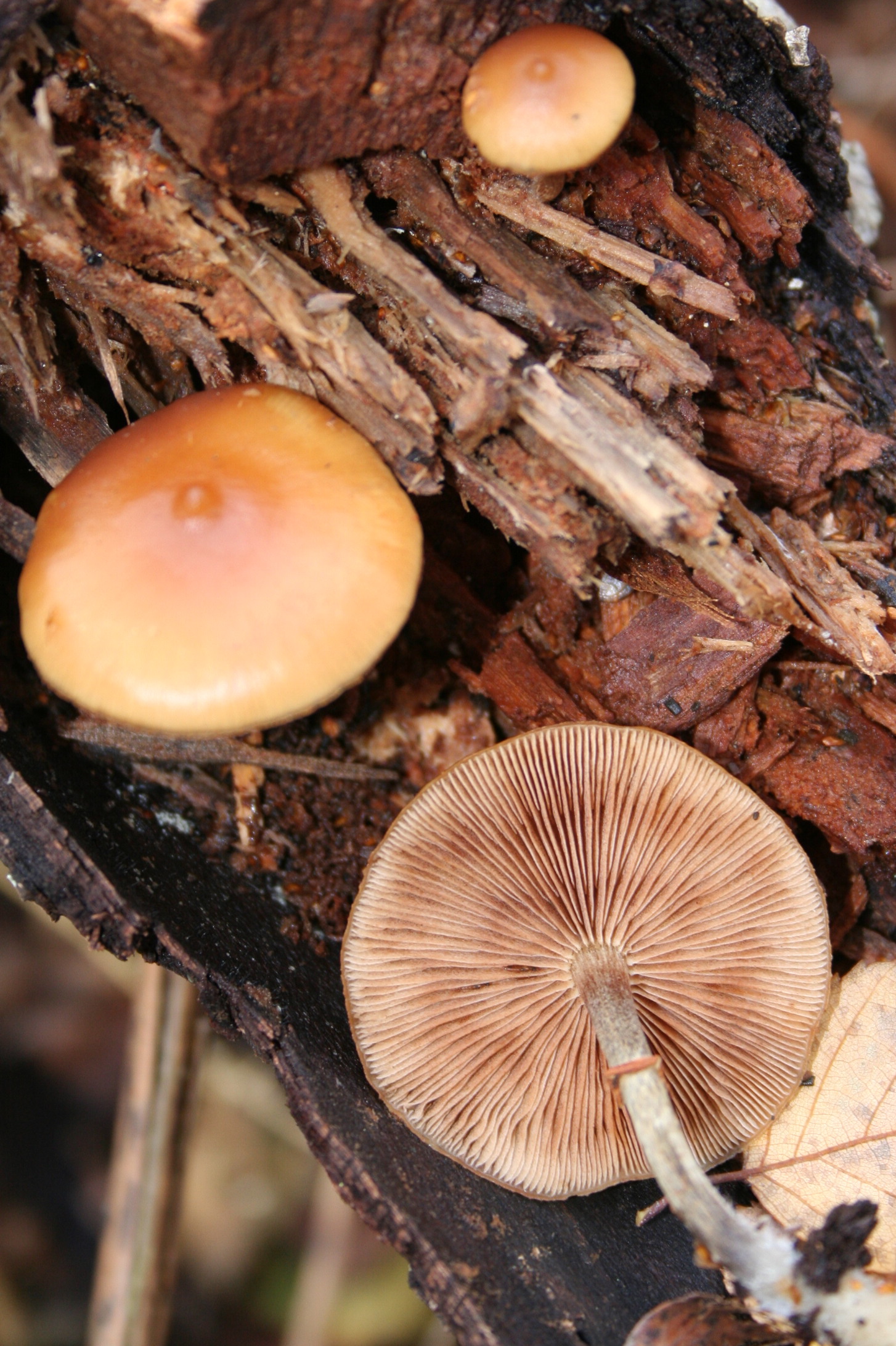
Source-labeled Galerina marginata, woodland near Paris, 6 November 2005. Photograph by Strobilomyces, CC BY-SA 3.0. Wood substrate or a familiar cap shape does not authenticate shiitake or enoki.
This photograph shows brown caps, an exposed gilled underside and decaying wood. Microscopic characters and a spore deposit are not shown; cap or gill colour alone cannot establish identity.
Photograph source and attribution · CC BY-SA 3.0. Original image, unmodified. Species attribution comes from the source; no independent specimen authentication is claimed.

This limited photo pilot is not a complete atlas or an edibility decision aid. Do not eat a wild mushroom based on this photograph.
Limits and regional differences
- F. filiformis and F. velutipes require taxonomically informed assessment; species-level work may need microscopy and DNA. Cultivated morphology and a trade name cannot resolve a wild species.
- Educational comparison only. Neither this card, an illustration, a photograph, a spore-print colour nor a checklist establishes that a wild collection is safe to eat. A qualified local mycologist must assess uncertain material; do not taste an unknown fungus. Cooking does not reliably eliminate mushroom toxins.
Regional reading paths
These sourced notes describe cultivation, trade, food traditions or material history. A regional connection does not claim exclusive origin.
Asia
Cultivated/traditional use: East Asia, including Japan.
Cook thoroughly for soups and cooked dishes.
Identity & detailed reference
Identity
Flammulina filiformis (Z.W. Ge et al.) P.M. Wang et al., the principal East Asian cultivated enoki; European F. velutipes is a distinct species.
Ingredient details, preparation and research
Also known as: enokitake; jin zhen gu / golden needle mushroom
Source plant or material
Flammulina filiformis (Z.W. Ge et al.) P.M. Wang et al.; Commercially cultivated fruiting-body clusters of East Asian enoki.
Fungal family: Physalacriaceae
Forms and route
Commercially cultivated fruiting-body clusters, usually pale and long-stemmed; cooked food. Extracts and isolated proteins are different materials.
Vitamins and minerals
Food composition depends on cultivar, water content and preparation. No vitamin/mineral dose or supplement-level benefit is inferred from the narrow cultivation and polysaccharide sources used here.
Absorption and preparation
Cook thoroughly and prevent contact between raw enoki and ready-to-eat food. Cooking here concerns food safety, not a demonstrated way to enhance medicinal absorption.
Traditional and reported uses
- Cultivated enoki is used as a food in East Asian cuisine, where the slender fruiting-body clusters are valued as a cooked ingredient.
- Modern cultivation studies grow authenticated F. filiformis on formulated substrates including soybean straw. This is a crop-production and residue-use application, not evidence for medicinal benefit.
Contraindications and cautions
- Cook thoroughly; do not use raw as a garnish. Keep raw enoki away from ready-to-eat food.
- Follow recalls and storage directions: multiple Listeria outbreaks have involved enoki.
- Store-bought white enoki appearance is not a wild-foraging identification guide.
- This card is not a foraging identification guide. Unknown wild mushrooms should not be eaten.
Identity, fungal material and preparation
Flammulina filiformis (Z.W. Ge et al.) P.M. Wang et al., the principal East Asian cultivated enoki; European F. velutipes is a distinct species. Commercially cultivated fruiting-body clusters of East Asian enoki. Cook thoroughly and prevent contact between raw enoki and ready-to-eat food. Cooking here concerns food safety, not a demonstrated way to enhance medicinal absorption.
Constituents and food context
Extracted polysaccharides contain several sugars; their profiles depend on extraction and purification. These chemical studies do not establish a therapeutic effect from food. Food composition depends on cultivar, water content and preparation. No vitamin/mineral dose or supplement-level benefit is inferred from the narrow cultivation and polysaccharide sources used here.
Traditional uses and evidence boundaries
Culinary importance does not require a disease-treatment claim. Laboratory polysaccharide findings and older reports using F. velutipes broadly do not establish enoki as an anticancer treatment.
Safety and product distinctions
Cook thoroughly; do not use raw as a garnish. Keep raw enoki away from ready-to-eat food. Follow recalls and storage directions: multiple Listeria outbreaks have involved enoki. Store-bought white enoki appearance is not a wild-foraging identification guide.
Entry sources
- Wang et al., 2018: integrated Flammulina species delimitation
- Chinese edible-fungi cultivation history, Mycosphere 16 (2025)
- FDA: enoki mushroom outbreak investigation and consumer advice
- Enoki cultivar identification and Physalacriaceae, 2023
- Primary study: F. filiformis polysaccharide extraction, 2022
- Primary study: F. filiformis cultivation on soybean straw, 2025
Reference entry 211 · Recorded content review: 2026-10-08 · Review scope and dates