


Key cautions
- Do not eat unidentified honeysuckle berries or substitute garden vines for authenticated flowers.
- Medicinal use during pregnancy, breastfeeding or childhood needs professional advice because adequate safety evidence is lacking.
What’s inside
Chlorogenic acid and flavonoids, including luteolin-related compounds; contents change with flower development and preparation.
Uses in brief

- Documented Chinese flower-tea and traditional fever/inflammation uses; clinical treatment benefits remain uncertain.
History, folklore and reported uses
History, folklore and traditional uses
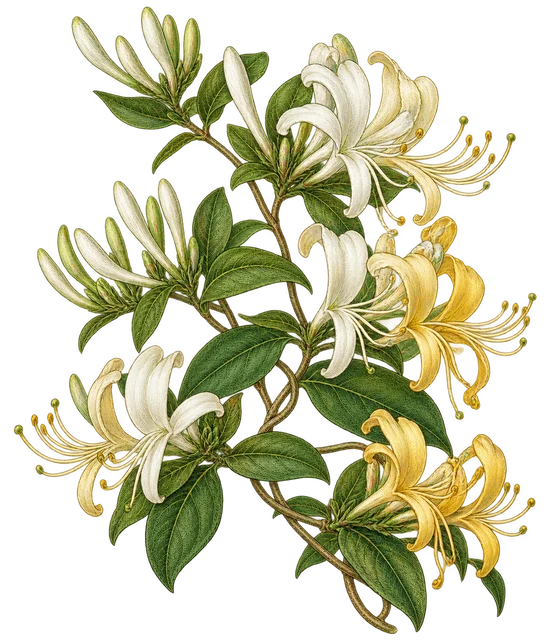
White flowers that age to yellow explain the familiar gold-and-silver flower name. Chinese flower use and tea preparations belong to this specific vine; the broad English name cannot identify a safe edible plant.
Traditional, historical and reported uses
- Flower beverage
Food or household practiceWhy this label?
The claim documents flower beverage as a culinary, craft, gardening, or practical material use; it reports neither a treatment outcome nor measured nutrient content.
Dried Japanese honeysuckle flowers are sold in Chinese medicine shops and prepared as tea.
- Traditional fever remedies
Traditional accountWhy this label?
The exact claim is an attributed traditional fever/inflammation use, not evidence from an intervention study.
NParks records historical use for fever and inflammatory complaints. This documents a practice, not an established treatment.
- Traditional skin-infection indications
Traditional accountWhy this label?
The teaching record lists traditional flower-material indications for skin infection, rather than tested treatment outcomes.
Hong Kong Polytechnic University’s medicinal-herb teaching record lists boils, carbuncles and erysipelas among traditional indications for dried Lonicera japonica buds or opening flowers. These recorded indications are not substitutes for clinical treatment of skin infection.
- Traditional dysentery indication
Traditional accountWhy this label?
The teaching record lists dysentery as a traditional indication for the flower material, not efficacy against infection.
The university record also lists acute dysentery for Lonicera japonica flower material. This is an attributed traditional digestive indication, not support for treating bloody diarrhea at home or using honeysuckle berries.
Only specifically supported historical or culinary uses are included; tradition is not evidence of effectiveness.
Historical-use additions reviewed 2026-10-08
Story sources
- NParks: Lonicera japonica
- Singapore Botanic Gardens Gardenwise 63: Japanese honeysuckle
- NC State Extension: Lonicera japonica
- Flowering-bud pharmacognosy and chlorogenic acid analysis
- Flower-development metabolite analysis
- Queensland Poisons Information Centre: Japanese honeysuckle
- Hong Kong Polytechnic University: Japanese Honeysuckle Flower
Identity & detailed reference
Identity
Lonicera japonica flower buds and flowers are the focus. Honeysuckle names cover many species; stems and berries are different materials.
Ingredient details, preparation and research
Also known as: Japanese honeysuckle; Jin yin hua
Source plant or material
Lonicera japonica flower buds and flowers are the focus. Honeysuckle names cover many species; stems and berries are different materials.
Plant family / material: Caprifoliaceae
Forms and route
Authenticated dried buds/flowers for infusions and commercial extracts; species and plant part must be stated.
Vitamins and minerals
No generic nutrient serving is assigned to flower tea. Whole-flower composition cannot be transferred to strained tea.
Absorption and preparation
An infusion extracts a different mixture from a concentrated extract. Flower-stage chemistry does not establish a useful absorption-enhancing recipe.
Traditional and reported uses
- Documented Chinese flower-tea and traditional fever/inflammation uses; clinical treatment benefits remain uncertain.
Contraindications and cautions
- Do not eat unidentified honeysuckle berries or substitute garden vines for authenticated flowers.
- Medicinal use during pregnancy, breastfeeding or childhood needs professional advice because adequate safety evidence is lacking.
Similar items and how they compare
- Sweet wormwood
Both occur in Chinese herbal traditions.
Different families, constituents and safety issues; neither substitutes for medical treatment.
Identity and plant parts
Opposite leaves and paired white-to-yellow flowers describe L. japonica. The floral drug is separate from fruit or stem products. Common-name identification alone is insufficient.
Evidence and constituents
Flower analyses identify chlorogenic acid and flavonoids and show developmental variation. Laboratory activity is not proof that home tea treats infections or inflammatory disease.
Berry uncertainty
NC State flags fruits as potentially toxic. Queensland poison guidance is internally mixed: its symptoms text says the plant is not considered poisonous, but its toxicity labels include potentially toxic and skin/eye irritation. These accounts do not establish berries as food; this card does not recommend berry consumption.
Evidence limits
- Species, plant part and product quality must be verified.
- Pregnancy, lactation, interaction and long-term flower-product data are insufficient; no medicinal dose is supplied.
Entry sources
- NParks: Lonicera japonica
- Singapore Botanic Gardens Gardenwise 63: Japanese honeysuckle
- NC State Extension: Lonicera japonica
- Flowering-bud pharmacognosy and chlorogenic acid analysis
- Flower-development metabolite analysis
- Queensland Poisons Information Centre: Japanese honeysuckle
- Hong Kong Polytechnic University: Japanese Honeysuckle Flower
Reference entry 190 · Recorded content review: 2026-10-07 · Review scope and dates