


Key cautions
- Borage can contain liver-toxic pyrrolizidine alkaloids; do not assume flowers, cooking or straining eliminate exposure.
- Avoid medicinal use in pregnancy, breastfeeding and liver disease. Supplement use needs a clinician and a verified product.
What’s inside
Unsaturated pyrrolizidine alkaloids are the key hazard; seed oil contains gamma-linolenic acid (GLA), an omega-6 fatty acid.
Uses in brief

- Reference for culinary and medicinal history; no home tea, smoothie or repeated flower-eating regimen.
History, folklore and reported uses
History, folklore and traditional uses
Oxford’s Plants 400 account records borage flowers in summer drinks and confectionery, and John Evelyn’s seventeenth-century enthusiasm for borage in wine. It also notes liver-toxic alkaloids. BfR’s later risk advice changes how that appealing history should be used today: it specifically warns against including PA-producing plants such as borage in gathered salads and smoothies. The notebook keeps the story while declining to turn it into a modern daily-use recipe.
Traditional, historical and reported uses
- Drink and confectionery decoration
Food or household practiceWhy this label?
The claim documents drink and confectionery decoration as a culinary, craft, gardening, or practical material use; it reports neither a treatment outcome nor measured nutrient content.
Oxford records flowers used in drinks or candied decorations; this is historical context, not the recommendation of this card.
- Frankfurt green sauce
Food or household practiceWhy this label?
The claim documents frankfurt green sauce as a culinary, craft, gardening, or practical material use; it reports neither a treatment outcome nor measured nutrient content.
BfR analyzes borage in a Frankfurt green-sauce exposure scenario. Inclusion in a traditional dish does not demonstrate negligible PA exposure.
- Historical melancholy remedy
Historical recordWhy this label?
The Wellcome-held garden record explicitly attributes the melancholy claim to Culpeper, making this a historical written-remedy record.
Dr Henry Oakeley’s Royal College of Physicians garden record, held by Wellcome, describes Culpeper’s belief that borage relieved sadness and melancholy. This early-modern claim is historical context, not a recommendation to ingest borage or a treatment for depression.
- Seed oil in arthritis research
Human researchWhy this label?
A named 1993 hospital trial studied gamma-linolenic acid in borage seed oil in people with rheumatoid arthritis; the label does not extend results to other borage parts.
Leventhal and colleagues studied gamma-linolenic acid supplied in borage seed oil in a 1993 university-hospital rheumatoid-arthritis trial. This documents a modern investigation of a specific oil material; it does not validate flowers, leaves or household borage tea as treatments.
Only specifically supported uses are included; historical or culinary use is not clinical proof.
Historical-use additions reviewed 2026-10-08
Story sources
- University of Oxford Plants 400: Borago officinalis
- German Federal Institute for Risk Assessment: Questions and answers on pyrrolizidine alkaloids in food, 2022
- EFSA (2017): Pyrrolizidine alkaloids in tea, herbal infusions and supplements
- Memorial Sloan Kettering: Borage
- BfR (2020): Updated risk assessment of pyrrolizidine alkaloids in foods; Frankfurt green sauce exposure scenario
- Wellcome Collection: Borago officinalis, Dr Henry Oakeley
- Leventhal et al. (1993): Treatment of rheumatoid arthritis with gammalinolenic acid
Identity & detailed reference
Identity
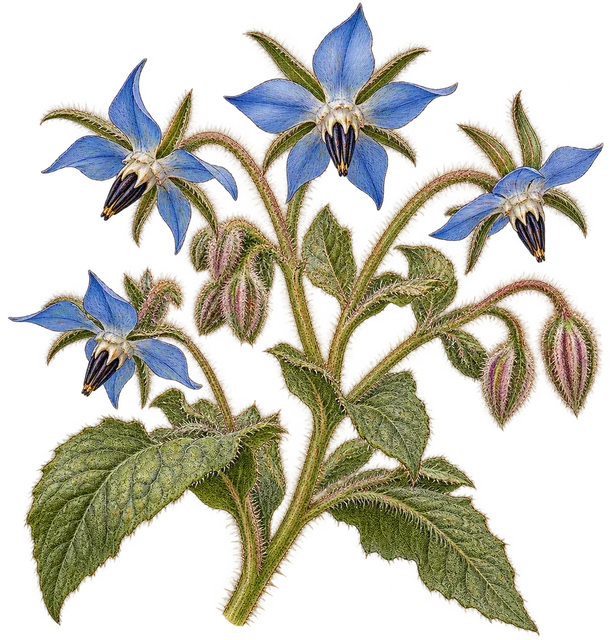
Borage reference card: flowers and leaves have culinary history, but pyrrolizidine-alkaloid concerns prevent an unrestricted edible-flower recommendation.
Ingredient details, preparation and research
Source plant or material
Borago officinalis L.; Borage reference card: flowers and leaves have culinary history, but pyrrolizidine-alkaloid concerns prevent an unrestricted edible-flower recommendation.
Plant family / material: Boraginaceae
Forms and route
Historical fresh leaves and flowers; herbal infusions; separately manufactured seed oil. Plant tea and tested seed oil are not substitutes.
Vitamins and minerals
No safe household serving or nutrient target is assigned to flowers or leaves. GLA in seed oil does not describe the nutritional contribution of a blossom.
Absorption and preparation
No absorption-enhancing recipe is appropriate for home borage preparations. Clinical findings about a characterized seed oil cannot establish the safety or effectiveness of leaf tea.
Practical preparation
No recipe is supplied. Choose another established food flower for routine garnishing. A supplement labelled borage oil requires quality and safety review, not a home-extraction substitute.
Traditional and reported uses
- Reference for culinary and medicinal history; no home tea, smoothie or repeated flower-eating regimen.
Contraindications and cautions
- Borage can contain liver-toxic pyrrolizidine alkaloids; do not assume flowers, cooking or straining eliminate exposure.
- Avoid medicinal use in pregnancy, breastfeeding and liver disease. Supplement use needs a clinician and a verified product.
Similar items and how they compare
- Pansies
A different flower garnish option.
Food-grown pansies do not carry borage’s specific PA-based recommendation here.
- Comfrey
Another Boraginaceae herb with PA concerns.
They are distinct plants; neither family membership nor culinary history establishes oral safety.
Why edible-flower lists are insufficient
BfR identifies borage among PA-producing plants to avoid when gathering salad or smoothie ingredients. EFSA recognizes potential long-term harm from food PA exposure. A simple culinary listing cannot settle this toxicological concern.
Seed oil is a separate decision
MSK advises using only appropriately certified oil and flags pregnancy, breastfeeding, liver disease and relevant medicine concerns. Its seed-oil discussion is not permission to prepare leaf or flower remedies.
Entry sources
- University of Oxford Plants 400: Borago officinalis
- German Federal Institute for Risk Assessment: Questions and answers on pyrrolizidine alkaloids in food, 2022
- EFSA (2017): Pyrrolizidine alkaloids in tea, herbal infusions and supplements
- Memorial Sloan Kettering: Borage
- BfR (2020): Updated risk assessment of pyrrolizidine alkaloids in foods; Frankfurt green sauce exposure scenario
- Wellcome Collection: Borago officinalis, Dr Henry Oakeley
- Leventhal et al. (1993): Treatment of rheumatoid arthritis with gammalinolenic acid
Reference entry 189 · Recorded content review: 2026-10-07 · Review scope and dates