


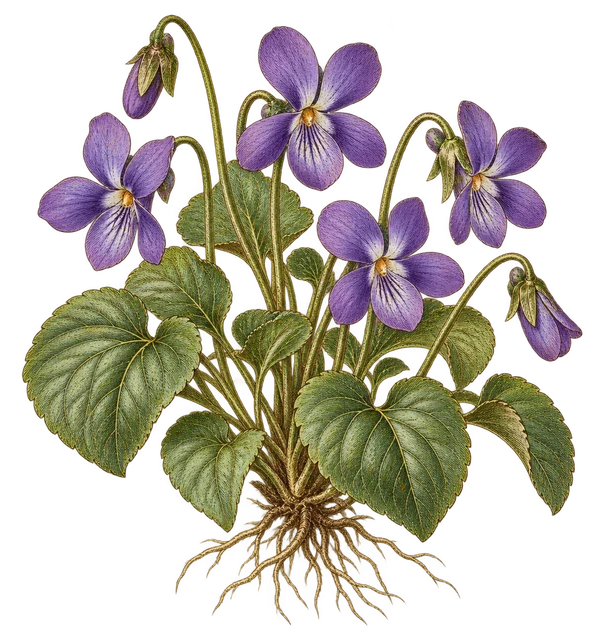
Key cautions
- Do not substitute African violet, ornamental nursery plants or another plant based on the word violet.
- This food guidance excludes roots, perfume products and medicinal extracts. Use food-safe handling for candied flowers.
What’s inside
This review does not assign a quantified phytochemical profile to culinary sweet-violet flowers. Their fragrance does not establish a nutrient dose or medicinal effect.
Uses in brief

- Flowers provide delicate fragrance and decoration; identified leaves have a separate food use.
History, folklore and reported uses
History, folklore and traditional uses
NC State notes that sweet violet was once widely cultivated for fragrance and is now often kept for edible flowers or historical interest. The RHS records candied violets decorating cakes and soufflés, alongside savory uses. This gives the flower a well-defined kitchen role without borrowing medical claims from other Viola species or confusing a perfumer’s violet extract with something made to eat.
Traditional, historical and reported uses
- Crystallized decoration
Food or household practiceWhy this label?
The claim documents crystallized decoration as a culinary, craft, gardening, or practical material use; it reports neither a treatment outcome nor measured nutrient content.
The RHS records candied violet flowers as decoration for cakes and soufflés.
- Leaves as food
Food or household practiceWhy this label?
The claim documents leaves as food as a culinary, craft, gardening, or practical material use; it reports neither a treatment outcome nor measured nutrient content.
NC State identifies V. odorata leaves, as well as flowers, as edible; roots are outside this card’s scope.
- Persian violet-flower respiratory syrup
Traditional accountWhy this label?
The claim identifies a Persian violet-flower syrup tradition; the standardized add-on study is contextual and does not validate the household heritage preparation.
Adel Mehraban and colleagues describe Banafsheh syrup, made with Viola odorata flowers, in the context of Persian respiratory-remedy traditions. Their study investigated a standardized product added to conventional care; it does not establish homemade violet syrup as an infection treatment.
Only specifically supported uses are included; historical or culinary use is not clinical proof.
Historical-use additions reviewed 2026-10-08
Identity & detailed reference
Identity
Sweet violet, Viola odorata; identified food-grown flowers and leaves have culinary use. Other violet species need separate identification.
Ingredient details, preparation and research
Source plant or material
Viola odorata L.; Sweet violet, Viola odorata; identified food-grown flowers and leaves have culinary use. Other violet species need separate identification.
Plant family / material: Violaceae
Forms and route
Fresh flowers or leaves; crystallized flowers and culinary infusions. Perfume absolutes and essential-oil products are different materials.
Vitamins and minerals
No reliable serving-based nutrient values were established for the sweet-violet flower garnish described here. Do not transfer leaf figures or another Viola species’ measurements.
Absorption and preparation
No proven absorption-enhancing combination is supplied. Scent perception and laboratory chemistry do not establish medicinal benefit.
Practical preparation
Choose verified culinary V. odorata, gently wash, and use modestly. A candied preparation should use a food-safe method; added sugar is part of the finished food.
Traditional and reported uses
- Flowers provide delicate fragrance and decoration; identified leaves have a separate food use.
Contraindications and cautions
- Do not substitute African violet, ornamental nursery plants or another plant based on the word violet.
- This food guidance excludes roots, perfume products and medicinal extracts. Use food-safe handling for candied flowers.
Similar items and how they compare
- Pansies
Related edible-flower tradition.
Garden pansies are V. × wittrockiana, usually less perfumed.
- African violet
Shares a common-name word only.
It is a different botanical group and is not covered by this food card.
A species-specific violet entry
NC State and Garden Organic identify V. odorata. The broad English name violet is not enough to verify the contents of a harvested bunch.
Entry sources
- NC State Extension: Viola odorata
- Garden Organic: Sweet violet, edible flowers
- Royal Horticultural Society: Edible flowers
- Adel Mehraban et al. (2023): Efficacy and safety of add-on Viola odorata L.
Reference entry 185 · Recorded content review: 2026-10-07 · Review scope and dates