


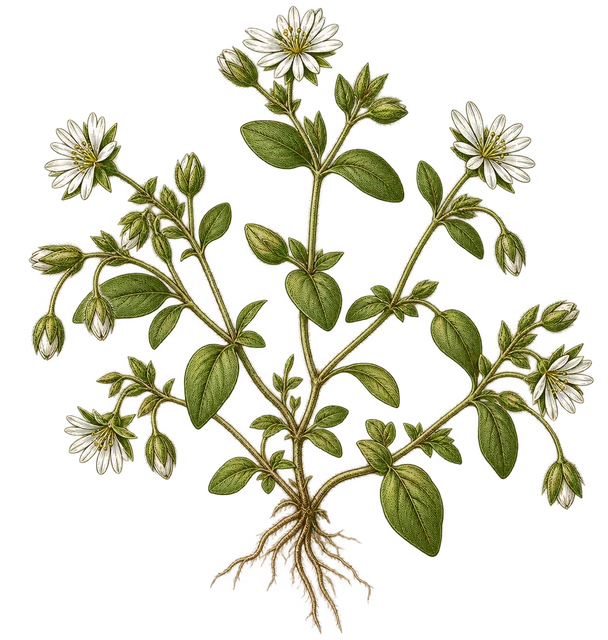
Key cautions
- Toxic lookalikes include scarlet pimpernel; common names and a photograph do not certify edibility.
- Use verified food-grown plants. Do not gather mixed handfuls from lawns or contaminated ground.
What’s inside
The reviewed Extension accounts do not supply a quantitative, preparation-specific phytochemical profile; this card does not infer medicinal activity from constituent lists.
Uses in brief

- Tender shoots used as salad greens or cooked in dishes.
History, folklore and reported uses
History, folklore and traditional uses
Iowa State’s chickweed account links its familiar weed status with a much quieter kitchen role: tender growth used as greens. It also attributes medicinal and chicken-feed uses to named Indigenous communities, but the brief source does not explain the remedies or their preparation. This notebook retains the clear culinary record without inventing a disease-specific tradition from that incomplete historical note.
Traditional, historical and reported uses
- Raw greens
Food or household practiceWhy this label?
The claim documents raw greens as a culinary, craft, gardening, or practical material use; it reports neither a treatment outcome nor measured nutrient content.
Iowa State records tender leaves, stems and flowers eaten in salads.
- Cooked greens
Food or household practiceWhy this label?
The claim documents cooked greens as a culinary, craft, gardening, or practical material use; it reports neither a treatment outcome nor measured nutrient content.
Iowa State also records use in cooked dishes as an alternative to spinach.
Only specifically supported uses are included; historical or culinary use is not clinical proof.
Identity & detailed reference
Identity
Common chickweed is Stellaria media; the culinary parts are tender leaves, stems and flowers, not every plant called chickweed.
Ingredient details, preparation and research
Source plant or material
Stellaria media (L.) Vill.; Common chickweed is Stellaria media; the culinary parts are tender leaves, stems and flowers, not every plant called chickweed.
Plant family / material: Caryophyllaceae
Forms and route
Washed fresh shoots or cooked greens; no concentrated herbal regimen.
Vitamins and minerals
Iowa State describes vitamin-containing greens but gives no measured serving basis; no nutrient percentages are assigned here.
Absorption and preparation
No clinical absorption study or special food pairing was established for the culinary portions described.
Practical preparation
Wash verified S. media shoots thoroughly. Raw salad use and cooked-green use are documented, but preparation cannot correct a mistaken identification.
Traditional and reported uses
- Tender shoots used as salad greens or cooked in dishes.
Contraindications and cautions
- Toxic lookalikes include scarlet pimpernel; common names and a photograph do not certify edibility.
- Use verified food-grown plants. Do not gather mixed handfuls from lawns or contaminated ground.
Similar items and how they compare
- Lamb’s quarters
Another tender leafy food used like spinach.
Chenopodium album has separate oxalate/nitrate cautions.
- Scarlet pimpernel
A potentially confusing ground-level plant.
Lysimachia arvensis, formerly Anagallis arvensis, is not a chickweed substitute.
Lookalikes are an unresolved field risk
University of California IPM identifies scarlet pimpernel as potentially toxic to people and notes its similarity to common chickweed. Neither a shared name nor one leaf feature is an eating test.
Botanical and evidence scope
NC State identifies S. media as a cool-season annual in Caryophyllaceae. This card covers food use only, not weight-loss, wound-care or skin-disease treatments.
Entry sources
- Iowa State University Extension: Chickweed
- NC State Extension: Stellaria media
- Ontario Ministry of Agriculture: Scarlet pimpernel, weed identification guide
- University of California IPM: Scarlet pimpernel, toxicity and chickweed lookalike
Reference entry 179 · Recorded content review: 2026-10-07 · Review scope and dates