


Key cautions
- Do not use rue tea, tincture, oil or homemade preparations as oral medicine. Reported poisoning includes kidney failure, circulatory instability and bleeding abnormalities.
- Avoid medicinal rue in pregnancy. Attempts to stimulate menstruation or end a pregnancy can cause severe poisoning, uterine bleeding and pregnancy loss; rue is not a safe method.
What’s inside
Ruta plants contain volatile ketones and varied alkaloids and flavonoids; common rue includes rutin and photoreactive furocoumarins such as psoralens. These light-reactive compounds contribute to skin injury after plant contact followed by sunlight. Composition varies by species and preparation.
Uses in brief

- Historical small-scale culinary flavouring and a tithed garden herb in Luke.
- Recorded digestive, vermifuge and other medicinal practices are preserved as history because oral rue and skin exposure can cause harm.
In the King James Bible
In the King James Bible
Probable botanical identification
Luke names rue among the carefully tithed herbs in a teaching about judgment and the love of God. Ruta chalepensis is a probable Middle Eastern identification. Common garden rue, Ruta graveolens, appears in much later herbal literature and should be distinguished from that proposed biblical species.
But woe unto you, Pharisees! for ye tithe mint and rue and all manner of herbs, and pass over judgment and the love of God: these ought ye to have done, and not to leave the other undone.
Luke 11:42 (KJV)
Scripture and identification sources
Words & their stories
WORDS & THEIR STORIES
The name behind the KJV
Koine Greek · Luke 11:42 (KJV)
πήγανονpḗganon
Rue, named alongside mint and other garden herbs.
Dictionary form: πήγανον · pḗganon
The neuter accusative form matches the dictionary form; checked in Scrivener’s Greek.
What the language reveals
The setting is tithing
Rue appears in a rebuke about justice and love of God, not in a healing instruction. Its mention establishes a place in the herb list, not a safe medicinal use.
Rue is the conventional identification, but the word does not settle a particular Ruta species, dose or essential-oil product.
Language and identification bibliography
History, folklore and reported uses
History, folklore and traditional uses
Rue appears just once in the KJV, among the herbs tithed in Luke’s criticism of religious priorities. It was a familiar enough garden plant to make the contrast between small observances and weightier duties immediately recognizable. For the Middle Eastern plant, Musselman points to Ruta chalepensis, still known for its strong aroma and historical use in flavouring olives. The passage places a strongly scented herb within ordinary garden life.
The garden rue of later European dispensatories, Ruta graveolens, gathered a much heavier medicinal reputation. Physicians used it for intestinal complaints, worms, nervous symptoms and menstruation-related purposes. Their own accounts also described poisoning. Today, clinical reports make those dangers concrete: oral preparations can damage several organ systems, and even handling the plant before sun exposure can cause blistering. The useful lesson in rue’s long story is how carefully historical practice must be separated from safe present-day care.
Traditional, historical and reported uses
- Culinary flavouring
Food or household practiceWhy this label?
Culinary and beverage flavouring use.
Musselman records Middle Eastern rue in black-olive flavouring; the IPCS monograph also notes bitter flavouring in some European foods and alcoholic drinks. This is historical context, not a serving recommendation for a potentially toxic herb.
- Digestive cramps
Historical recordWhy this label?
An 1898 dispensatory records medicinal flatulent-colic use.
The 1898 dispensatory records garden rue for flatulent colic. This was a medicinal use of Ruta graveolens, which should not be converted into a modern home tea or transferred uncritically to every Ruta species.
- Intestinal worms
Historical recordWhy this label?
Older dispensatory record of vermifuge practice; toxicity source is supplementary.
Older dispensatories used rue as a vermifuge. This separate therapeutic aim is documented, but oral toxicity makes rue inappropriate as a do-it-yourself treatment for suspected parasites.
- Nervous complaints
Historical recordWhy this label?
An 1898 dispensatory records period-specific nervous-remedy practice.
Felter and Lloyd describe rue in the period’s practice for nervous symptoms and convulsive disorders. Such historical claims do not establish a safe treatment for seizures, anxiety or insomnia.
- Menstruation-related medicine
Historical recordWhy this label?
Historical dispensatory records menstruation-related use; poisoning context qualifies it.
Rue was historically used to stimulate menstruation and in attempts to end pregnancy. The same tradition includes severe poisoning and miscarriage reports. This is a hazardous historical practice to document, never a recipe or recommendation to reproduce.
- London personal aromatics, 1665
Historical recordWhy this label?
Explicit 1665 College of Physicians directions document plague-era aromatics.
The College of Physicians’ 1665 directions named rue among the aromatics people might carry during the London plague. Its place in this advice reflects an attempt to counter dangerous air, not a demonstrated protection against infection.
Historical-use additions reviewed 2026-10-08
Story sources
- Felter and Lloyd, King’s American Dispensatory (1898): Ruta / Rue
- International Programme on Chemical Safety: Ruta graveolens, Poisons Information Monograph 475
- Seak and Lin (2007): Ruta graveolens intoxication
- Heskel et al. (1983): Phytophotodermatitis due to Ruta graveolens
- Kew Medicinal Plant Names Services: Ruta chalepensis
- Lytton John Musselman, Old Dominion University: Rue
- The King James Bible: Project Gutenberg ebook 10
- Royal College of Physicians: Plague remedies from the garden
- College of Physicians: Certain necessary directions (1665), Wellcome digitized copy
- NC State Extension: Common rue (Ruta graveolens)
- CDC: Clinical Care of Plague
Identity & detailed reference
Identity
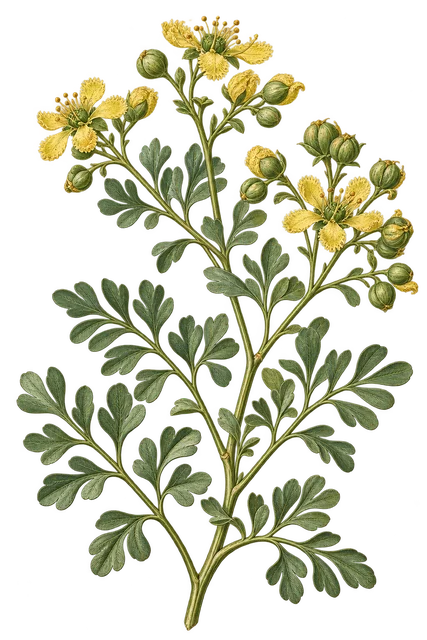
Rue covers several Ruta species. Biblical botanist Musselman identifies the Middle Eastern rue as Ruta chalepensis. Much later European herbal literature and the cited poisoning studies concern Ruta graveolens. These related species should be named rather than treated as one verified biblical specimen.
Ingredient details, preparation and research
Also known as: Fringed rue (Ruta chalepensis); Garden rue (Ruta graveolens)
Source plant or material
Rue covers several Ruta species. Biblical botanist Musselman identifies the Middle Eastern rue as Ruta chalepensis. Much later European herbal literature and the cited poisoning studies concern Ruta graveolens. These related species should be named rather than treated as one verified biblical specimen.
Plant family / material: Rutaceae (citrus family)
Forms and route
Aromatic leaves and flowering shoots; historical flavouring, infusions and tinctures; concentrated rue oil is a separate high-risk material. This entry gives no ingestion, extraction or pregnancy-related recipe. Highly diluted homeopathic products are not equivalent to herbal tincture or essential oil.
Vitamins and minerals
No nutritional serving is recommended. Trace plant vitamins or the flavonoid rutin do not make rue a safe supplement or useful nutrient source. Historical culinary use is not a reason to increase intake or swallow medicinal preparations.
Absorption and preparation
Human dose–absorption relationships are inadequately characterized. Oral infusions can nevertheless cause systemic poisoning, while plant sap on skin can cause a local sunlight-activated burn. There is no safe absorption-enhancing recipe or food pairing supplied here.
Traditional and reported uses
- Historical small-scale culinary flavouring and a tithed garden herb in Luke.
- Recorded digestive, vermifuge and other medicinal practices are preserved as history because oral rue and skin exposure can cause harm.
Contraindications and cautions
- Do not use rue tea, tincture, oil or homemade preparations as oral medicine. Reported poisoning includes kidney failure, circulatory instability and bleeding abnormalities.
- Avoid medicinal rue in pregnancy. Attempts to stimulate menstruation or end a pregnancy can cause severe poisoning, uterine bleeding and pregnancy loss; rue is not a safe method.
- Avoid sap or fresh plant contact on skin, especially before sun exposure. Wear protective gloves when handling the plant; wash exposed skin and protect it from sunlight.
- Seek prompt medical or poison-service advice after ingestion or a significant reaction; extensive blistering, severe vomiting or faintness need urgent assessment.
Similar items and how they compare
- Garden rue and fringed rue
Both occur under the common name rue.
Ruta graveolens and R. chalepensis are related species, not proof of an identical chemical or clinical profile.
- Goat’s rue
The common name also includes rue.
Galega officinalis is a different plant; its name and uses should not be merged with Ruta.
Which rue is meant?
The KJV says rue without a scientific name. Ruta chalepensis is a strong regional identification; R. graveolens is the species in the later dispensatory and most cited toxicity reports. Keeping the names visible prevents an uncertain ancient identity from becoming a modern clinical claim.
Constituents and skin reactions
Rue contains photoactive furocoumarins. A published family case series described redness, pigmentation and blistering after handling R. graveolens followed by sunlight. This is a phototoxic reaction and can occur without a prior allergy.
Oral poisoning is documented
Seak and Lin reported bradycardia, kidney failure, potassium disturbance and coagulopathy after a woman drank a rue decoction for a perceived heart benefit. A case report cannot set the frequency of harm, but it clearly disproves the assumption that a traditional tea is necessarily safe.
Pregnancy-specific danger
The IPCS monograph describes uterine bleeding and abortion among poisoning effects in pregnant patients, together with potentially severe systemic illness. Neither traditional use nor a plant-based label makes rue a safe way to manage menstruation or pregnancy.
No nutrition or absorption plan
This card does not assign rue a food serving, supplement dose or absorption recipe. Historical uses do not establish a safe threshold for homemade extracts. Rutin is a constituent, not evidence that eating rue is a sensible way to obtain it.
Clinical and practical limits
The historical indications are not supported here as present-day treatments. The most actionable human evidence concerns poisoning and phototoxic skin injury. Do not replace medical care with rue, and obtain prompt help after suspected poisoning.
Plague care boundary
No historical plant or material here is established to prevent or cure plague. Suspected plague requires urgent medical assessment and prompt antibiotics.
Evidence limits
- The verse does not distinguish modern Ruta species.
- Historical uses are included for documentation, not as safe self-care options.
- Poisoning reports cannot define a safe household dose; none is supplied.
Entry sources
- Felter and Lloyd, King’s American Dispensatory (1898): Ruta / Rue
- International Programme on Chemical Safety: Ruta graveolens, Poisons Information Monograph 475
- Seak and Lin (2007): Ruta graveolens intoxication
- Heskel et al. (1983): Phytophotodermatitis due to Ruta graveolens
- Kew Medicinal Plant Names Services: Ruta chalepensis
- Lytton John Musselman, Old Dominion University: Rue
- The King James Bible: Project Gutenberg ebook 10
- Royal College of Physicians: Plague remedies from the garden
- College of Physicians: Certain necessary directions (1665), Wellcome digitized copy
- NC State Extension: Common rue (Ruta graveolens)
- CDC: Clinical Care of Plague
Reference entry 133 · Recorded content review: 2026-10-06 · Review scope and dates