


Key cautions
- Do not ingest calamus oil, homemade Acorus tea, tincture or rhizome preparations. FDA food restrictions and asarone toxicity make historical recipes unsuitable to reproduce.
- Avoid medicinal calamus during pregnancy or breastfeeding and in children; an uncertain species or an “asarone-free” claim does not establish safety.
What’s inside
Modern Acorus rhizomes contain a variable volatile fraction, potentially including alpha- and beta-asarone. Chemistry differs with botanical identity and cytotype; a common name cannot establish an asarone-free product. These constituents cannot be assigned to the unidentified biblical material.
Uses in brief

- Biblical ingredient of sacred anointing oil and a traded fragrant cane.
- Modern Acorus has recorded digestive, respiratory and external folk uses; these are historical records, not self-treatment directions.
In the King James Bible
In the King James Bible
Uncertain botanical connection
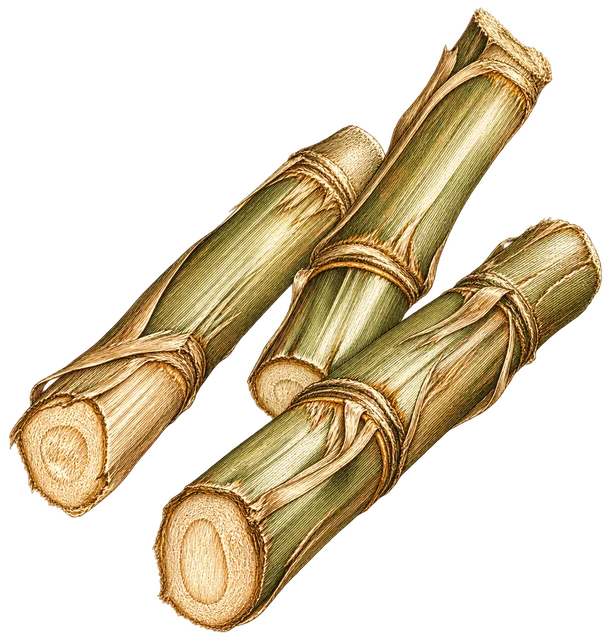
Exodus names sweet calamus among the spices for holy anointing oil, and Jeremiah refers to imported sweet cane. The underlying plant is uncertain; Acorus and Cymbopogon are proposals. These verses establish an aromatic material, not a modern species, extraction method or essential-oil use.
Take thou also unto thee principal spices, of pure myrrh five hundred shekels, and of sweet cinnamon half so much, even two hundred and fifty shekels, and of sweet calamus two hundred and fifty shekels,
Exodus 30:23 (KJV)
To what purpose cometh there to me incense from Sheba, and the sweet cane from a far country? your burnt offerings are not acceptable, nor your sacrifices sweet unto me.
Jeremiah 6:20 (KJV)
Scripture and identification sources
Words & their stories
WORDS & THEIR STORIES
The name behind the KJV
Biblical Hebrew · Exodus 30:23 (KJV)
וּקְנֵה־בֹשֶׂםūqənē-bōśem
And aromatic cane, rendered “sweet calamus.”
Dictionary form: קָנֶה · בֹּשֶׂם · qāneh · bōśem
Qənē is the linking form of qāneh, reed or cane; bōśem denotes fragrance or spice.
Biblical Hebrew · Jeremiah 6:20 (KJV)
וְקָנֶה הַטּוֹבwəqāneh haṭṭōb
And the good cane, rendered “the sweet cane.”
Dictionary form: קָנֶה · טוֹב · qāneh · ṭōb
The adjective is “good”; the context describes an imported aromatic from a distant land.
What the language reveals
The noun needs its context
Qāneh can mean a reed, stalk or measuring rod elsewhere. Fragrance in Exodus and distant trade in Jeremiah narrow the sense here to an aromatic cane.
Neither phrase supplies a secure modern species. It does not establish Acorus calamus, cannabis, or a modern essential-oil preparation.
Language and identification bibliography
- Hebrew text: Exodus 30 (Mechon-Mamre)
- Brown–Driver–Briggs: קָנֶה · בֹּשֶׂם (H7070; Bible Hub transcription)
- Hebrew text: Jeremiah 6:20 (Mechon-Mamre)
- Brown–Driver–Briggs: קָנֶה · טוֹב (H7070; Bible Hub transcription)
- Brown–Driver–Briggs: קָנֶה (H7070; Bible Hub transcription)
- Brown–Driver–Briggs: בֹּשֶׂם (H1314; Bible Hub transcription)
History, folklore and reported uses
History, folklore and traditional uses
The KJV’s sweet calamus belongs to an ancient world in which aroma was valuable enough to travel long distances. Exodus places it among the ingredients of a holy anointing oil; Jeremiah speaks of sweet cane arriving from a far country. These passages preserve the material’s place in worship and trade, while leaving its modern botanical name unsettled. Botanist Lytton John Musselman discusses both sweet flag, Acorus calamus, and aromatic Cymbopogon grasses as candidates.
Sweet flag has a later, identifiable history of its own. Its fragrant underground stem entered apothecary practice as an aromatic digestive herb, and nineteenth-century dispensatories also recorded external applications. Those accounts tell us what practitioners did, not what the biblical plant necessarily was. Modern assessment of asarones changed the safety picture: a familiar name and a long history do not make a homemade preparation safe.
Traditional, historical and reported uses
- Sacred anointing material
Historical recordWhy this label?
Exodus supplies the explicit written ceremonial-use record.
Exodus places sweet calamus in a compound intended for sacred anointing. The text documents a valued fragrant ingredient, without identifying a modern Acorus species or a bottle of distilled essential oil.
- Aromatic digestive remedies
Historical recordWhy this label?
An 1898 dispensatory documents sweet-flag digestive preparations.
Felter and Lloyd’s 1898 dispensatory describes sweet-flag rhizome for flatulence and weak digestion. This is an Acorus apothecary tradition; its historical preparations are not appropriate home recipes under present safety knowledge.
- Respiratory folk medicine
Traditional accountWhy this label?
Reported later sweet-flag respiratory folk practice.
EMA’s historical-use summary lists asthma among the reported uses of Acorus rhizome. The use belongs to later sweet-flag practice; the card’s asarone-related ingestion warning applies.
- Vermifuge and pest-related uses
Mixed/contextual sourcesWhy this label?
Combines medicinal vermifuge and practical insecticidal-use contexts.
EMA also records anthelmintic and insecticidal uses of Acorus. These are distinct from perfume use and do not justify swallowing calamus for parasites or using untested preparations around a household.
- External ulcer applications
Historical recordWhy this label?
An 1898 dispensatory documents a specific external ulcer application.
The 1898 dispensatory records application of sweet flag to slow-healing ulcers. This is a specific historical practice, not evidence of safe wound treatment; open or infected wounds need suitable clinical care.
Story sources
- Kew Plants of the World Online: Acorus calamus L.
- Felter and Lloyd, King’s American Dispensatory (1898): Calamus / Sweet Flag
- EMA: Use of herbal medicinal products containing asarone
- EMA (2005): Public statement on herbal medicinal products containing asarone
- FDA: Calamus oil, prohibited substance in food
- 21 CFR 189.110: Calamus and its derivatives (official CFR text)
- Lytton John Musselman, Old Dominion University: Calamus
- The King James Bible: Project Gutenberg ebook 10
Identity & detailed reference
Identity
The biblical aromatic called sweet calamus or sweet cane has no securely established modern species. Acorus calamus (sweet flag) is a proposed identification, as are fragrant Cymbopogon grasses. Modern sweet-flag information below is explicitly about Acorus, not proof of the biblical identity.
Ingredient details, preparation and research
Also known as: Sweet calamus; Sweet cane; Qaneh (biblical plant name; identity unresolved)
Source plant or material
The biblical aromatic called sweet calamus or sweet cane has no securely established modern species. Acorus calamus (sweet flag) is a proposed identification, as are fragrant Cymbopogon grasses. Modern sweet-flag information below is explicitly about Acorus, not proof of the biblical identity.
Plant family / material: Unresolved: Acoraceae for Acorus; Poaceae for Cymbopogon
Forms and route
Biblical aromatic material used in compounded anointing oil; modern Acorus dried rhizome, extracts and distilled oil are separate products. A Cymbopogon leaf oil has a different composition. This card supplies no oral preparation or home extraction instructions.
Vitamins and minerals
No nutritional serving can be assigned to an unidentified ancient aromatic. Acorus rhizome and calamus oil are not appropriate vitamin, mineral or fibre supplements; the FDA lists added calamus and its derivatives as prohibited in food.
Absorption and preparation
There is no established safe home-use absorption strategy for biblical calamus or Acorus products. Extraction can change exposure to asarones; neither a tea nor a tincture solves the identity and toxicity problems. Topical fragrance is not a nutritional route.
Traditional and reported uses
- Biblical ingredient of sacred anointing oil and a traded fragrant cane.
- Modern Acorus has recorded digestive, respiratory and external folk uses; these are historical records, not self-treatment directions.
Contraindications and cautions
- Do not ingest calamus oil, homemade Acorus tea, tincture or rhizome preparations. FDA food restrictions and asarone toxicity make historical recipes unsuitable to reproduce.
- Avoid medicinal calamus during pregnancy or breastfeeding and in children; an uncertain species or an “asarone-free” claim does not establish safety.
- Do not apply concentrated fragrance oil to skin or use it on wounds. Plant identity, formulation and skin tolerance need separate assessment.
Similar items and how they compare
- Lemongrass
Cymbopogon species are another proposed sweet-cane identity.
Modern lemongrass is an identified grass; its chemistry and food use cannot establish what qaneh meant.
- Cinnamon
Another aromatic named in Exodus’s anointing material.
Cinnamomum bark is a separate ingredient, not a substitute that resolves calamus identity.
Identity comes before chemistry
Qaneh is an ancient plant name, not a modern scientific identification. The aromatic canes proposed by biblical botanists belong to different families. This card therefore does not give the ancient material one species, one chemical profile or a medicinal dose.
Modern sweet flag
Kew places Acorus calamus in Acoraceae. Its fragrant rhizome is the medicinal material described in later dispensatories. Older literature can use Acorus names more broadly than current taxonomy, adding another reason to verify a modern product’s species.
Asarones and extraction
EMA identifies alpha- and beta-asarone as toxicological concerns, including genotoxic and carcinogenic findings in experimental animals. The proportion varies among plant material and preparations. Distilled oil can concentrate exposure; a plant name alone cannot establish safety.
Food and nutritional limits
The FDA’s current substance listing marks calamus oil as prohibited; 21 CFR 189.110 identifies calamus as Acorus calamus rhizome and covers its added oil and extract. No household nutritional serving or absorption-enhancing recipe is appropriate here.
What historical evidence can show
The documented digestive, respiratory, vermifuge and external traditions concern later Acorus use. They are not clinical proof, and they cannot be retroactively attached to the unresolved plant in Exodus or Jeremiah.
Practical safety boundary
Keep this entry as botanical and historical information rather than an ingestion guide. Pregnancy, breastfeeding and childhood are especially unsuitable settings for experimentation. A fragrance formulation needs its own ingredient and topical-safety assessment.
Evidence limits
- The ancient botanical identity remains unresolved.
- Later Acorus traditions and toxicology are kept separate from the biblical material.
- No safe oral dose or home extraction method is established here.
Entry sources
- Kew Plants of the World Online: Acorus calamus L.
- Felter and Lloyd, King’s American Dispensatory (1898): Calamus / Sweet Flag
- EMA: Use of herbal medicinal products containing asarone
- EMA (2005): Public statement on herbal medicinal products containing asarone
- FDA: Calamus oil, prohibited substance in food
- 21 CFR 189.110: Calamus and its derivatives (official CFR text)
- Lytton John Musselman, Old Dominion University: Calamus
- The King James Bible: Project Gutenberg ebook 10
Reference entry 117 · Recorded content review: 2026-10-06 · Review scope and dates