


Key cautions
- Do not substitute aloe gel, bitter aloe latex or an unidentified resin for the material described in these passages.
- Biblical mention does not establish a safe oral use, skin preparation or essential-oil recipe.
- Burning fragrant wood or incense adds particles to indoor air. Avoid smoke exposure, especially around people with asthma or other heart or lung disease, children and older adults; fragrance is not evidence that the smoke is harmless.
- Do not swallow an oud essential oil or use it as a home skin remedy. Essential oils can irritate skin, and oil entering the lungs can cause serious harm. After accidental swallowing, do not induce vomiting; contact a poison center for product-specific advice. These are general essential-oil precautions, not a measured toxicity profile for ancient aloes.
What’s inside
No fixed chemical profile can be assigned to biblical aloes. Agarwood is resin-impregnated wood, but the chemistry of a modern agarwood sample cannot authenticate the biblical name.
Dafni and Böck (2019): Medicinal plants of the Bible—revisited · ITTO/CITES (2022): Expensive, Exploited and Endangered, review of Aquilaria and Gyrinops
Chemistry of a named modern sample
A study of cultivated Aquilaria sinensis examined ethanol extracts of resinous wood, not biblical material or a finished oud perfume. It detected sesquiterpenoids and 2-(2-phenylethyl)chromones, two families of plant chemicals. Their relative profiles differed among samples produced by different induction methods; formation time also differed, so method alone cannot explain every difference.
Yan et al. (2019): Chemical Profiles of Cultivated Agarwood Induced by Different Techniques
Identified compounds and tentative assignments
The researchers compared agarotetrol and two other chromones with reference compounds. Many other chemical names were tentative assignments from mass-spectral libraries or published fragmentation patterns. Those screening assignments are not an authenticated ingredient list for every agarwood product, and the experiment did not test benefits in people.
Yan et al. (2019): Chemical Profiles of Cultivated Agarwood Induced by Different Techniques
Uses in brief

- Biblical fragrance in garments, a perfumed bed and poetic garden imagery.
- John records a burial mixture called myrrh and aloes; candidate agarwood also has a separate incense and perfumery history.
In the King James Bible
In the King James Bible
Uncertain botanical connection
Psalm 45 describes royal garments scented with aloes, while Numbers pictures trees of lign aloes beside water. Aquilaria aloeswood is a leading interpretation of the Old Testament fragrance, but the plant’s identity remains uncertain. The burial aloes in John 19:39 are also debated and do not securely identify Aloe vera or a distilled oil.
All thy garments smell of myrrh, and aloes, and cassia, out of the ivory palaces, whereby they have made thee glad.
Psalm 45:8 (KJV)
As the valleys are they spread forth, as gardens by the river’s side, as the trees of lign aloes which the LORD hath planted, and as cedar trees beside the waters.
Numbers 24:6 (KJV)
Scripture and identification sources
- King James Bible: Psalm 45:8
- King James Bible: Numbers 24:6
- Project Gutenberg: The King James Version of the Bible, ebook 10
- Lytton John Musselman, Old Dominion University: Lign Aloes
- Dafni and Böck (2019): Medicinal plants of the Bible—revisited
- Thompson, Lim and Turjaman (2022), ITTO/CITES: Expensive, Exploited and Endangered: A review of the agarwood-producing genera Aquilaria and Gyrinops
Words & their stories
WORDS & THEIR STORIES
The name behind the KJV
Biblical Hebrew · Psalm 45:8 (KJV); Psalm 45:9 in the Hebrew edition
וַאֲהָלוֹתwaʾăhālōt
And aloes, an aromatic associated with royal garments.
Dictionary form: אֲהָלִים · אֲהָלוֹת · ʾăhālīm · ʾăhālōt
The noun occurs in plural forms; wa- means “and.” The Hebrew edition counts the introductory line.
Biblical Hebrew · Numbers 24:6 (KJV)
כַּאֲהָלִיםkaʾăhālīm
Like aloes, in a comparison with luxuriant planted trees.
Dictionary form: אֲהָלִים · אֲהָלוֹת · ʾăhālīm · ʾăhālōt
Ka- means “like”; the noun here has the masculine plural ending.
What the language reveals
Fragrance and landscape
The psalm places aloes among garment fragrances; Numbers places the word beside cedars in a landscape comparison. These contexts preserve different aspects of an uncertain ancient name.
The fragrant wood identification is a hypothesis. These Hebrew words do not identify Aloe vera gel, a particular agarwood species or distilled oud oil.
History, folklore and reported uses
Scent in the biblical landscape
Aloes enter the biblical world through scent. Psalm 45 surrounds a royal figure with myrrh, aloes and cassia; Proverbs 7 places the same fragrant vocabulary in a very different setting, a seductress’s perfumed bed. In the Song of Solomon, aloes belong to a luxuriant imagined garden. Numbers adds the image of trees beside water. Taken together, the passages preserve a remembered fragrance and its literary associations much more clearly than they preserve a botanist’s description.
King James Bible: Psalm 45:8 · King James Bible: Proverbs 7:17 · King James Bible: Song of Solomon 4:14 · King James Bible: John 19:39-40 · Dafni and Böck (2019): Medicinal plants of the Bible—revisited · ITTO/CITES (2022): Expensive, Exploited and Endangered, review of Aquilaria and Gyrinops · Lytton John Musselman, Old Dominion University: Lign Aloes · King James Bible: Numbers 24:6
Aloeswood and the limits of identification
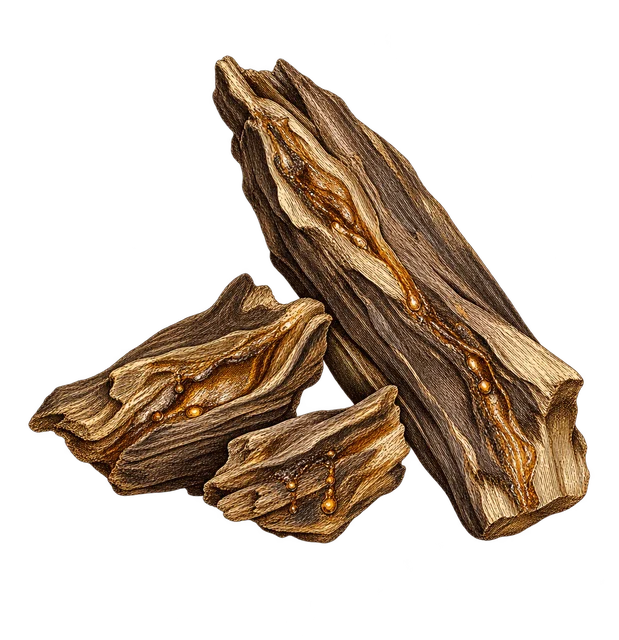
Aloeswood offers one explanation: certain Asian trees produce a valuable resinous wood now associated with incense and oud perfumery. Musselman discusses Aquilaria as an Old Testament candidate, while scholarly reassessment keeps the identification open. The similarly named succulent Aloe vera has a different material history, and the burial aloes in John cannot settle the question for every passage. Reading this entry as an ancient aromatic, with modern candidate traditions kept separate, preserves both the rich imagery and the genuine uncertainty.
King James Bible: Psalm 45:8 · King James Bible: Proverbs 7:17 · King James Bible: Song of Solomon 4:14 · King James Bible: John 19:39-40 · Dafni and Böck (2019): Medicinal plants of the Bible—revisited · ITTO/CITES (2022): Expensive, Exploited and Endangered, review of Aquilaria and Gyrinops · Lytton John Musselman, Old Dominion University: Lign Aloes
Fragrance for garments and bedding
Psalm 45:8 associates aloes with royal garments; Proverbs 7:17 places it in perfumed bedding. Together they show fragrance working in public splendor and an intimate domestic setting.
King James Bible: Psalm 45:8 · King James Bible: Proverbs 7:17
Poetic garden imagery
Song of Solomon 4:14 includes aloes in a sensuous garden of precious aromatics, alongside myrrh and other chief spices. The garden image gathers scent into its expression of affection.
Burial aromatics, with disputed identity
John 19:39–40 places a mixture called myrrh and aloes in Jesus’s burial. Whether these aloes match the Old Testament wood or an Aloe product remains contested.
King James Bible: John 19:39-40 · Dafni and Böck (2019): Medicinal plants of the Bible—revisited
Candidate aloeswood in incense
Modern agarwood has a documented incense tradition. This belongs to the proposed woody candidate and should not be presented as proof of what every biblical author meant.
ITTO/CITES (2022): Expensive, Exploited and Endangered, review of Aquilaria and Gyrinops
Candidate aloeswood in perfumery
Resinous agarwood supplies modern aromatic products including oud perfumes. A distilled perfume is a separate preparation from the unspecified material named in scripture.
ITTO/CITES (2022): Expensive, Exploited and Endangered, review of Aquilaria and Gyrinops
Wood, oil and the finished perfume
Distillation concentrates a different fraction from a laboratory solvent extract of wood. A commercial oud perfume is also a formulated product rather than simply a piece of resinous wood. Product identity and processing matter when comparing chemistry; an extract analysis cannot be read as the composition of a perfume bottle.
ITTO/CITES (2022): Expensive, Exploited and Endangered, review of Aquilaria and Gyrinops · Yan et al. (2019): Chemical Profiles of Cultivated Agarwood Induced by Different Techniques
The name and the material
Aloeswood is a botanical hypothesis, not a synonym for inner-leaf aloe gel. The Old Testament passages emphasize fragrance, and Numbers 24:6 adds tree imagery.
Lytton John Musselman, Old Dominion University: Lign Aloes · King James Bible: Numbers 24:6
Candidate identity and product form
Aquilaria and Gyrinops are major modern sources of agarwood. Their resinous wood, incense products and fragrant oils have different forms; none can be inserted automatically into a biblical verse.
ITTO/CITES (2022): Expensive, Exploited and Endangered, review of Aquilaria and Gyrinops
Limits of modern applications
This card assigns no therapeutic benefit, dietary nutrient value or absorption-enhancing method. Evidence about a named modern plant product would concern that product, not the unresolved ancient material.
Dafni and Böck (2019): Medicinal plants of the Bible—revisited
Identity & detailed reference
Identity
The fragrant “aloes” and “lign aloes” of the Old Testament are an uncertain aromatic material, often interpreted as resinous aloeswood. This does not identify them as Aloe vera gel or prove one modern agarwood species.
Ingredient details, preparation and research
Also known as: Lign aloes (KJV); Aloeswood (candidate identification); Agarwood (candidate material)
Source plant or material
Probably a fragrant woody material in the Old Testament; resinous wood of Aquilaria is a candidate. The “aloes” mixed with myrrh in John 19:39 must be considered separately because its identity is disputed.
Plant family / material: Unresolved for the biblical term; Aquilaria candidates belong to Thymelaeaceae.
Forms and route
Biblical scented material and tree imagery; candidate resin-rich wood. Modern agarwood chips and distilled oud perfume are distinct later product forms, not forms specified by the verses.
Vitamins and minerals
This is a historical-material entry, not a dietary recommendation. The biblical name supplies no dependable modern food identity, serving size or vitamin/mineral values.
Absorption and preparation
No absorption guidance or medicinal dose is assigned to this uncertain ancient material. A modern product would require its own verified identity, preparation and safety assessment.
Traditional and reported uses
- Biblical fragrance in garments, a perfumed bed and poetic garden imagery.
- John records a burial mixture called myrrh and aloes; candidate agarwood also has a separate incense and perfumery history.
Contraindications and cautions
- Do not substitute aloe gel, bitter aloe latex or an unidentified resin for the material described in these passages.
- Biblical mention does not establish a safe oral use, skin preparation or essential-oil recipe.
- Burning fragrant wood or incense adds particles to indoor air. Avoid smoke exposure, especially around people with asthma or other heart or lung disease, children and older adults; fragrance is not evidence that the smoke is harmless.
- Do not swallow an oud essential oil or use it as a home skin remedy. Essential oils can irritate skin, and oil entering the lungs can cause serious harm. After accidental swallowing, do not induce vomiting; contact a poison center for product-specific advice. These are general essential-oil precautions, not a measured toxicity profile for ancient aloes.
Similar items and how they compare
- Aloe vera
The English names are easily confused.
Aloe vera is a succulent with gel and latex; biblical fragrant aloes are not securely identified as those materials.
- Myrrh
It accompanies aloes in several fragrance passages.
Sharing a verse does not make the two materials interchangeable.
Evidence limits
- Ancient names do not provide a verified modern species or product specification.
- Historical practice is recorded as history and does not establish present-day medical benefit or safety.
Entry sources
- Lytton John Musselman, Old Dominion University: Lign Aloes
- Dafni and Böck (2019): Medicinal plants of the Bible—revisited
- ITTO/CITES (2022): Expensive, Exploited and Endangered, review of Aquilaria and Gyrinops
- King James Bible: Psalm 45:8
- King James Bible: Numbers 24:6
- Project Gutenberg: The King James Version of the Bible, ebook 10
- King James Bible: Proverbs 7:17
- King James Bible: Song of Solomon 4:14
- King James Bible: John 19:39-40
Reference entry 113 · Recorded content review: 2026-10-06 · Review scope and dates